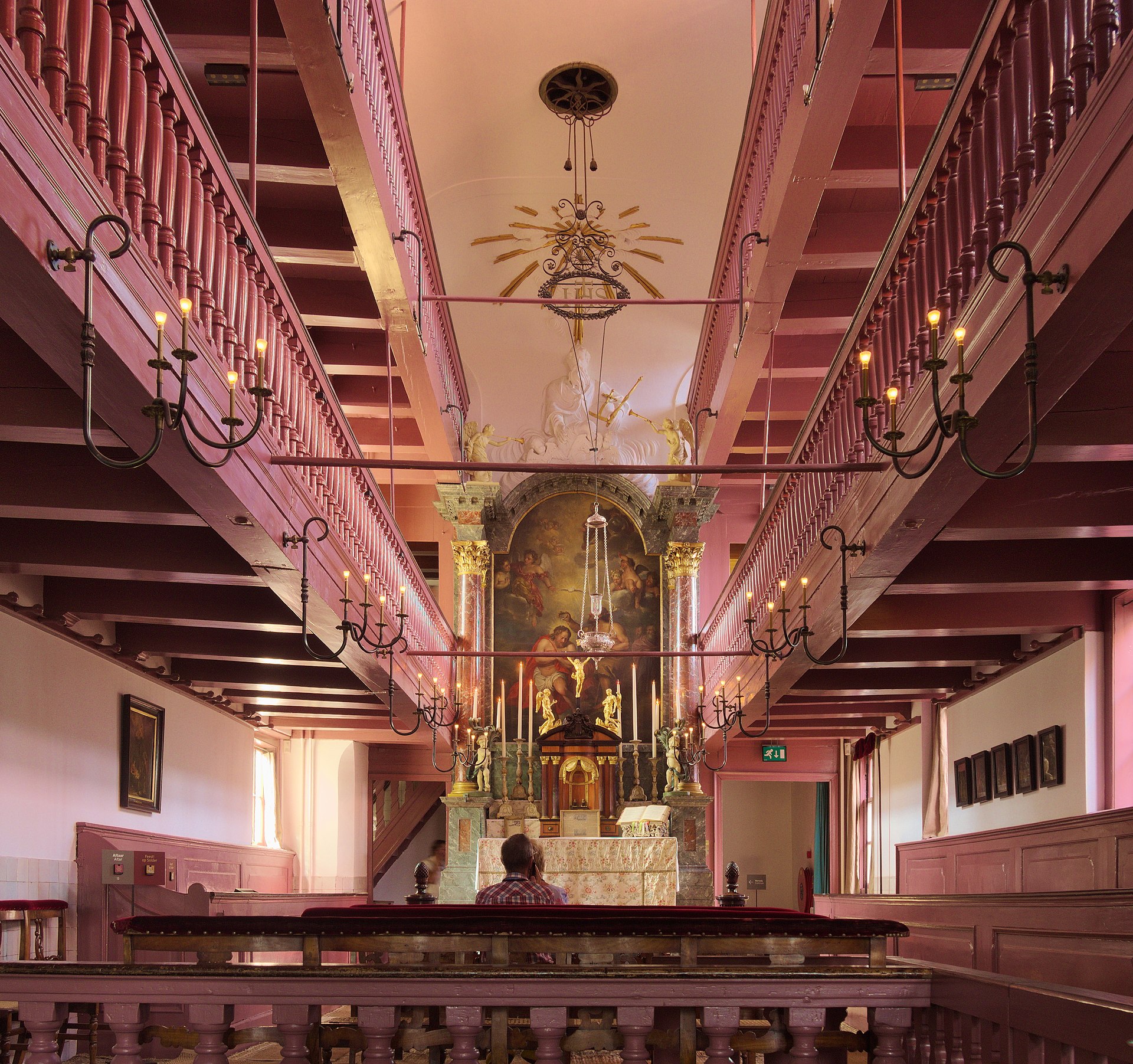
Ons' Lieve Heer op Solder, or 'Our Lord in the Attic,' is a unique canal house museum located in the heart of Amsterdam. The building preserves a clandestine Catholic church constructed in the 17th century within the top three floors of a private residence. Following the Protestant Reformation, public Catholic worship was prohibited in the Netherlands, leading to the creation of 'hidden churches' where the faithful could practice their religion discreetly.
The museum offers a rare glimpse into the religious and domestic life of the Dutch Golden Age. The house remains largely intact, featuring period-accurate living quarters, kitchens, and the remarkably preserved church space, which retains its original altar, pews, and organ. It serves as a significant monument to the history of religious tolerance and the complex social landscape of 17th-century Amsterdam.
Key Facts
- Materials
- Brick, Wood, Marble, Stucco
- Civilization
- Dutch
- Accessibility
- Limited due to historic architecture; stairs required for upper levels
- Date(s)
- 1661-1663
- Condition
- Restored and preserved as a museum
- Original Function
- Private residence and clandestine church
- Key Figures
- Jan Hartman
Establishment of the Hidden Church
1661Wealthy merchant Jan Hartman purchased three adjacent canal houses and commissioned the construction of a church in the attic spaces. This was a response to the ban on public Catholic services, allowing the local community to worship in secret.
Operational Period
1663-1887For over two centuries, the attic church served as a vital center for the Catholic community in Amsterdam. It functioned alongside the private residence, which was occupied by the Hartman family and subsequent owners who maintained the religious space.
Transition to Museum
1888-PresentFollowing the construction of the St. Nicholas Basilica, the attic church ceased its religious functions. It was opened to the public as a museum in 1888, making it one of the oldest museums in Amsterdam dedicated to preserving the city's religious history.
Cultural Significance
The site is a profound symbol of the Dutch tradition of 'gedoogbeleid' or policy of tolerance. It illustrates how religious minorities navigated the restrictive laws of the Dutch Republic, balancing private conviction with public conformity. It remains a key site for understanding the pluralistic nature of Dutch society.
Interpretive Notes
Scholarly debates and areas of uncertainty
Debates often center on the extent to which the authorities were aware of the church's existence and the degree of 'official' tolerance versus simple bribery or indifference by local officials during the 17th and 18th centuries.
Visiting Information
Entry Rules
Open daily. Tickets can be purchased online or at the entrance. Visitors are encouraged to book time slots in advance. Large bags are not permitted in the historic rooms.
Best Times to Visit
Weekday mornings are generally quieter. The museum is less crowded during the shoulder seasons of spring and autumn.
Photography
Personal photography is permitted without flash or tripods. Commercial photography requires prior authorization.
Preservation Notes
The building is a historic monument; please refrain from touching the walls, furniture, or artifacts. Use handrails carefully as the stairs are steep and narrow.
Nearby POIs
11 shownSources & Further Reading
- [1]Ons' Lieve Heer op Solder: The Hidden Church — Benjamin Schmidt. Amsterdam University Press (2015)View
- [2]The Dutch Golden Age: A History — Jonathan Israel. Oxford University Press (1995)
Key Facts
- Materials
- Brick, Wood, Marble, Stucco
- Civilization
- Dutch
- Accessibility
- Limited due to historic architecture; stairs required for upper levels
- Date(s)
- 1661-1663
- Condition
- Restored and preserved as a museum
- Original Function
- Private residence and clandestine church
- Key Figures
- Jan Hartman