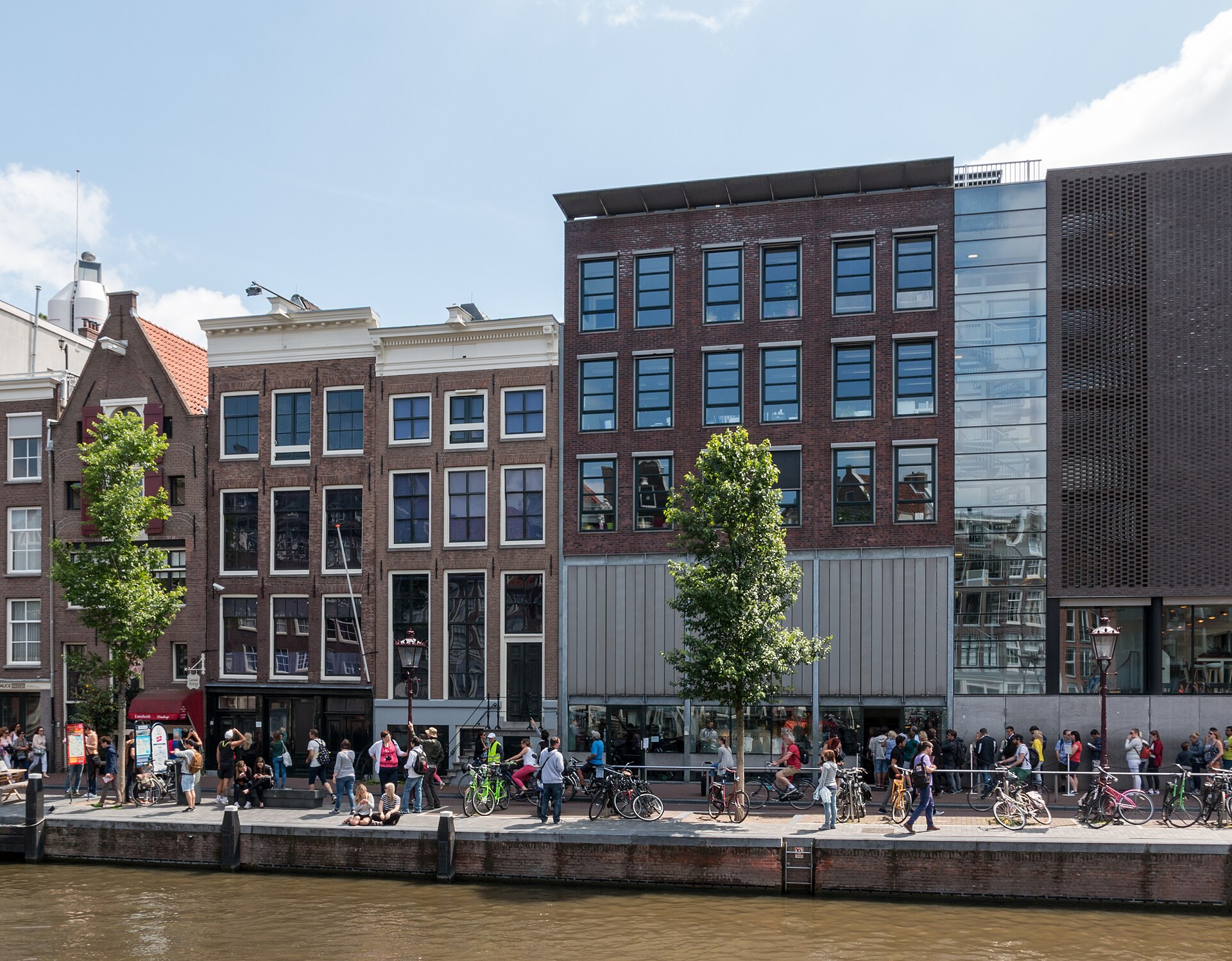
The Anne Frank House is a biographical museum located on the Prinsengracht canal in Amsterdam. It preserves the 'Secret Annex' (Achterhuis), the hidden rooms where Anne Frank, her family, and four others concealed themselves from Nazi persecution between 1942 and 1944. The museum serves as a site of memory, documenting the Holocaust and the history of the Frank family.
The building includes the original office and warehouse spaces where the family hid behind a movable bookcase. Since its opening in 1960, the museum has maintained the annex in a largely unfurnished state to reflect the atmosphere of the period, while displaying the original diary of Anne Frank and other historical artifacts related to the occupation of the Netherlands.
Key Facts
- Materials
- Brick, Wood, Glass
- Civilization
- Dutch
- Accessibility
- Limited due to historic architecture; stairs are steep and narrow
- Date(s)
- 1635
- Condition
- Preserved as a museum
- Original Function
- Private residence and business premises
- Key Figures
- Anne Frank, Otto Frank, Miep Gies
Early History
17th CenturyThe canal house was built in 1635 by Dirk van Delft. Like many Amsterdam canal houses, it consisted of a front house and a rear house, the latter of which would later serve as the hiding place.
The Hiding Period
1942-1944On July 6, 1942, the Frank family went into hiding in the Secret Annex to escape Nazi persecution. They were joined by the van Pels family and Fritz Pfeffer. They remained in the hidden space for over two years, supported by employees of Otto Frank's company, until their discovery and arrest on August 4, 1944.
Post-War Preservation
1945-1960After the war, Otto Frank was the sole survivor of the group. He returned to Amsterdam and received Anne's diary, which was subsequently published. In the 1950s, the building faced demolition, but a public campaign led by local citizens saved the structure, leading to the establishment of the Anne Frank House foundation.
Museum Development
1960-PresentThe museum opened to the public on May 3, 1960. Over the decades, the site has undergone several expansions and renovations to accommodate increasing visitor numbers and to improve the educational experience, while maintaining the integrity of the original hiding space.
Cultural Significance
The Anne Frank House is a global symbol of resistance against persecution and the importance of human rights. It plays a critical role in Holocaust education, drawing millions of visitors who seek to understand the personal impact of the Nazi regime through the lens of Anne Frank's life and writing.
Beyond its role as a museum, the foundation actively campaigns against antisemitism and discrimination worldwide. The site remains a focal point for discussions regarding historical memory, the preservation of personal narratives, and the responsibility of future generations to uphold democratic values.
Interpretive Notes
Scholarly debates and areas of uncertainty
There is ongoing academic discussion regarding the balance between preserving the site as an authentic historical space and managing the high volume of tourism. Some scholars debate the ethics of 'dark tourism' and how to maintain the solemnity of the site while providing access to the public.
Visiting Information
Entry Rules
Tickets must be purchased online in advance via the official website. Time slots are strictly enforced. The house is not suitable for visitors with mobility issues due to the original, steep, and narrow staircases of the 17th-century building.
Best Times to Visit
Early morning or late evening slots are recommended to avoid peak crowds. The museum is generally less crowded during the winter months compared to the summer tourist season.
Photography
Photography is strictly prohibited inside the Secret Annex to maintain the atmosphere and protect the artifacts. Photography is permitted in other areas of the museum.
Preservation Notes
The Secret Annex is kept in a preserved state. Visitors are requested to remain quiet and respectful throughout the tour. Touching of original walls or artifacts is strictly forbidden.
Nearby POIs
11 shownSources & Further Reading
- [1]
- [2]Anne Frank House: A Museum with a Story — Anne Frank Stichting. Anne Frank House Publications (2015)
Key Facts
- Materials
- Brick, Wood, Glass
- Civilization
- Dutch
- Accessibility
- Limited due to historic architecture; stairs are steep and narrow
- Date(s)
- 1635
- Condition
- Preserved as a museum
- Original Function
- Private residence and business premises
- Key Figures
- Anne Frank, Otto Frank, Miep Gies