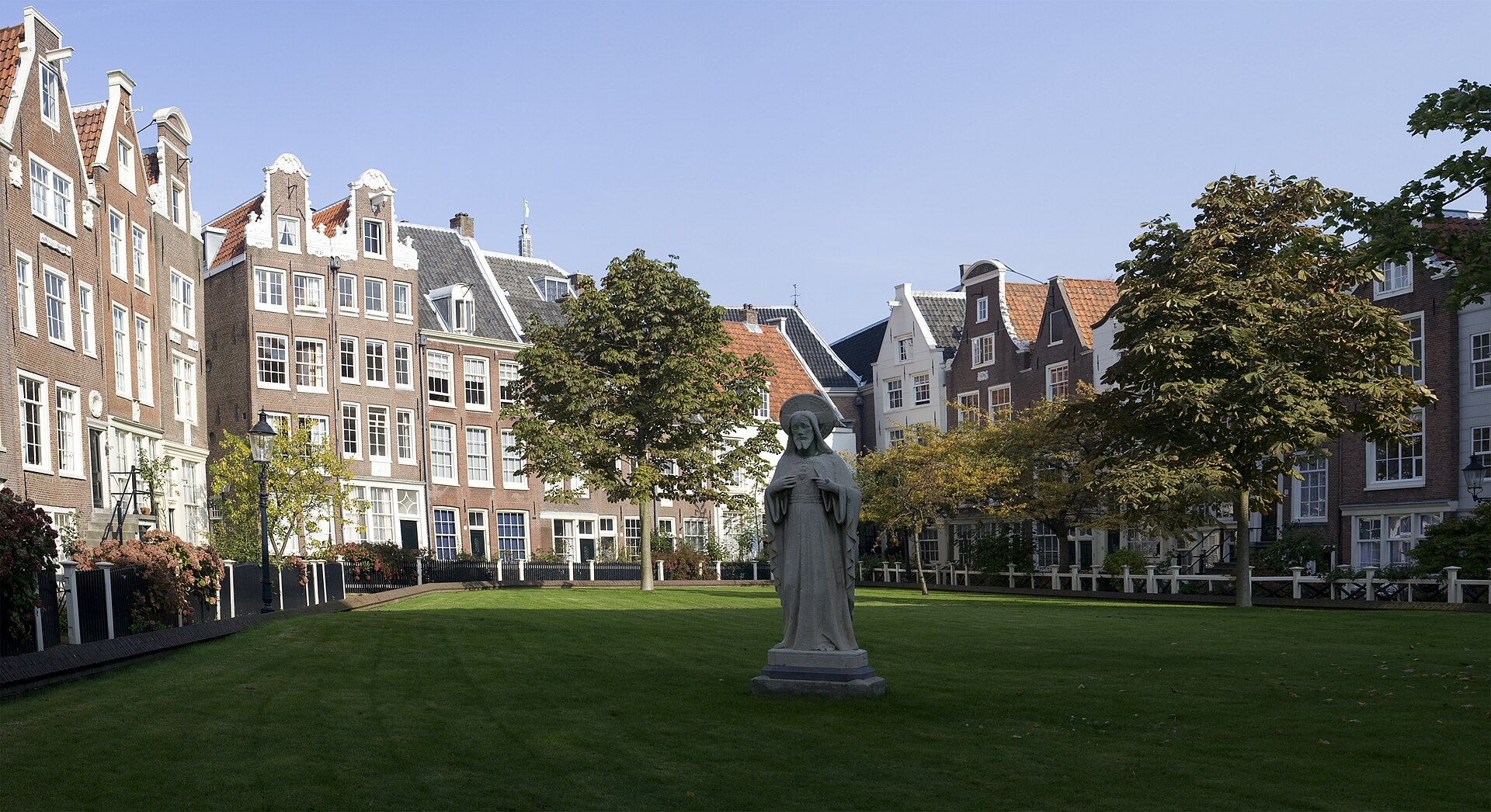
The Begijnhof is one of the oldest inner courts in Amsterdam, dating back to the early 14th century. Originally established as a sanctuary for the Beguines—a lay sisterhood of Catholic women who lived in a religious community without taking formal monastic vows—the site remains a quiet, enclosed space hidden from the bustle of the city center.
The courtyard features a unique collection of historic architecture, including the Houten Huys (Wooden House) at number 34, which is one of only two remaining wooden houses in Amsterdam. The site also contains the Begijnhofkapel, a clandestine church established after the Reformation when Catholic worship was prohibited in public spaces.
Key Facts
- Materials
- Brick, Wood, Stone
- Civilization
- Dutch
- Accessibility
- Ground level access to the courtyard
- Date(s)
- 14th century
- Condition
- Well-preserved, residential and religious use
- Original Function
- Religious community for laywomen
- Key Figures
- Cornelia Arens
Founding of the Sisterhood
14th centuryThe Begijnhof was founded as a residence for Beguines, laywomen who dedicated their lives to prayer and charity. The site was originally surrounded by water and accessible only via a single gate, providing the seclusion necessary for their communal life.
The Reformation and Clandestine Worship
16th-17th centuryFollowing the Protestant Reformation in 1578, the city of Amsterdam confiscated Catholic properties. While the Beguines were allowed to remain in their homes, their main chapel was repurposed for the English Reformed Church. Consequently, the sisters established a 'schuilkerk' (clandestine church) within two of their private houses to continue their religious practices.
Modern Preservation
20th century - presentThe Begijnhof has undergone several restoration projects to maintain its historic character. Today, it remains a private residential area while welcoming visitors to its courtyard and chapel, serving as a rare example of medieval urban planning in the heart of Amsterdam.
Cultural Significance
The Begijnhof serves as a physical manifestation of Amsterdam's history of religious tolerance and the unique social structure of the Beguines. It represents a rare survival of medieval communal living in a city that has been largely rebuilt over the centuries. The site is deeply tied to the city's Catholic history and the resilience of religious minorities during the post-Reformation era.
Interpretive Notes
Scholarly debates and areas of uncertainty
There is ongoing discussion regarding the exact dating of the Houten Huys, with dendrochronological studies providing varying estimates for the timber used in its construction. Additionally, the extent of the Beguines' influence on the local economy during the 15th century remains a subject of interest for urban historians.
Visiting Information
Entry Rules
The courtyard is open to the public daily. Visitors are requested to maintain silence as the site is a private residential area. The chapel is open for visitors and prayer.
Best Times to Visit
Early morning or late afternoon on weekdays to avoid peak tourist crowds. The courtyard is particularly quiet during the winter months.
Photography
Photography is permitted in the courtyard, but visitors are asked to respect the privacy of the residents and refrain from photographing house interiors.
Preservation Notes
The site is a protected monument. Visitors must stay on the designated paths and avoid touching the historic facades of the houses.
Nearby POIs
11 shownSources & Further Reading
- [1]The Beguines of Medieval Amsterdam — L.J.M. van der Meer. Amsterdam University Press (2012)
- [2]Architecture of the Dutch Golden Age — P.J.J. van Thiel. Rijksmuseum Publications (2018)
Key Facts
- Materials
- Brick, Wood, Stone
- Civilization
- Dutch
- Accessibility
- Ground level access to the courtyard
- Date(s)
- 14th century
- Condition
- Well-preserved, residential and religious use
- Original Function
- Religious community for laywomen
- Key Figures
- Cornelia Arens