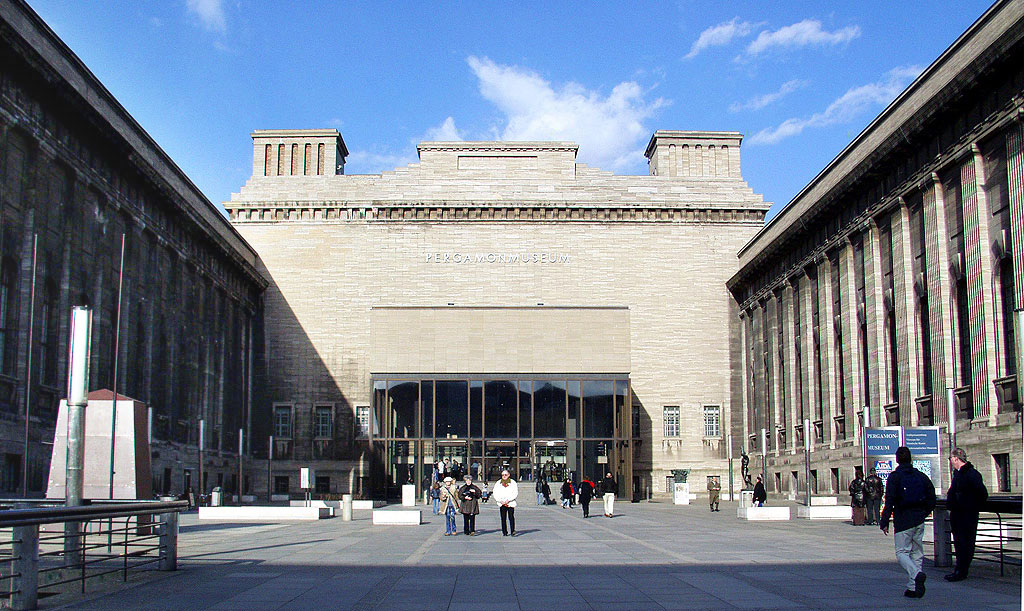
The Pergamonmuseum is a major archaeological museum located on Museum Island in Berlin. Opened in 1930, it was designed to house monumental architectural reconstructions and antiquities acquired by German archaeological expeditions. The museum is internationally renowned for large-scale exhibits such as the Pergamon Altar, the Ishtar Gate of Babylon, and the Market Gate of Miletus. It forms part of the UNESCO-listed Museum Island ensemble and remains one of Germany’s most visited cultural institutions, though sections are currently closed for extensive renovation.
Key Facts
- Materials
- Stone, Concrete, Steel
- Accessibility
- Limited access due to construction works
- Current Function
- Museum (under phased renovation)
- Date(s)
- 1910-1930
- Condition
- Partially closed for long-term renovation
- Original Function
- Archaeological museum
- Key Figures
- Alfred Messel, Ludwig Hoffmann, Carl Humann
- Civilization Focus
- Ancient Greek, Mesopotamian, Islamic
- Architectural Style
- Neoclassical
Origins and Excavations
19th centuryGerman archaeological excavations in the Ottoman Empire, particularly at Pergamon in present-day Turkey, uncovered monumental structures such as the Pergamon Altar. These discoveries prompted the need for a purpose-built museum to display reconstructed architectural ensembles.
Construction of the Museum
1910-1930Designed by architect Alfred Messel and completed by Ludwig Hoffmann, the museum was constructed specifically to house large-scale antiquities. It opened to the public in 1930.
World War II and Division
1939-1990The museum sustained damage during World War II, and many artifacts were evacuated. After the war, some collections were transported to the Soviet Union and later partially returned. During the Cold War, the museum was located in East Berlin.
Renovation and Master Plan
2013-presentA comprehensive renovation under the Museum Island Master Plan aims to modernize infrastructure and improve conservation standards. Portions of the museum, including the Pergamon Altar hall, are closed until the renovation is completed.
Cultural Significance
The Pergamonmuseum is one of the most significant archaeological museums in the world, noted for its immersive reconstructions of ancient architectural monuments. It has played a central role in shaping public engagement with classical and Near Eastern antiquity. Its collections reflect 19th- and early 20th-century European archaeological practices and imperial-era acquisitions, contributing to ongoing discussions about cultural heritage and restitution.
Interpretive Notes
Scholarly debates and areas of uncertainty
Scholarly debates address the ethics of artifact acquisition during the imperial period, particularly concerning large-scale removals from the Ottoman Empire. Discussions also focus on the challenges of preserving monumental reconstructions within modern conservation standards.
Visiting Information
Entry Rules
Ticketed entry required. Advance booking recommended. Some sections closed due to renovation. Security screening at entrance.
Best Times to Visit
Morning time slots on weekdays offer reduced visitor density. Check official website for reopening schedules of closed galleries.
Photography
Photography permitted without flash. Tripods and commercial filming require prior authorization.
Preservation Notes
Do not touch reconstructed surfaces or artifacts. Follow designated pathways and staff instructions during renovation phases.
Nearby POIs
11 shownSources & Further Reading
- [1]
- [2]The Pergamon Altar — John Boardman. Thames & Hudson (1994)
- [3]Archaeology and Empire in the Ottoman World — Zainab Bahrani et al.. Duke University Press (2011)
Key Facts
- Materials
- Stone, Concrete, Steel
- Accessibility
- Limited access due to construction works
- Current Function
- Museum (under phased renovation)
- Date(s)
- 1910-1930
- Condition
- Partially closed for long-term renovation
- Original Function
- Archaeological museum
- Key Figures
- Alfred Messel, Ludwig Hoffmann, Carl Humann
- Civilization Focus
- Ancient Greek, Mesopotamian, Islamic
- Architectural Style
- Neoclassical