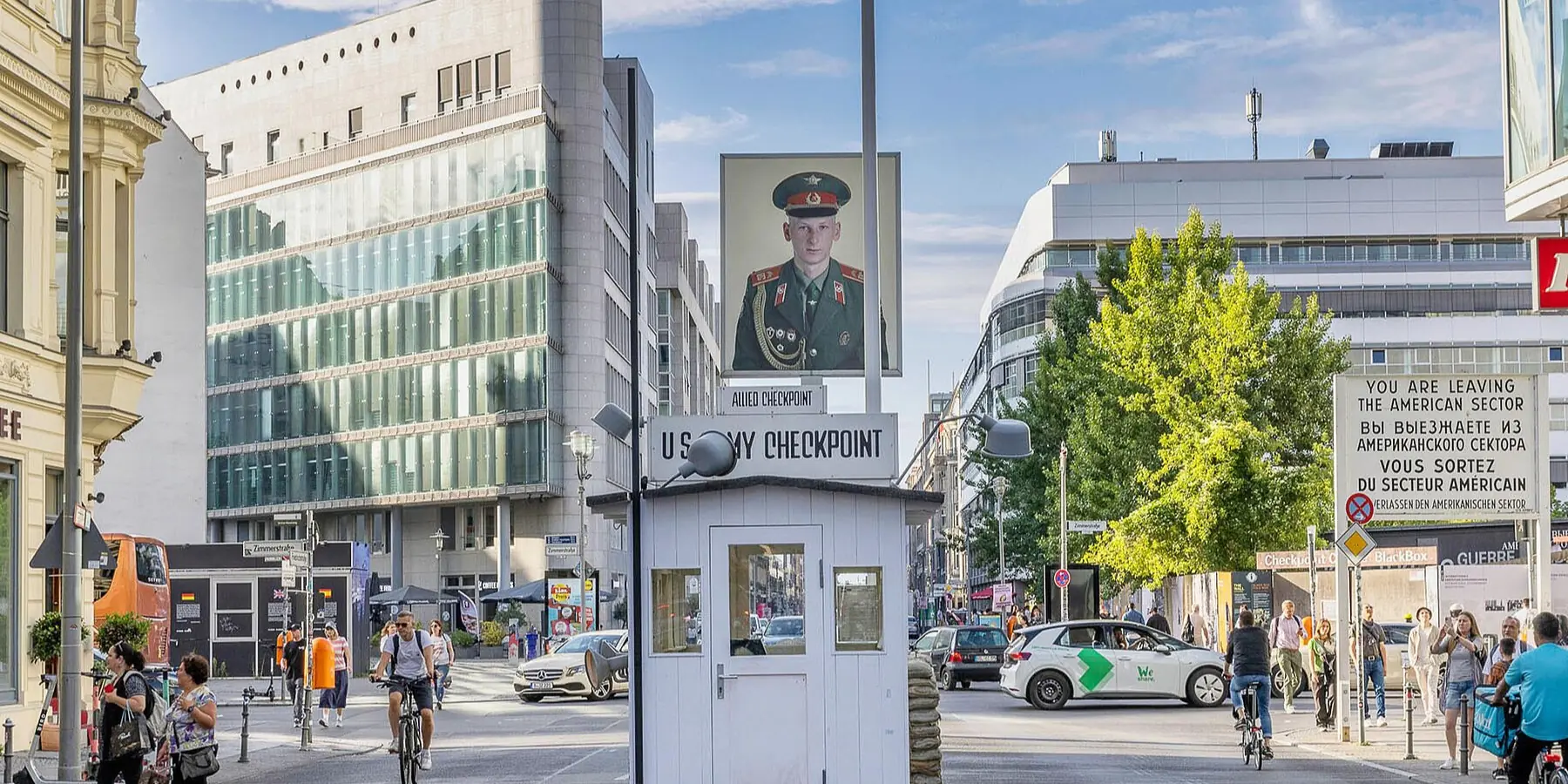
Checkpoint Charlie was the best-known border crossing point between East Berlin and West Berlin during the Cold War. Established in 1961 following the construction of the Berlin Wall, it served as a crossing for Allied military personnel, diplomats, and foreign visitors. Located at the junction of Friedrichstrasse and Zimmerstrasse, the checkpoint became a symbol of Cold War confrontation. Today, a replica guardhouse marks the site, which functions as a major historical landmark and tourist destination.
Key Facts
- Materials
- Wood (replica guardhouse), Concrete
- Established
- 1961
- Accessibility
- Fully accessible public intersection
- Current Function
- Historic site and open-air landmark
- Condition
- Reconstructed guardhouse; surrounding area modernized
- Historical Period
- 1961-1990
- Original Function
- Allied-controlled border crossing between East and West Berlin
- Associated Entities
- United States Army, German Democratic Republic, Allied Forces
Creation of the Checkpoint
1961After the Berlin Wall was erected in August 1961, Allied forces established Checkpoint Charlie as the primary crossing point for American and other Western Allied personnel. The name followed the NATO phonetic alphabet designation for the third checkpoint.
Tank Standoff
October 1961A confrontation between American and Soviet tanks occurred at Checkpoint Charlie following disputes over diplomatic access rights. The standoff heightened Cold War tensions but was resolved without armed conflict.
Escape Attempts
1961-1989Numerous escape attempts were made in the vicinity of the checkpoint, some successful and others fatal. The crossing became one of the most visible symbols of Berlin’s division.
Closure and Memorialization
1990-presentThe checkpoint was officially removed in June 1990 after German reunification. A replica guardhouse was later installed, and the site now includes outdoor exhibits and the nearby Mauermuseum dedicated to Wall history.
Cultural Significance
Checkpoint Charlie became one of the most recognizable symbols of Cold War division, representing both geopolitical confrontation and personal tragedy. It featured prominently in espionage narratives, media coverage, and diplomatic crises. Today, it serves as a reminder of Berlin’s divided past and the broader ideological struggle between East and West during the 20th century.
Interpretive Notes
Scholarly debates and areas of uncertainty
Debates focus on the commercialization of the site and the authenticity of reconstructed elements, particularly the replica guardhouse and staged historical displays. Scholars also examine how memory culture shapes public interpretation of Cold War history.
Visiting Information
Entry Rules
Open public access at all times. No admission required for the outdoor site. Nearby museums operate with separate ticketing.
Best Times to Visit
Early morning for reduced tourist congestion. Weekdays generally less crowded than weekends.
Photography
Photography permitted in outdoor areas. Commercial filming requires authorization.
Preservation Notes
Respect commemorative plaques and informational panels. Avoid obstructing traffic, as the site is located at an active urban intersection.
Nearby POIs
11 shownSources & Further Reading
- [1]
- [2]The Berlin Wall: A World Divided, 1961-1989 — Frederick Taylor. HarperCollins (2006)
- [3]The Cold War — Odd Arne Westad. Basic Books (2017)
Key Facts
- Materials
- Wood (replica guardhouse), Concrete
- Established
- 1961
- Accessibility
- Fully accessible public intersection
- Current Function
- Historic site and open-air landmark
- Condition
- Reconstructed guardhouse; surrounding area modernized
- Historical Period
- 1961-1990
- Original Function
- Allied-controlled border crossing between East and West Berlin
- Associated Entities
- United States Army, German Democratic Republic, Allied Forces