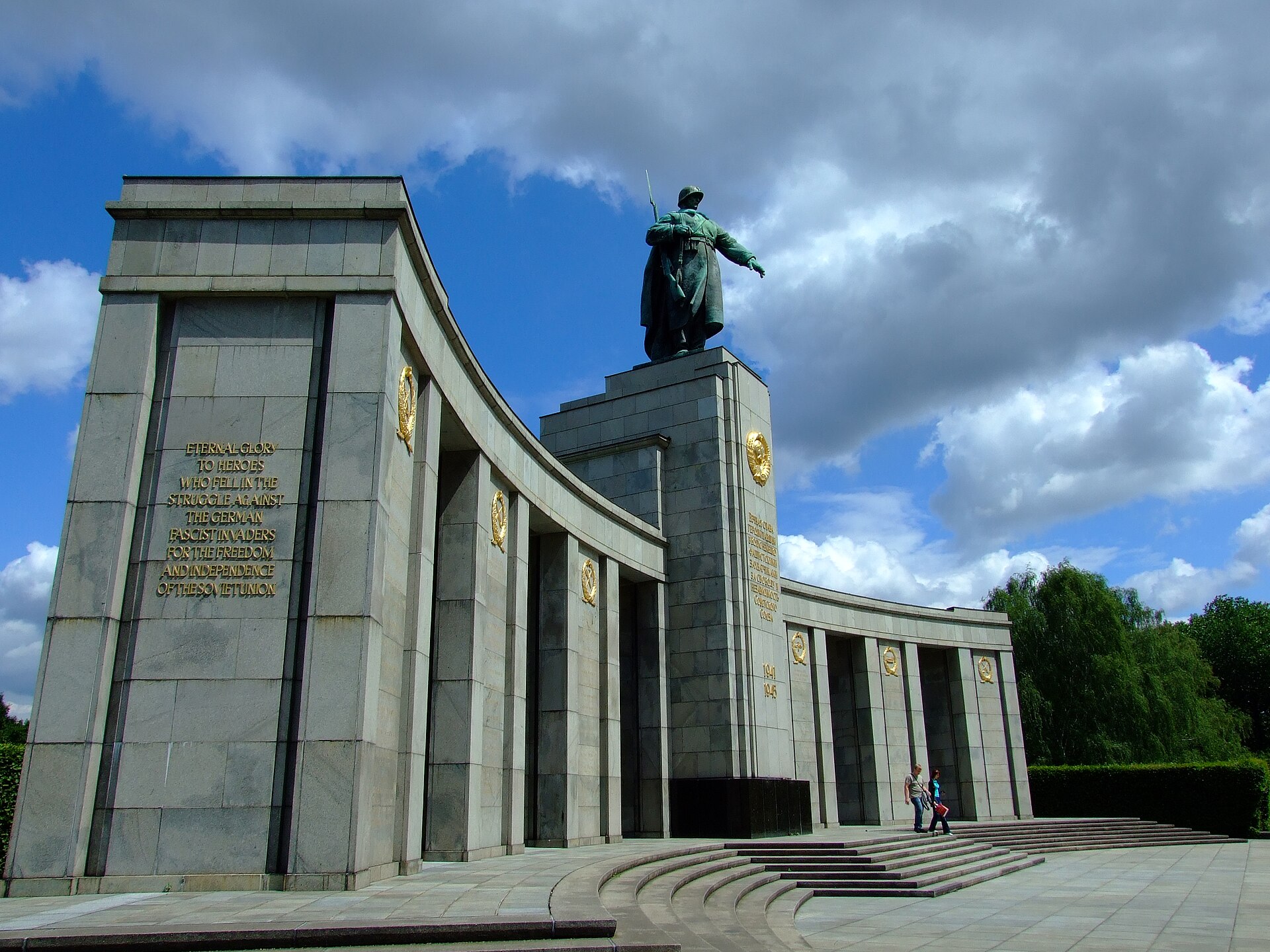
The Soviet War Memorial in the Tiergarten is a monumental structure erected by the Soviet Union in 1945 to commemorate the soldiers of the Red Army who fell during the Battle of Berlin in World War II. Located on the Straße des 17. Juni, the memorial serves as both a burial ground and a site of remembrance for approximately 2,000 of the 80,000 Soviet soldiers who died during the final offensive of the war.
The architectural design features a curved colonnade topped by a large statue of a Soviet soldier, flanked by two T-34 tanks and two ML-20 howitzers. The site remains a significant historical landmark, maintained by the city of Berlin under the terms of the 1990 Treaty on the Final Settlement with Respect to Germany, which guarantees the preservation and protection of Soviet memorials within the city.
Key Facts
- Materials
- Granite, Marble
- Civilization
- Soviet Union
- Accessibility
- Ground level, fully accessible
- Date(s)
- 1945
- Condition
- Well-preserved and maintained
- Original Function
- War memorial and military cemetery
- Key Figures
- Nikolai Sergievsky, Mikhail Belov
Construction and Dedication
1945The memorial was constructed in the immediate aftermath of the Battle of Berlin, with work beginning just months after the German surrender. It was inaugurated on November 7, 1945, to coincide with the anniversary of the October Revolution.
Cold War Significance
1945-1990During the division of Berlin, the memorial was located in the British sector but remained under Soviet guard. It became a site of political tension and symbolic importance, serving as a constant reminder of the Soviet role in the defeat of Nazi Germany.
Post-Reunification Status
1990-PresentFollowing German reunification, the status of the memorial was formalized through international treaty. It continues to be a site for official commemorations, particularly on May 8th, marking the end of World War II in Europe.
Cultural Significance
The memorial represents a complex intersection of historical memory and diplomatic relations. It serves as a somber reminder of the immense human cost of the Battle of Berlin and the pivotal role of the Soviet Union in the liberation of the city from National Socialism.
For many, it is a site of reflection on the legacy of the Second World War. Its continued presence in the heart of Berlin, protected by treaty, underscores the ongoing commitment to historical remembrance and the reconciliation between Germany and the successor states of the Soviet Union.
Interpretive Notes
Scholarly debates and areas of uncertainty
Debates often center on the memorial's role as a tool of Soviet propaganda versus its function as a legitimate war grave. Scholars also discuss the architectural symbolism of the site, specifically how the use of materials salvaged from the ruins of the Reich Chancellery was intended to project Soviet dominance over the defeated Nazi regime.
Visiting Information
Entry Rules
Open to the public 24 hours a day. No tickets required. Visitors are expected to maintain a respectful demeanor as the site is a military cemetery.
Best Times to Visit
Early morning or late afternoon for a quieter atmosphere. May 8th is historically significant but attracts large crowds for official ceremonies.
Photography
Personal photography is permitted. Commercial photography requires a permit from the Berlin Senate.
Preservation Notes
The site is protected by law. Do not climb on the memorial structures or the military hardware. Stay on the designated paths.
Nearby POIs
11 shownSources & Further Reading
- [1]
- [2]The Battle for Berlin: 1945 — Antony Beevor. Penguin Books (2002)
Key Facts
- Materials
- Granite, Marble
- Civilization
- Soviet Union
- Accessibility
- Ground level, fully accessible
- Date(s)
- 1945
- Condition
- Well-preserved and maintained
- Original Function
- War memorial and military cemetery
- Key Figures
- Nikolai Sergievsky, Mikhail Belov