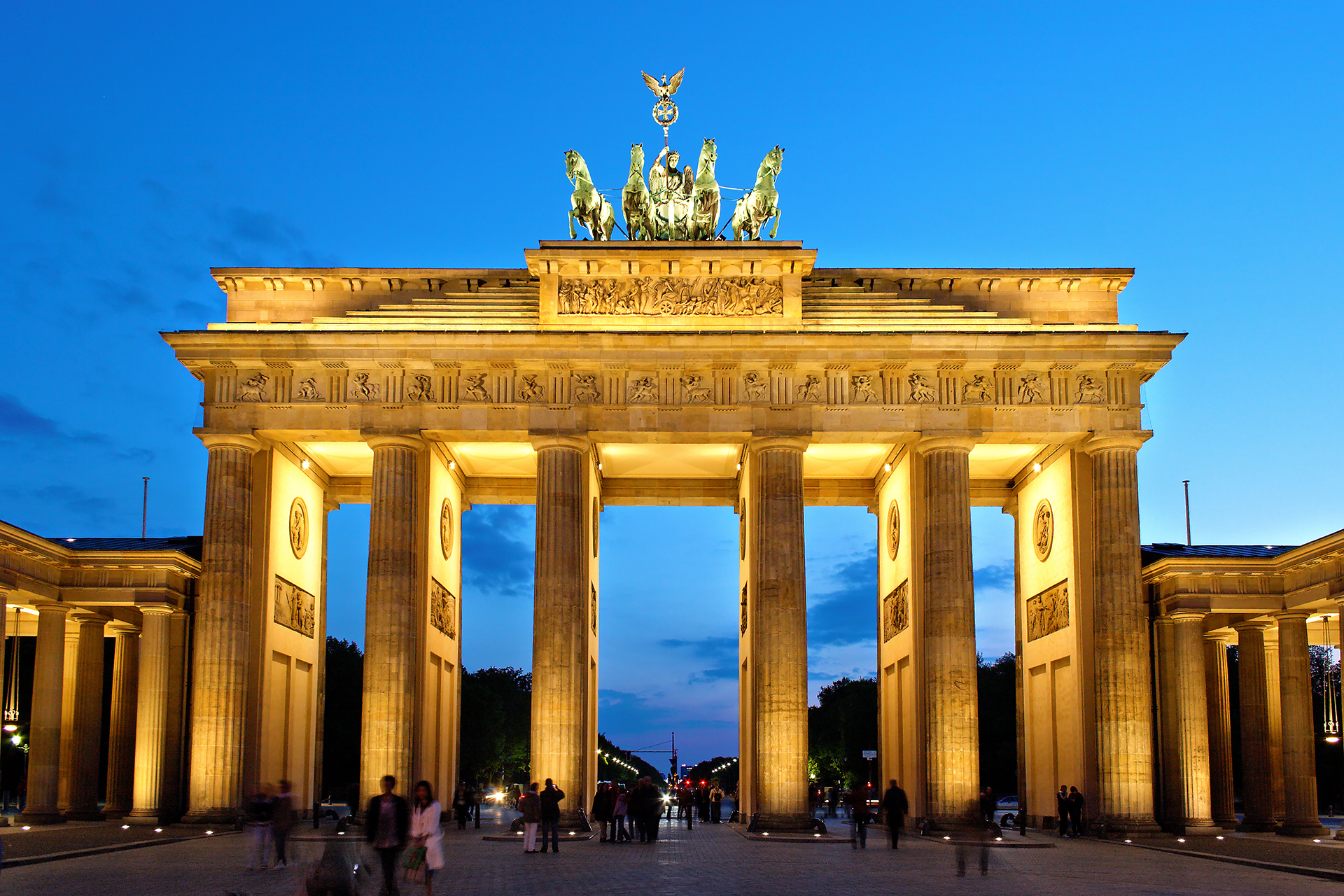
The Brandenburg Gate is an 18th-century neoclassical monument in Berlin that has served as a symbol of both division and unity in German history. Commissioned by King Frederick William II of Prussia, it was constructed between 1788 and 1791 as a ceremonial city gate marking the entrance to Unter den Linden boulevard. Inspired by the Propylaea of the Acropolis in Athens, the gate features twelve Doric columns forming five passageways and is crowned by the Quadriga sculpture, a chariot drawn by four horses driven by the goddess Victoria. During the Cold War, the monument stood within the restricted border zone between East and West Berlin, later becoming an emblem of German reunification.
Key Facts
- Materials
- Sandstone
- Civilization
- Kingdom of Prussia
- Accessibility
- Fully accessible public plaza
- Date(s)
- 1788-1791
- Condition
- Fully preserved and restored
- Original Function
- Ceremonial city gate
- Key Figures
- Frederick William II of Prussia, Carl Gotthard Langhans
- Architectural Style
- Neoclassical
Prussian Construction
1788-1791Designed by architect Carl Gotthard Langhans, the gate was commissioned as a symbol of peace and royal authority. Its design drew inspiration from classical Greek architecture, reflecting Enlightenment ideals embraced by the Prussian monarchy.
Napoleonic Occupation
1806-1814After Napoleon’s defeat of Prussia in 1806, the Quadriga sculpture was taken to Paris as a trophy. It was returned to Berlin in 1814 following Napoleon’s downfall and reinstalled as a symbol of victory.
World War II Damage
1939-1945The gate suffered significant damage during Allied bombings and the Battle of Berlin. Much of the surrounding Pariser Platz was destroyed, though the gate itself remained standing.
Cold War Division
1961-1989With the construction of the Berlin Wall in 1961, the Brandenburg Gate stood in the border zone between East and West Berlin, inaccessible to the public and symbolizing the division of Germany.
Reunification Symbol
1989-presentFollowing the fall of the Berlin Wall in 1989, the gate became a powerful symbol of German unity. It now serves as a site for national celebrations, political events, and public gatherings.
Images
(1)Cultural Significance
The Brandenburg Gate has evolved from a symbol of Prussian authority to a national emblem of Germany. Its association with key historical moments—including Napoleonic occupation, Nazi rallies, Cold War division, and reunification—has made it one of Europe’s most politically resonant monuments. Today, it represents peace, democracy, and unity, serving as a focal point for state ceremonies and public celebrations.
Interpretive Notes
Scholarly debates and areas of uncertainty
Historians debate the gate’s shifting symbolic meanings across regimes, particularly its appropriation during the Nazi period and later transformation into a democratic symbol after reunification. Discussions also address restoration authenticity following wartime damage.
Visiting Information
Entry Rules
Open access at all times. Public plaza; no ticket required. Security restrictions may apply during official events.
Best Times to Visit
Early morning or late evening for reduced crowds. Illuminated views at night are popular. National holidays may attract large gatherings.
Photography
Photography permitted. Tripods may require permission during events. Drone usage subject to Berlin aviation regulations.
Preservation Notes
Do not climb on the monument. Respect barriers and security instructions during official events.
Nearby POIs
11 shownSources & Further Reading
- [1]
- [2]Berlin: The Downfall 1945 — Antony Beevor. Viking Press (2002)
- [3]The Cold War: A World History — Odd Arne Westad. Basic Books (2017)
Key Facts
- Materials
- Sandstone
- Civilization
- Kingdom of Prussia
- Accessibility
- Fully accessible public plaza
- Date(s)
- 1788-1791
- Condition
- Fully preserved and restored
- Original Function
- Ceremonial city gate
- Key Figures
- Frederick William II of Prussia, Carl Gotthard Langhans
- Architectural Style
- Neoclassical