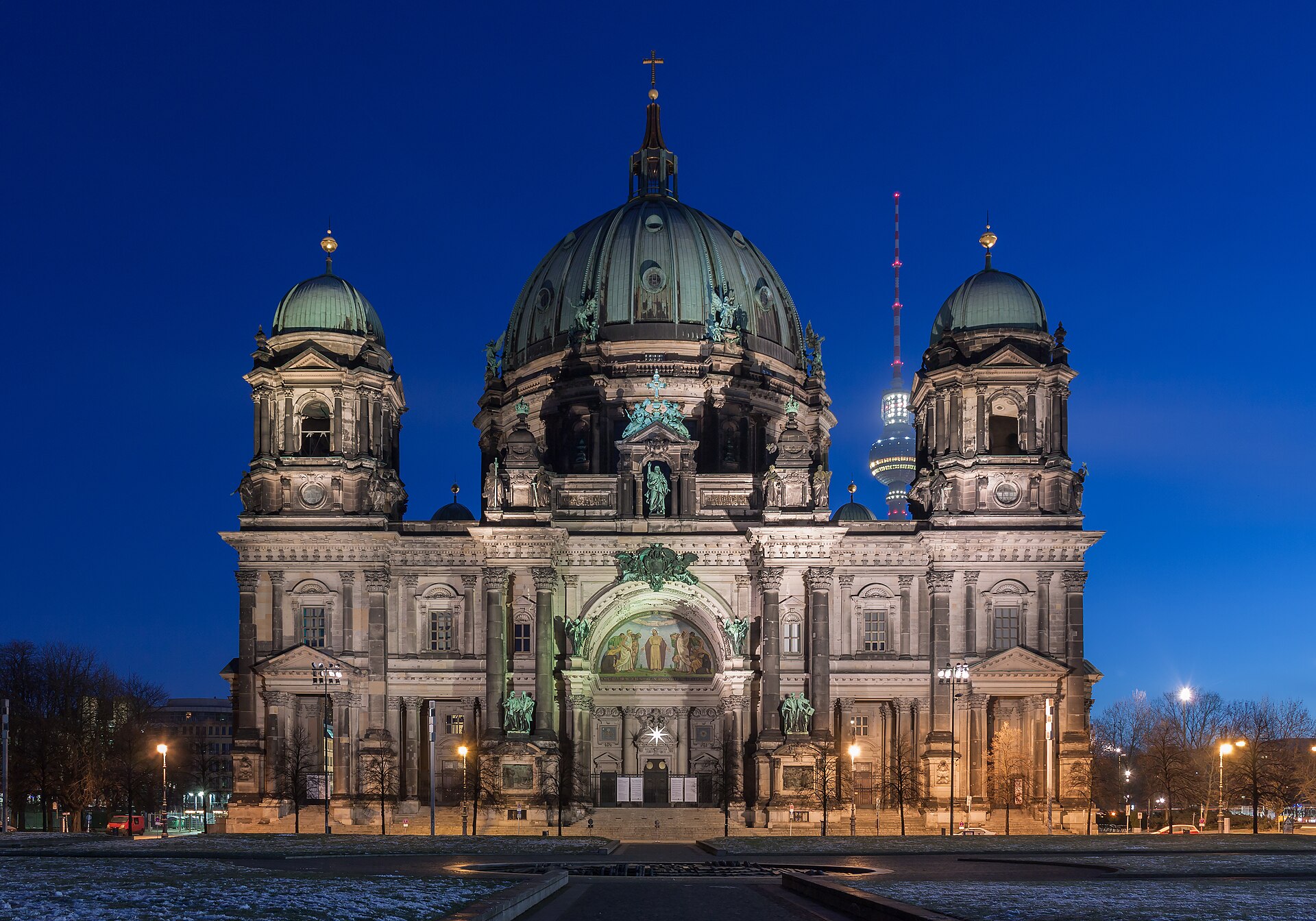
Berliner Dom (Berlin Cathedral) is the largest Protestant church in Germany, located on Museum Island in Berlin. The current structure was built between 1894 and 1905 under Emperor Wilhelm II, replacing earlier cathedral buildings on the site. Designed in an Italian High Renaissance style with Baroque influences, the cathedral features a monumental dome, richly decorated interior, and the Hohenzollern crypt. Severely damaged during World War II, it was restored over several decades and remains both an active church and major cultural landmark.
Key Facts
- Materials
- Sandstone, Steel, Copper
- Civilization
- German Empire
- Accessibility
- Main floor accessible; dome requires stairs
- Current Function
- Protestant cathedral and cultural landmark
- Date(s)
- 1894-1905
- Condition
- Restored; active church
- Original Function
- Court church of the Hohenzollern dynasty
- Key Figures
- Wilhelm II, Julius Carl Raschdorff
- Architectural Style
- Neo-Renaissance with Baroque elements
Earlier Churches on the Site
15th-19th centuryThe cathedral site hosted earlier parish and court churches serving the Hohenzollern rulers of Brandenburg and Prussia. These earlier structures were gradually replaced as Berlin developed into an imperial capital.
Imperial Construction
1894-1905Commissioned by Emperor Wilhelm II, the present cathedral was designed by architect Julius Carl Raschdorff. It was intended to rival Catholic cathedrals in scale and symbolize Protestant imperial power.
World War II Damage
1944-1945The cathedral suffered heavy damage during Allied bombings and the Battle of Berlin. The dome was severely compromised, and much of the interior was destroyed.
Restoration and Reopening
1975-1993Restoration began during the East German period and continued after reunification. The cathedral reopened fully in 1993, though some original decorative elements were simplified compared to the pre-war design.
Cultural Significance
Berliner Dom represents the religious and political ambitions of the German Empire at the turn of the 20th century. Its monumental scale reflects imperial aspirations and the central role of Protestantism in Prussian identity. Today, the cathedral functions as a place of worship, a concert venue, and a major architectural landmark within Berlin’s historic core.
Interpretive Notes
Scholarly debates and areas of uncertainty
Scholars debate the extent to which post-war restoration altered Raschdorff’s original vision, particularly the simplification of certain decorative elements. Discussions also examine the cathedral’s role as an expression of imperial nationalism.
Visiting Information
Entry Rules
Open daily. Entrance fee required for dome ascent and crypt access. Religious services free to attend. Security checks may apply during major events.
Best Times to Visit
Morning visits offer fewer crowds. Late afternoon provides favorable lighting for dome photography. Sundays may be busier due to services.
Photography
Photography permitted without flash. Tripods and commercial photography require prior authorization.
Preservation Notes
Maintain quiet during services. Do not touch historic tomb monuments. Follow designated visitor routes.
Nearby POIs
11 shownSources & Further Reading
- [1]
- [2]Berlin: The Downfall 1945 — Antony Beevor. Viking Press (2002)
- [3]Imperial Germany 1871-1918 — James Retallack. Oxford University Press (2008)
Key Facts
- Materials
- Sandstone, Steel, Copper
- Civilization
- German Empire
- Accessibility
- Main floor accessible; dome requires stairs
- Current Function
- Protestant cathedral and cultural landmark
- Date(s)
- 1894-1905
- Condition
- Restored; active church
- Original Function
- Court church of the Hohenzollern dynasty
- Key Figures
- Wilhelm II, Julius Carl Raschdorff
- Architectural Style
- Neo-Renaissance with Baroque elements