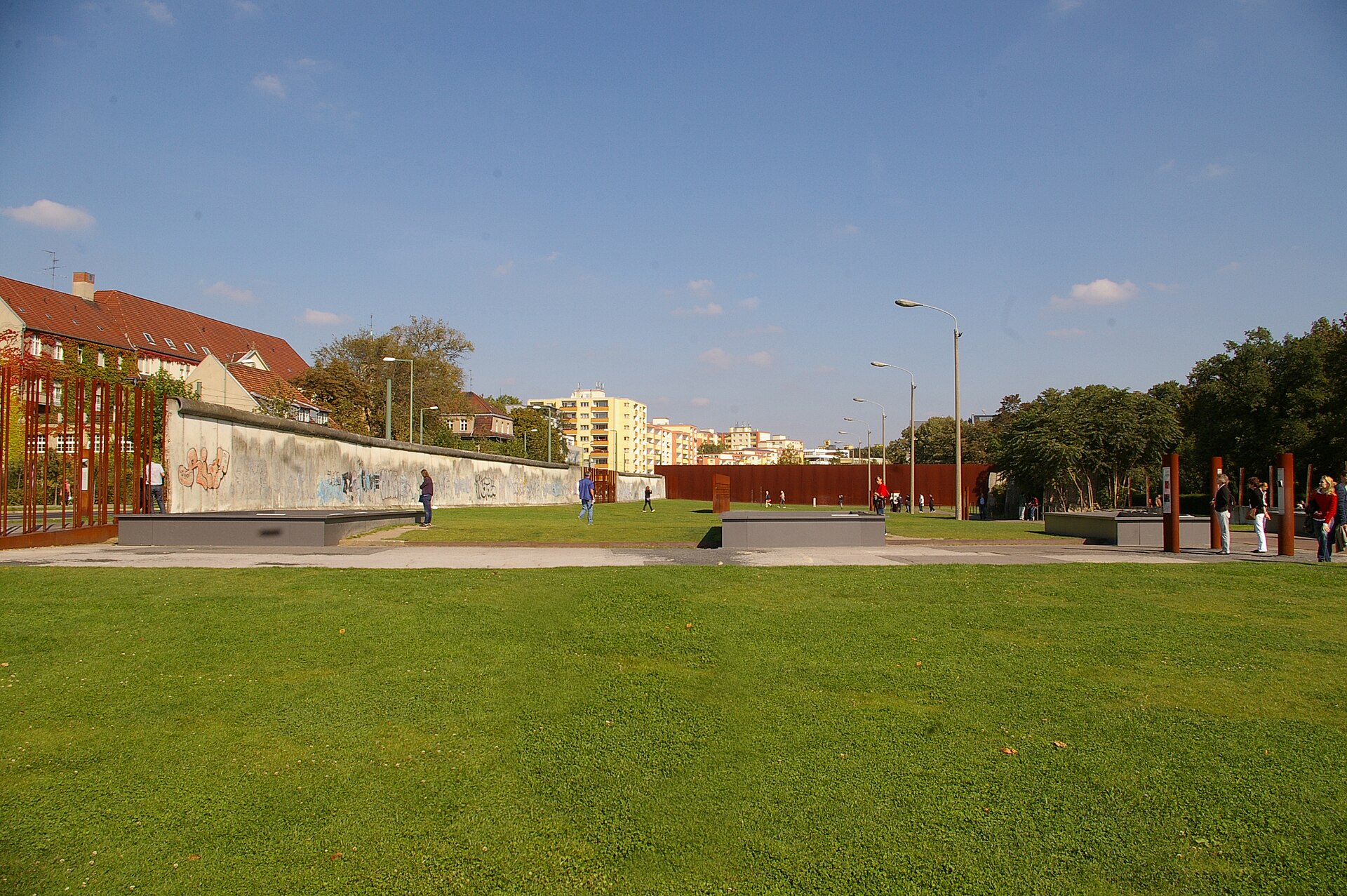
The Berlin Wall Memorial is a preserved section of the former Berlin Wall complex located along Bernauer Strasse in Berlin. It commemorates the division of the city from 1961 to 1989 and the victims who lost their lives attempting to cross from East to West. The memorial spans approximately 1.4 kilometers and includes an original section of the border fortifications, a documentation center, an observation tower, and the Chapel of Reconciliation. It serves as the central site of remembrance for the history of the Berlin Wall.
Key Facts
- Materials
- Concrete, Steel, Glass
- Established
- 1998 (expanded 2009)
- Accessibility
- Outdoor memorial open access; documentation center accessible
- Current Function
- Memorial and documentation center
- Condition
- Preserved and curated memorial complex
- Historical Period
- 1961-1989
- Original Function
- Border fortification of the German Democratic Republic
- Associated Entities
- German Democratic Republic, Federal Republic of Germany
Construction of the Berlin Wall
1961On 13 August 1961, the German Democratic Republic began constructing the Berlin Wall to prevent emigration to West Berlin. Bernauer Strasse became one of the most dramatic border locations, with buildings sealed and residents displaced.
Border Regime and Escapes
1961-1989The area featured guard towers, anti-vehicle trenches, signal fences, and the so-called 'death strip.' Numerous escape attempts occurred here, some successful and others fatal, making it one of the most symbolically charged segments of the Wall.
Fall of the Wall
1989Following political reforms and public protests in East Germany, border crossings opened on 9 November 1989. The Wall was gradually dismantled in the following months.
Creation of the Memorial
1998-presentThe Berlin Wall Memorial was officially established in 1998 to preserve an authentic section of the border system. It was expanded in 2009 into a comprehensive memorial landscape integrating historical remains and interpretive exhibits.
Cultural Significance
The Berlin Wall Memorial is the central site for understanding the physical and human consequences of Germany’s division. Unlike isolated wall fragments displayed elsewhere, this preserved border strip conveys the scale and mechanisms of the Cold War frontier. It functions as a place of remembrance, historical education, and reflection on themes of freedom, state control, and reunification.
Interpretive Notes
Scholarly debates and areas of uncertainty
Scholars debate how best to preserve and interpret Cold War heritage, particularly whether reconstruction or minimal intervention more effectively conveys historical authenticity. Discussions also address memory politics and the representation of victims within unified Germany.
Visiting Information
Entry Rules
Outdoor memorial open at all times. Documentation center and exhibitions open daily with free admission. Guided tours available.
Best Times to Visit
Morning visits provide quieter conditions for reflection. Weekdays offer reduced group traffic compared to weekends and public holidays.
Photography
Photography permitted in outdoor areas and exhibition spaces. Commercial filming requires prior authorization.
Preservation Notes
Do not climb on preserved wall segments. Respect memorial plaques and commemorative installations. Maintain appropriate conduct in remembrance areas.
Nearby POIs
11 shownSources & Further Reading
- [1]
- [2]The Berlin Wall: A World Divided, 1961-1989 — Frederick Taylor. HarperCollins (2006)
- [3]The Cold War: A New History — John Lewis Gaddis. Penguin Press (2005)
Key Facts
- Materials
- Concrete, Steel, Glass
- Established
- 1998 (expanded 2009)
- Accessibility
- Outdoor memorial open access; documentation center accessible
- Current Function
- Memorial and documentation center
- Condition
- Preserved and curated memorial complex
- Historical Period
- 1961-1989
- Original Function
- Border fortification of the German Democratic Republic
- Associated Entities
- German Democratic Republic, Federal Republic of Germany