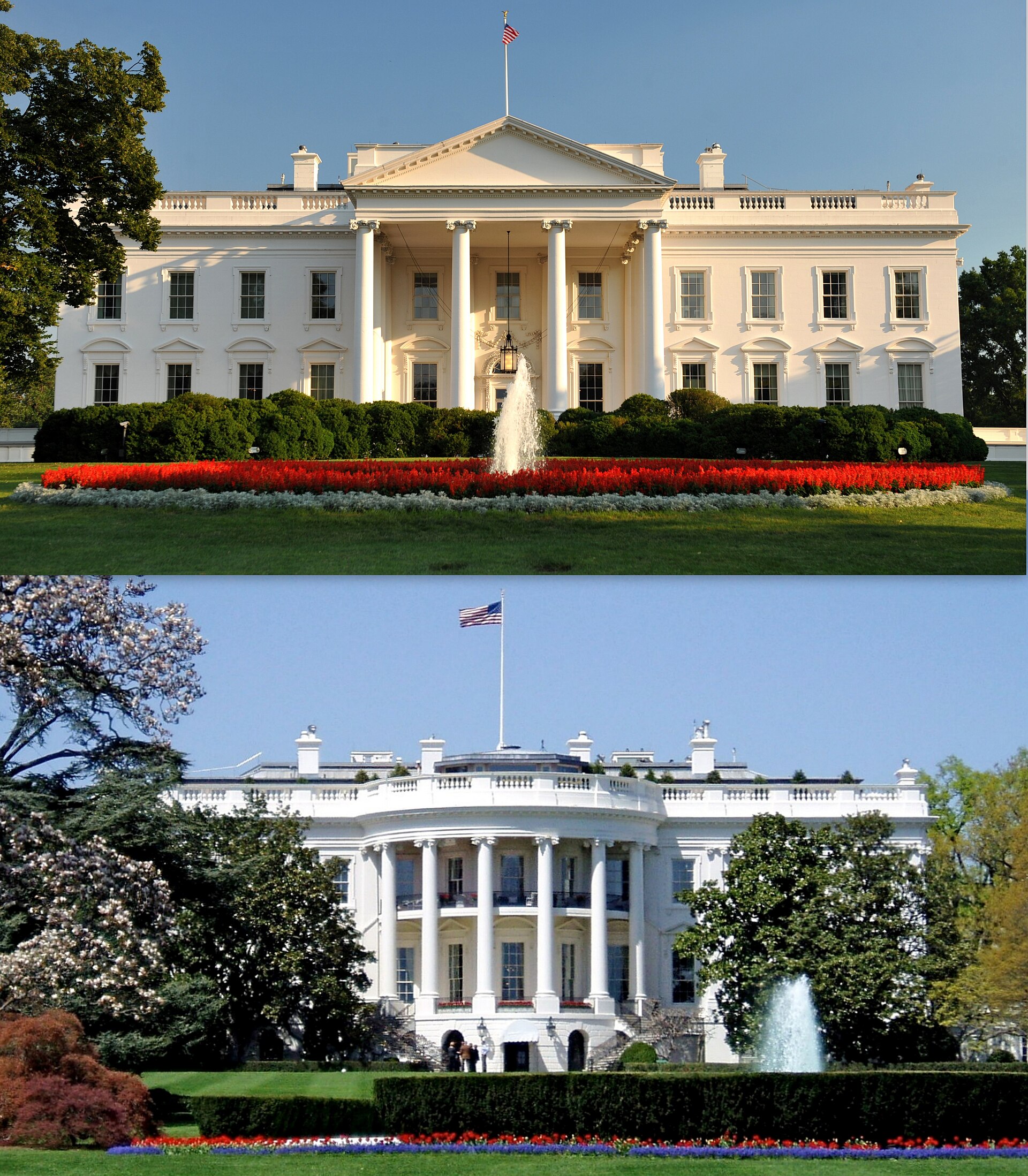
The White House is the official residence and workplace of the president of the United States, located at 1600 Pennsylvania Avenue NW in Washington, D.C. It has served as the residence of every U.S. president since John Adams in 1800. The structure was designed by Irish-born architect James Hoban in the Neoclassical style, drawing inspiration from Leinster House in Dublin and the Château de Rastignac in France.
The complex consists of the Executive Residence, the West Wing, and the East Wing. Over the centuries, the building has undergone numerous renovations and expansions, most notably the addition of the West Wing in 1902 and the East Wing in 1942. It remains a central symbol of American executive power and a focal point for national political discourse.
Key Facts
- Materials
- Aquia Creek sandstone, Brick, Steel, Concrete
- Civilization
- United States
- Accessibility
- Wheelchair accessible via designated entrances
- Date(s)
- 1792-1800
- Condition
- Active, well-maintained
- Original Function
- Presidential residence and office
- Key Figures
- George Washington, James Hoban, Theodore Roosevelt, Franklin D. Roosevelt
Design and Construction
1792-1800Following the Residence Act of 1790, George Washington selected the site for the new capital. James Hoban won the design competition, and construction began in 1792. The building was constructed primarily by enslaved laborers, free Black workers, and European immigrants.
Burning and Reconstruction
1814During the War of 1812, British forces set fire to the White House in August 1814, gutting the interior and charring the exterior walls. James Hoban was tasked with the reconstruction, which was completed by 1817.
Expansion and Modernization
1902-1952Theodore Roosevelt initiated a major renovation in 1902, moving the presidential offices to the newly constructed West Wing. Later, during the Truman administration, the interior was completely gutted and rebuilt with a steel frame to address structural instability.
Cultural Significance
The White House serves as the primary symbol of the American presidency and the executive branch of government. It is a site of significant historical events, diplomatic meetings, and national ceremonies. Beyond its political function, it is a repository of American art and history, housing a vast collection of portraits, furniture, and decorative arts acquired over two centuries.
As a public monument, it represents the continuity of American democracy. The building's architecture and its evolving interior reflect the changing tastes and political priorities of successive administrations, making it a living museum of American history.
Interpretive Notes
Scholarly debates and areas of uncertainty
There is ongoing academic discussion regarding the role of enslaved labor in the construction of the White House. Recent historical research has sought to better document the identities and contributions of the enslaved individuals who worked on the site, correcting long-standing omissions in the official narrative.
Visiting Information
Entry Rules
Public tours are available by request through members of Congress. Requests must be submitted at least 21 days in advance. All visitors must undergo a security screening and present valid government-issued photo identification.
Best Times to Visit
Spring and autumn offer the most pleasant weather for viewing the exterior and grounds. Tours are generally conducted on Friday and Saturday mornings.
Photography
Personal photography is permitted in designated areas during tours, but flash, tripods, and selfie sticks are prohibited. Professional photography requires prior authorization.
Preservation Notes
The building is a protected historic site. Visitors must remain on designated paths and follow all instructions from Secret Service personnel. Touching walls or artifacts is strictly prohibited.
Nearby POIs
11 shown- National Museum of African American History and Culture0.8 km
- Smithsonian National Museum of American History0.9 km
- Washington Monument0.9 km
- Smithsonian National Museum of Natural History1.2 km
- National Archives Building1.3 km
- Martin Luther King Jr. Memorial1.4 km
- Lincoln Memorial1.5 km
- National Gallery of Art1.6 km
- Smithsonian National Air and Space Museum1.8 km
- International Spy Museum1.8 km
- Jefferson Memorial1.8 km
Key Facts
- Materials
- Aquia Creek sandstone, Brick, Steel, Concrete
- Civilization
- United States
- Accessibility
- Wheelchair accessible via designated entrances
- Date(s)
- 1792-1800
- Condition
- Active, well-maintained
- Original Function
- Presidential residence and office
- Key Figures
- George Washington, James Hoban, Theodore Roosevelt, Franklin D. Roosevelt
Nearby POIs
11 shown- National Museum of African American History and Culture0.8 km
- Smithsonian National Museum of American History0.9 km
- Washington Monument0.9 km
- Smithsonian National Museum of Natural History1.2 km
- National Archives Building1.3 km
- Martin Luther King Jr. Memorial1.4 km
- Lincoln Memorial1.5 km
- National Gallery of Art1.6 km
- Smithsonian National Air and Space Museum1.8 km
- International Spy Museum1.8 km
- Jefferson Memorial1.8 km