Washington D.C.,United States of America
National Museum of the American Indian
The National Museum of the American Indian (NMAI) is a cultural institution dedicated to the life, languages, literature, history, and arts of the Native peoples of the Western Hemisphere. Located on the National Mall in Washington, D.C., the museum is part of the Smithsonian Institution and is unique for its commitment to collaborative curation, ensuring that Indigenous voices and perspectives lead the interpretation of their own history and culture.
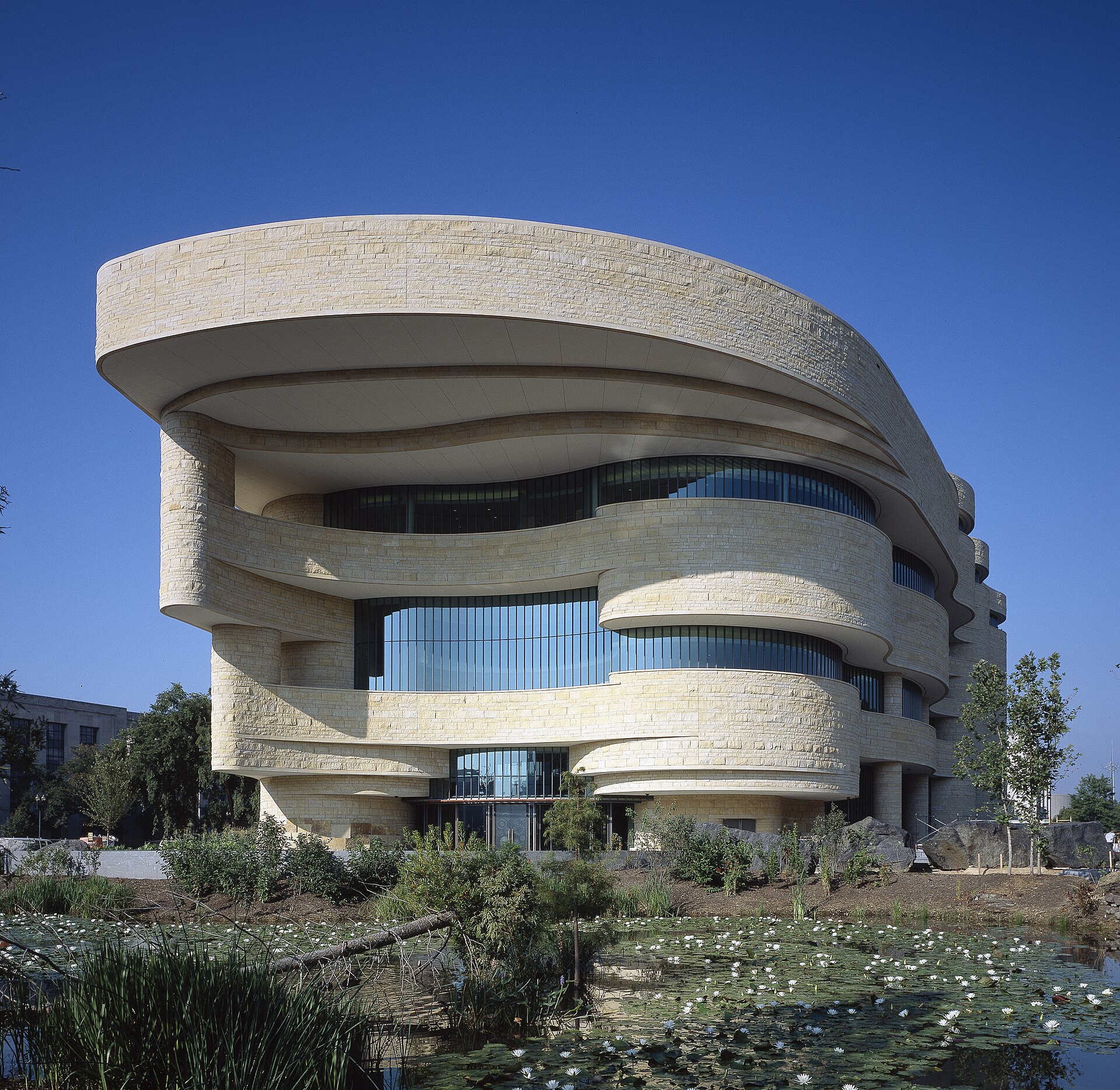
The building itself, designed by architect Douglas Cardinal, is notable for its curvilinear, organic form intended to evoke natural rock formations shaped by wind and water. The structure is oriented toward the east to capture the sunrise and is surrounded by a landscape that features native plants and water elements, reflecting the museum's focus on the deep connection between Indigenous cultures and the natural environment.
Key Facts
- Materials
- Kasota limestone, Bronze, Glass
- Civilization
- Pan-American Indigenous
- Accessibility
- Fully wheelchair accessible
- Date(s)
- 2004
- Condition
- Active
- Original Function
- Museum
- Key Figures
- Douglas Cardinal, W. Richard West Jr.
Origins and Foundation
1989The museum was established by an Act of Congress in 1989, which transferred the extensive collection of the Museum of the American Indian, Heye Foundation, in New York City to the Smithsonian Institution.
Design and Construction
1999-2004Architect Douglas Cardinal was selected to design the building. The construction process involved extensive consultation with tribal leaders from across the Americas to ensure the design and landscape reflected Indigenous values and traditions.
Opening and Mission
2004-PresentThe museum opened to the public on September 21, 2004. Since its inception, it has focused on shifting the narrative of Indigenous history from a colonial perspective to one centered on the lived experiences and ongoing vitality of Native communities.
Cultural Significance
The NMAI serves as a critical site for the preservation and revitalization of Indigenous cultures. By prioritizing oral histories and community-led exhibitions, it challenges traditional museum paradigms that often objectify Native peoples. It acts as a diplomatic space where tribal nations engage with the public, fostering a deeper understanding of the sovereignty and diversity of Indigenous nations.
Interpretive Notes
Scholarly debates and areas of uncertainty
There is ongoing academic discussion regarding the balance between the museum's role as a repository for historical artifacts and its mission as a living cultural center. Some scholars debate the efficacy of the 'collaborative curation' model in addressing the complexities of repatriation and the representation of sensitive or sacred items.
Visiting Information
Entry Rules
Open daily. Admission is free. Security screening is required for all visitors upon entry.
Best Times to Visit
Weekday mornings are generally less crowded. The museum's Mitsitam Native Foods Cafe is a popular destination, so visiting outside of peak lunch hours (12:00-13:30) is recommended.
Photography
Personal photography is permitted in most galleries. Flash and tripods are prohibited. Commercial photography requires prior authorization.
Preservation Notes
Maintain a respectful distance from artifacts. Some areas may have specific cultural protocols regarding photography or behavior; please observe posted signage.
Nearby POIs
11 shown- Smithsonian National Air and Space Museum0.3 km
- National Gallery of Art0.4 km
- United States Capitol0.7 km
- National Archives Building0.7 km
- Smithsonian National Museum of Natural History0.9 km
- International Spy Museum0.9 km
- Library of Congress1 km
- Smithsonian National Museum of American History1.2 km
- National Museum of African American History and Culture1.4 km
- Washington Monument1.6 km
- Jefferson Memorial1.9 km
Key Facts
- Materials
- Kasota limestone, Bronze, Glass
- Civilization
- Pan-American Indigenous
- Accessibility
- Fully wheelchair accessible
- Date(s)
- 2004
- Condition
- Active
- Original Function
- Museum
- Key Figures
- Douglas Cardinal, W. Richard West Jr.
Nearby POIs
11 shown- Smithsonian National Air and Space Museum0.3 km
- National Gallery of Art0.4 km
- United States Capitol0.7 km
- National Archives Building0.7 km
- Smithsonian National Museum of Natural History0.9 km
- International Spy Museum0.9 km
- Library of Congress1 km
- Smithsonian National Museum of American History1.2 km
- National Museum of African American History and Culture1.4 km
- Washington Monument1.6 km
- Jefferson Memorial1.9 km