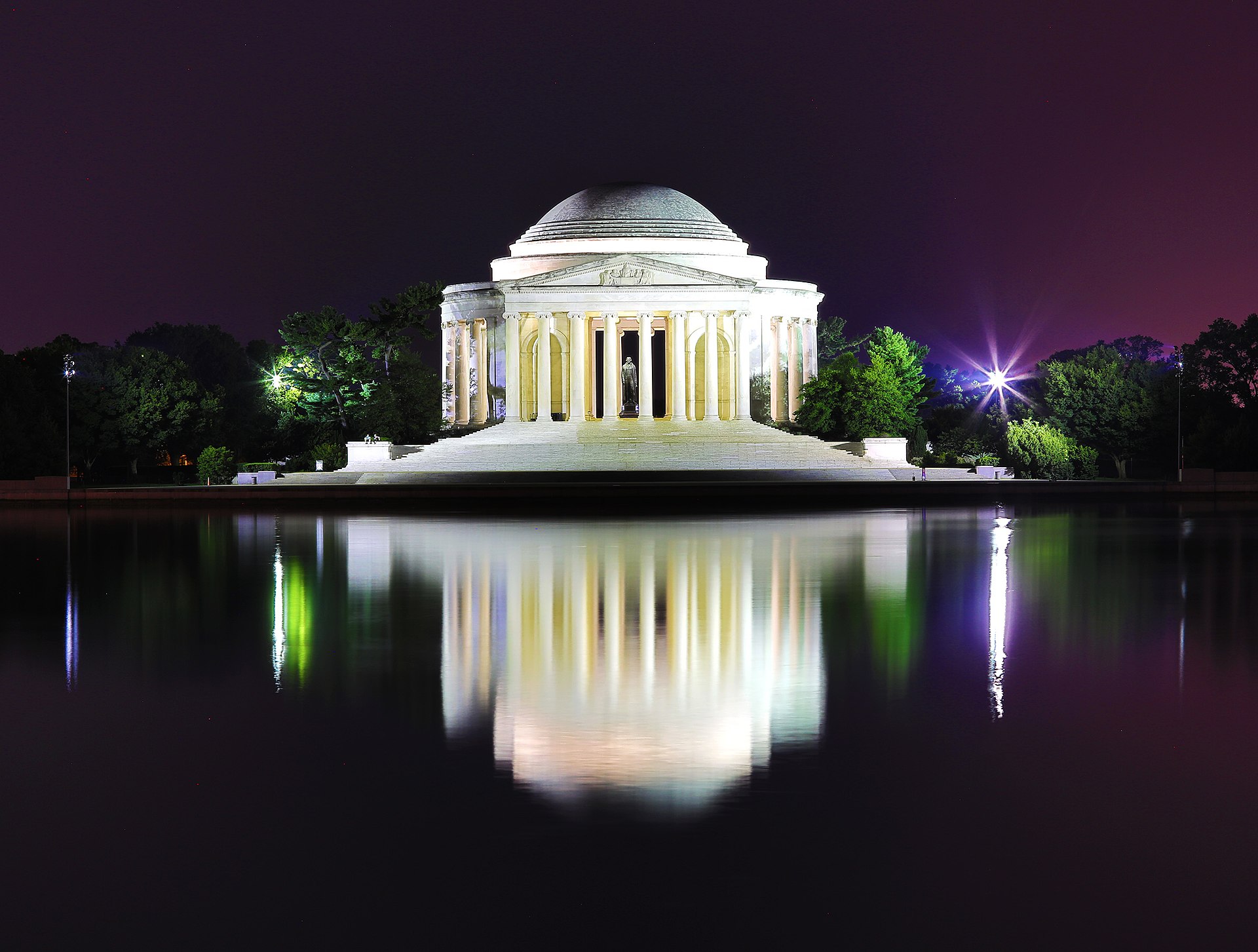
The Thomas Jefferson Memorial is a presidential memorial in Washington, D.C., dedicated to the third President of the United States and primary author of the Declaration of Independence. Located in West Potomac Park on the shore of the Tidal Basin, the structure was designed by architect John Russell Pope and completed in 1943.
The memorial is built in the Neoclassical style, featuring a circular colonnade of Ionic columns supporting a shallow dome. Inside, a 19-foot bronze statue of Jefferson stands on a pedestal, surrounded by walls inscribed with excerpts from his writings, most notably the Declaration of Independence and the Virginia Statute for Religious Freedom.
Key Facts
- Materials
- Imperial Danby marble, White Georgia marble, Bronze
- Civilization
- United States
- Accessibility
- Wheelchair accessible via elevator and ramp
- Date(s)
- 1939-1943
- Condition
- Well-preserved, managed by the National Park Service
- Original Function
- Presidential memorial
- Key Figures
- Thomas Jefferson, John Russell Pope, Franklin D. Roosevelt
Conception and Design
1934-1938President Franklin D. Roosevelt championed the creation of a memorial to Thomas Jefferson. Architect John Russell Pope was selected to design the structure, choosing a Neoclassical rotunda style that drew inspiration from the Pantheon in Rome and Jefferson's own architectural work at Monticello and the University of Virginia.
Construction
1939-1943Construction began in 1939 despite public controversy regarding the removal of Japanese cherry trees and the memorial's impact on the Tidal Basin landscape. The memorial was officially dedicated by President Roosevelt on April 13, 1943, the 200th anniversary of Jefferson's birth.
Statue Installation
1947The original statue installed in 1943 was made of plaster due to wartime metal shortages. It was replaced in 1947 by the current bronze statue, sculpted by Rudulph Evans, which stands 19 feet tall and weighs approximately 10,000 pounds.
Modern Preservation
20th century - presentThe memorial is maintained by the National Park Service. It has undergone several major restoration projects, including significant repairs to the roof and marble exterior to address weathering and structural integrity.
Cultural Significance
The Jefferson Memorial serves as a symbolic anchor for American democratic ideals. Its location on the Tidal Basin aligns it with the Washington Monument and the Lincoln Memorial, forming a core component of the National Mall's commemorative landscape. The inscriptions within the memorial are frequently cited in American political discourse regarding liberty, religious freedom, and the role of government.
Beyond its political symbolism, the memorial is a focal point for the annual National Cherry Blossom Festival. The surrounding trees, a gift from the city of Tokyo in 1912, create a globally recognized vista that draws millions of visitors annually, blending historical commemoration with seasonal natural beauty.
Interpretive Notes
Scholarly debates and areas of uncertainty
Academic discourse surrounding the memorial often focuses on the selective nature of the inscriptions. Critics argue that the chosen quotes present an idealized version of Jefferson, omitting his complex and contradictory legacy regarding the institution of slavery and his personal history as an enslaver. Recent scholarly efforts have sought to contextualize the memorial by highlighting these omissions and providing a more comprehensive view of Jefferson's life.
Visiting Information
Entry Rules
Open 24 hours a day, seven days a week. Park rangers are on duty from 9:30 a.m. to 10:00 p.m. daily. Admission is free. No specific dress code is required.
Best Times to Visit
Early morning or late evening to avoid peak tourist crowds. The site is particularly significant during the peak bloom of the cherry blossoms in late March or early April.
Photography
Personal photography is permitted. Commercial photography and filming require a permit from the National Park Service.
Preservation Notes
The marble surfaces are sensitive to environmental pollutants and biological growth. Visitors are requested to stay on designated paths and refrain from climbing on the memorial structure.
Nearby POIs
11 shown- Martin Luther King Jr. Memorial0.9 km
- Washington Monument0.9 km
- International Spy Museum1 km
- National Museum of African American History and Culture1.1 km
- Smithsonian National Museum of American History1.2 km
- Smithsonian National Museum of Natural History1.4 km
- Lincoln Memorial1.5 km
- Smithsonian National Air and Space Museum1.6 km
- National Archives Building1.7 km
- White House1.8 km
- National Gallery of Art1.8 km
Sources & Further Reading
- [1]Thomas Jefferson Memorial: History & Culture — National Park Service. U.S. Department of the Interior (2023)View
- [2]The Architecture of the Jefferson Memorial — Christopher A. Thomas. University of Virginia Press (2002)
Key Facts
- Materials
- Imperial Danby marble, White Georgia marble, Bronze
- Civilization
- United States
- Accessibility
- Wheelchair accessible via elevator and ramp
- Date(s)
- 1939-1943
- Condition
- Well-preserved, managed by the National Park Service
- Original Function
- Presidential memorial
- Key Figures
- Thomas Jefferson, John Russell Pope, Franklin D. Roosevelt
Nearby POIs
11 shown- Martin Luther King Jr. Memorial0.9 km
- Washington Monument0.9 km
- International Spy Museum1 km
- National Museum of African American History and Culture1.1 km
- Smithsonian National Museum of American History1.2 km
- Smithsonian National Museum of Natural History1.4 km
- Lincoln Memorial1.5 km
- Smithsonian National Air and Space Museum1.6 km
- National Archives Building1.7 km
- White House1.8 km
- National Gallery of Art1.8 km