Washington D.C.,United States of America
National Gallery of Art
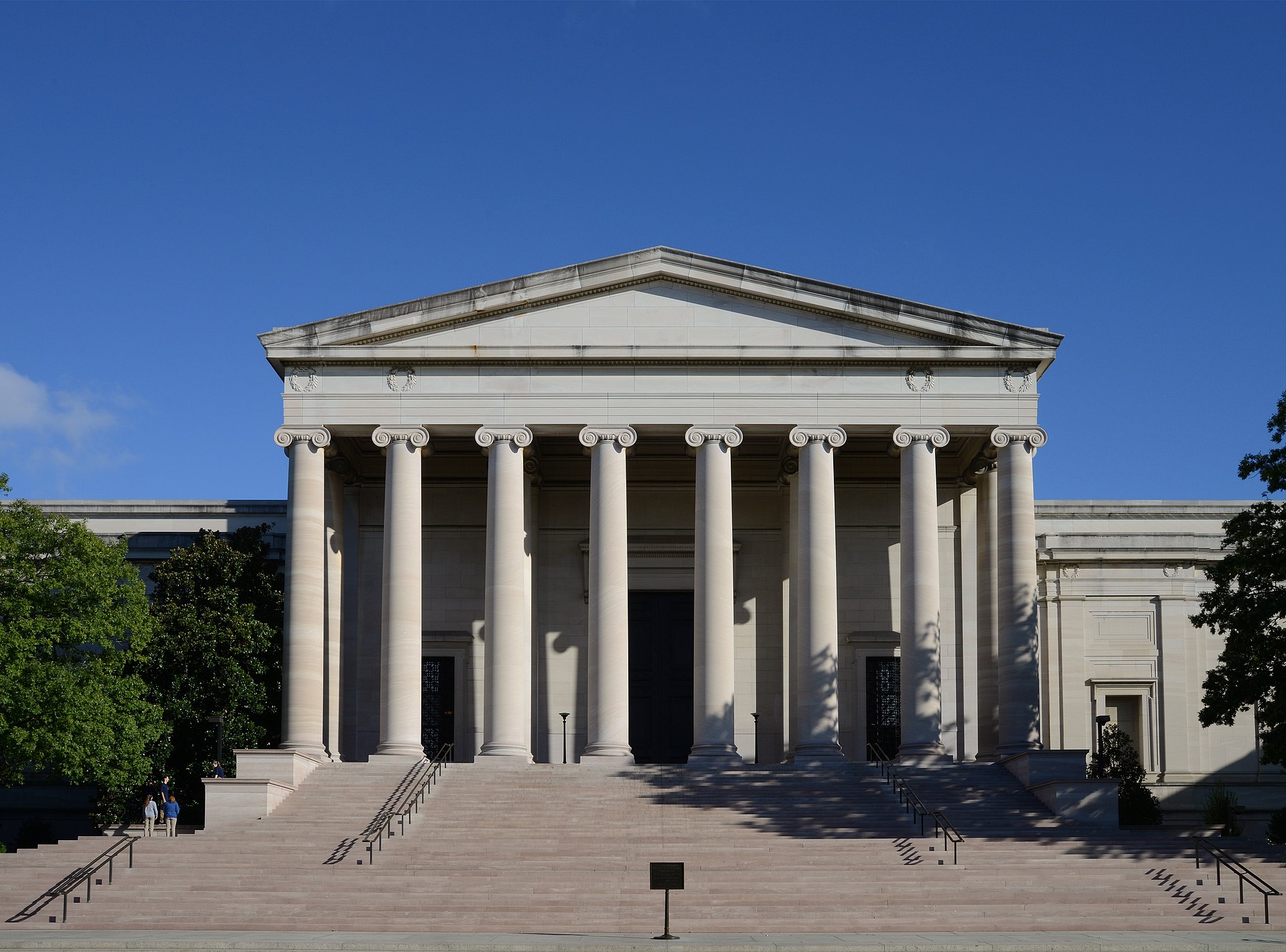
The National Gallery of Art is a national art museum in Washington, D.C., located on the National Mall. Established in 1937 by a joint resolution of the United States Congress, the museum was founded with funds and a substantial art collection donated by Andrew W. Mellon. The institution comprises two primary buildings: the West Building, designed by John Russell Pope in a Neoclassical style, and the East Building, designed by I.M. Pei, which focuses on modern and contemporary works.
The gallery houses a vast collection of paintings, drawings, prints, photographs, sculptures, and decorative arts spanning from the Middle Ages to the present day. It is notable for being the only institution in the Americas to hold a painting by Leonardo da Vinci, 'Ginevra de' Benci'. The museum serves as a center for research, conservation, and public education, operating as a public-private partnership.
Key Facts
- Materials
- Tennessee pink marble, Concrete, Glass, Steel
- Civilization
- United States
- Accessibility
- Fully wheelchair accessible with elevators and ramps
- Date(s)
- 1937-1941 (West Building); 1971-1978 (East Building)
- Condition
- Active, well-maintained
- Original Function
- Art Museum
- Key Figures
- Andrew W. Mellon, John Russell Pope, I.M. Pei, Paul Mellon
Founding and Vision
1930sAndrew W. Mellon, a financier and former Secretary of the Treasury, donated his extensive art collection and funds for the construction of a national gallery to the U.S. government. Congress accepted the gift in 1937, establishing the museum as an independent bureau of the Smithsonian Institution.
The West Building
1941Designed by John Russell Pope, the West Building opened to the public in 1941. Its Neoclassical design, featuring a massive rotunda and marble facade, was intended to harmonize with the surrounding federal architecture of the National Mall.
Expansion and the East Building
1970sTo accommodate a growing collection and interest in modern art, Paul Mellon commissioned I.M. Pei to design the East Building. Completed in 1978, the structure is celebrated for its geometric, modernist design and its integration into the urban landscape.
Modern Era
21st CenturyThe gallery has continued to expand its footprint and digital reach, including the renovation of the East Building galleries and the development of the Sculpture Garden. It remains one of the most visited art museums in the world.
Cultural Significance
The National Gallery of Art serves as a primary repository of Western art history in the United States. It plays a critical role in the cultural life of Washington, D.C., providing free access to world-class exhibitions and scholarly resources. The museum's presence on the National Mall underscores the importance of the arts in American civic and national identity.
Interpretive Notes
Scholarly debates and areas of uncertainty
Debates often center on the provenance of specific works within the collection, particularly regarding acquisitions made during the mid-20th century. Additionally, the museum frequently engages in scholarly discourse regarding the balance between traditional European art historical canons and the inclusion of diverse, contemporary, and non-Western perspectives.
Visiting Information
Entry Rules
Open daily. Admission is free to the public. Security screening is required for all visitors upon entry. Large bags and backpacks are not permitted in the galleries.
Best Times to Visit
Weekday mornings are generally less crowded. The museum is busiest during weekends and peak tourist seasons in the spring and summer.
Photography
Non-commercial photography is permitted for personal use in most galleries, provided no flash, tripods, or selfie sticks are used. Certain special exhibitions may prohibit photography.
Preservation Notes
Maintain a respectful distance from all artworks. Do not touch surfaces or frames. Food and drink are strictly prohibited inside the galleries.
Nearby POIs
11 shown- National Archives Building0.3 km
- Smithsonian National Air and Space Museum0.4 km
- National Museum of the American Indian0.4 km
- Smithsonian National Museum of Natural History0.5 km
- Smithsonian National Museum of American History0.9 km
- International Spy Museum1 km
- United States Capitol1 km
- National Museum of African American History and Culture1.1 km
- Washington Monument1.3 km
- Library of Congress1.4 km
- White House1.6 km
Sources & Further Reading
- [1]The National Gallery of Art: A History — Neil Harris. National Gallery of Art (2013)
- [2]I.M. Pei: A Profile in American Architecture — Carter Wiseman. Harry N. Abrams (2001)
Key Facts
- Materials
- Tennessee pink marble, Concrete, Glass, Steel
- Civilization
- United States
- Accessibility
- Fully wheelchair accessible with elevators and ramps
- Date(s)
- 1937-1941 (West Building); 1971-1978 (East Building)
- Condition
- Active, well-maintained
- Original Function
- Art Museum
- Key Figures
- Andrew W. Mellon, John Russell Pope, I.M. Pei, Paul Mellon
Nearby POIs
11 shown- National Archives Building0.3 km
- Smithsonian National Air and Space Museum0.4 km
- National Museum of the American Indian0.4 km
- Smithsonian National Museum of Natural History0.5 km
- Smithsonian National Museum of American History0.9 km
- International Spy Museum1 km
- United States Capitol1 km
- National Museum of African American History and Culture1.1 km
- Washington Monument1.3 km
- Library of Congress1.4 km
- White House1.6 km