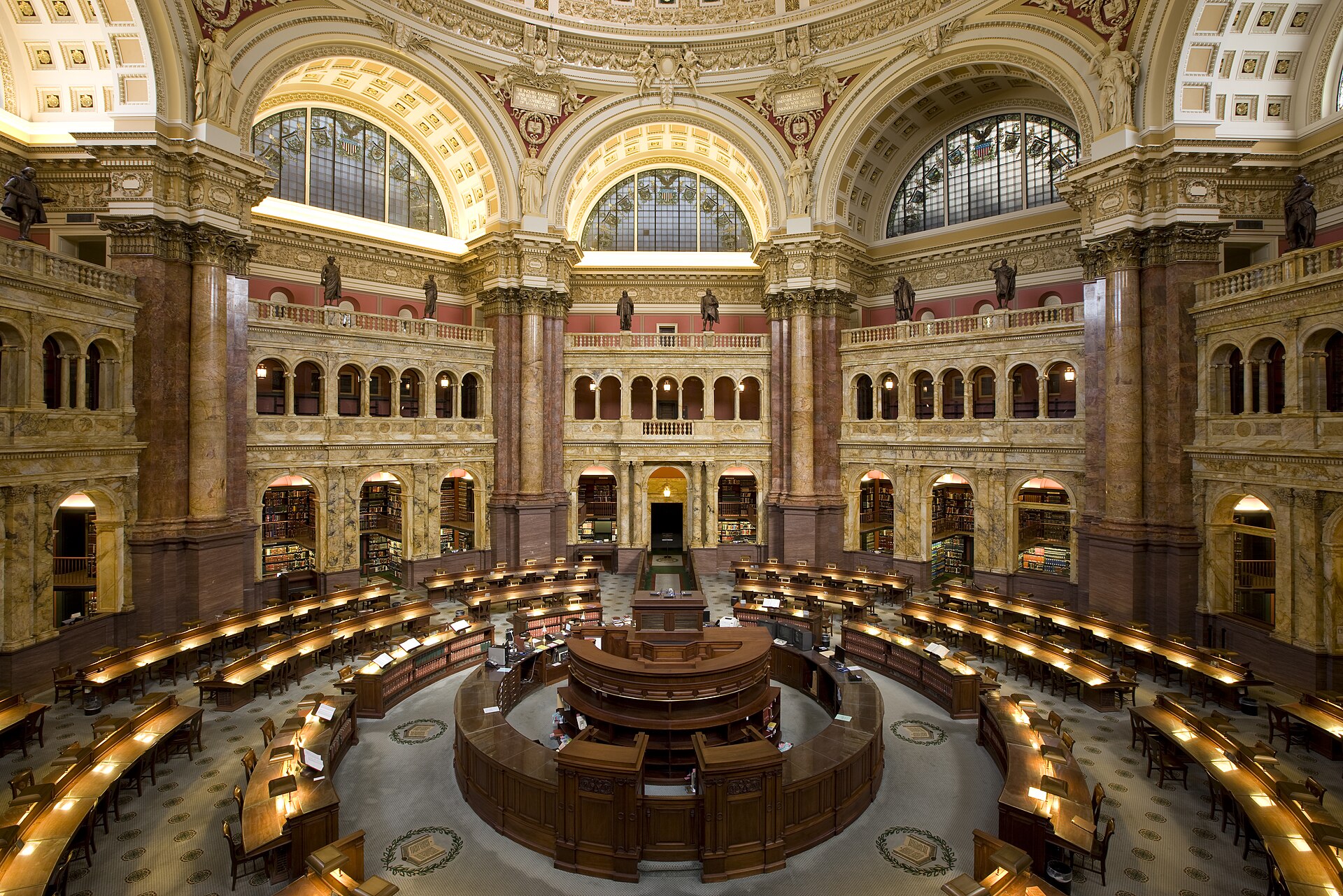
The Library of Congress serves as the research arm of the United States Congress and is the de facto national library of the United States. Established in 1800, it is housed primarily in three buildings on Capitol Hill in Washington, D.C.: the Thomas Jefferson Building, the John Adams Building, and the James Madison Memorial Building.
The institution holds a vast collection of more than 173 million items, including books, recordings, photographs, maps, sheet music, and manuscripts. It functions as a major center for scholarly research and preserves a significant portion of the American cultural and intellectual record.
Key Facts
- Materials
- Granite, Marble, Iron, Bronze
- Civilization
- United States
- Accessibility
- Fully accessible with designated entrances
- Date(s)
- 1897 (Jefferson Building)
- Condition
- Active, well-maintained
- Original Function
- Congressional research library
- Key Figures
- Thomas Jefferson, John Adams, Ainsworth Rand Spofford
Founding and Early Years
1800-1814The Library was established by an act of Congress in 1800. During the War of 1812, the original collection was destroyed when British troops burned the Capitol building.
The Jefferson Acquisition
1815To replace the lost collection, Congress purchased the personal library of Thomas Jefferson, which contained over 6,400 volumes. This acquisition transformed the library from a small legislative reference collection into a comprehensive research institution.
Expansion and Modernization
1897-1980The Thomas Jefferson Building opened in 1897 to house the rapidly growing collection. Throughout the 20th century, the library expanded into the Adams and Madison buildings to accommodate its massive holdings and administrative functions.
Cultural Significance
The Library of Congress is a cornerstone of American democracy, providing legislators and the public with access to a vast repository of knowledge. It serves as the primary copyright agency for the United States and maintains the National Film Registry and the National Recording Registry, playing a critical role in the preservation of American heritage.
Interpretive Notes
Scholarly debates and areas of uncertainty
Debates often center on the balance between physical preservation of fragile manuscripts and the push for mass digitization. Additionally, the library's role in defining the 'American canon' through its selection processes for national registries is a frequent subject of academic discourse.
Visiting Information
Entry Rules
Open to the public for research and tourism. Visitors must obtain a Reader Identification Card for access to reading rooms. Security screening is mandatory for all entrants.
Best Times to Visit
Weekdays during business hours are best for researchers. The Jefferson Building is open for public tours, which are best scheduled in advance.
Photography
Personal photography is permitted in public areas without flash or tripods. Photography is strictly prohibited in reading rooms and restricted areas.
Preservation Notes
Strict climate control is maintained throughout the facilities. Visitors are prohibited from bringing food or drink into the reading rooms and must store personal bags in lockers.
Nearby POIs
11 shown- United States Capitol0.4 km
- National Museum of the American Indian1 km
- Smithsonian National Air and Space Museum1.3 km
- National Gallery of Art1.4 km
- National Archives Building1.6 km
- Smithsonian National Museum of Natural History1.9 km
- International Spy Museum1.9 km
- Smithsonian National Museum of American History2.2 km
- National Museum of African American History and Culture2.4 km
- Washington Monument2.7 km
- Jefferson Memorial2.9 km
Key Facts
- Materials
- Granite, Marble, Iron, Bronze
- Civilization
- United States
- Accessibility
- Fully accessible with designated entrances
- Date(s)
- 1897 (Jefferson Building)
- Condition
- Active, well-maintained
- Original Function
- Congressional research library
- Key Figures
- Thomas Jefferson, John Adams, Ainsworth Rand Spofford
Nearby POIs
11 shown- United States Capitol0.4 km
- National Museum of the American Indian1 km
- Smithsonian National Air and Space Museum1.3 km
- National Gallery of Art1.4 km
- National Archives Building1.6 km
- Smithsonian National Museum of Natural History1.9 km
- International Spy Museum1.9 km
- Smithsonian National Museum of American History2.2 km
- National Museum of African American History and Culture2.4 km
- Washington Monument2.7 km
- Jefferson Memorial2.9 km