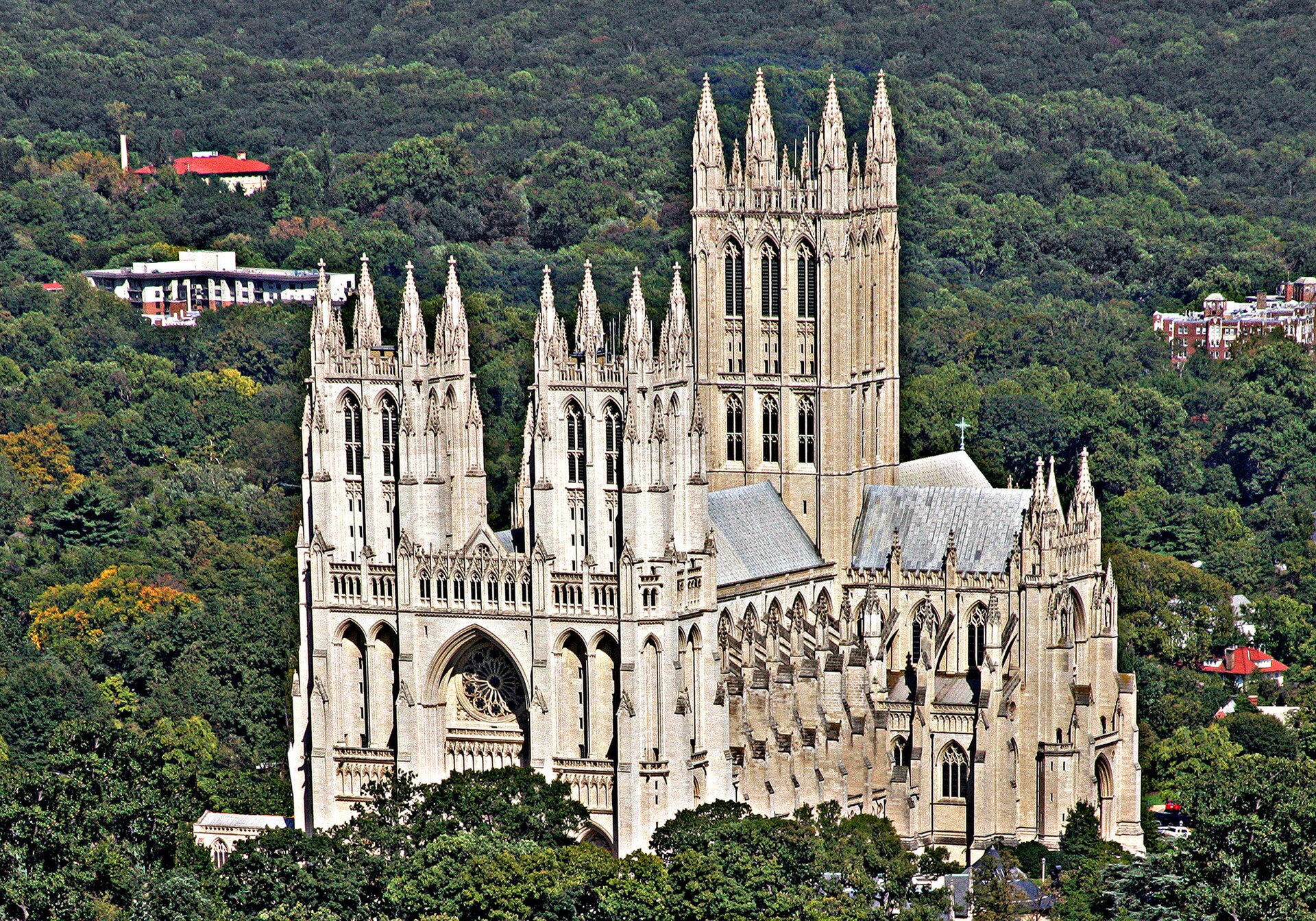
Washington D.C.,United States of America
Washington National Cathedral
The Cathedral Church of Saint Peter and Saint Paul in the City and Diocese of Washington, commonly known as the Washington National Cathedral, is a cathedral of the Episcopal Church located in Washington, D.C. Construction began in 1907 under the direction of architect George Frederick Bodley and was completed in 1990, spanning 83 years of labor. It is the sixth-largest cathedral in the world and the second-largest in the United States, designed in the Neo-Gothic style inspired by 14th-century English Gothic architecture.
The structure is built primarily of Indiana limestone and features intricate stone carvings, including a famous gargoyle depicting Darth Vader. It serves as a national house of prayer and has hosted numerous state funerals, presidential inaugural prayer services, and significant cultural events. The cathedral is renowned for its extensive stained glass, including the Space Window, which contains a lunar rock fragment.
Key Facts
- Materials
- Indiana limestone, Steel, Stained glass
- Civilization
- American
- Accessibility
- Fully accessible with elevators and ramps
- Date(s)
- 1907-1990
- Condition
- Active, well-preserved
- Original Function
- Episcopal Cathedral
- Key Figures
- George Frederick Bodley, Henry Vaughan, Philip Hubert Frohman
Founding and Design
1893-1907Congress granted a charter to the Protestant Episcopal Cathedral Foundation in 1893. The site on Mount Saint Alban was selected for its elevation, and the foundation stone was laid in 1907 in the presence of President Theodore Roosevelt.
Mid-Century Construction
1907-1960Construction progressed through the early 20th century, though it was significantly slowed by the Great Depression and World War II. The Great Choir and St. Mary's Chapel were completed early, allowing for services to be held long before the full structure was finished.
Completion
1960-1990The final pinnacle was placed on the west towers in 1990, marking the official completion of the cathedral. This ceremony was attended by President George H.W. Bush, concluding 83 years of continuous construction.
Modern Era and Restoration
2011-presentThe cathedral sustained significant damage during the 2011 Virginia earthquake, which caused cracks in the central tower and pinnacles. A multi-year, multi-million dollar restoration project has been underway to repair the stone masonry.
Cultural Significance
The Washington National Cathedral occupies a unique space in American civic life, functioning as a 'national house of prayer' rather than a seat of a bishop. It has become a focal point for national mourning and celebration, hosting the funerals of several U.S. Presidents and serving as a site for ecumenical dialogue.
Its architecture and iconography reflect a blend of traditional religious themes and modern American history. The inclusion of contemporary figures and events in its stone carvings and stained glass windows serves to bridge the gap between medieval architectural traditions and the modern American experience.
Interpretive Notes
Scholarly debates and areas of uncertainty
Debates often center on the appropriateness of the Neo-Gothic style for a 20th-century American monument, with some critics arguing it represents an architectural anachronism. Additionally, the cathedral's role as a 'national' institution in a secular state remains a subject of ongoing discussion regarding the separation of church and state.
Visiting Information
Entry Rules
Open to the public for sightseeing and worship. Sightseeing tickets are required for entry during designated hours. Visitors are expected to maintain a respectful demeanor appropriate for a house of worship.
Best Times to Visit
Weekday mornings are generally quieter. The cathedral is particularly significant during national holidays and major liturgical seasons.
Photography
Personal photography is permitted for non-commercial use. Tripods and professional lighting equipment require prior authorization.
Preservation Notes
The structure is fragile due to its limestone composition and earthquake history. Visitors are asked to refrain from touching the stone carvings and to follow all posted safety signage regarding active restoration zones.
Nearby POIs
11 shown- White House4.7 km
- Lincoln Memorial4.9 km
- United States Holocaust Memorial Museum5.2 km
- Martin Luther King Jr. Memorial5.4 km
- National Museum of African American History and Culture5.5 km
- Washington Monument5.5 km
- Smithsonian National Museum of American History5.6 km
- Smithsonian National Museum of Natural History5.8 km
- National Archives Building5.9 km
- National Gallery of Art6.2 km
- Jefferson Memorial6.2 km
Sources & Further Reading
- [1]Washington National Cathedral: The History of a National Monument — Marjorie Hunt. Smithsonian Institution Press (1999)View
- [2]The Cathedral Age: A History of the Washington National Cathedral — Richard P. Townsend. Washington National Cathedral Archives (2015)
Key Facts
- Materials
- Indiana limestone, Steel, Stained glass
- Civilization
- American
- Accessibility
- Fully accessible with elevators and ramps
- Date(s)
- 1907-1990
- Condition
- Active, well-preserved
- Original Function
- Episcopal Cathedral
- Key Figures
- George Frederick Bodley, Henry Vaughan, Philip Hubert Frohman
Nearby POIs
11 shown- White House4.7 km
- Lincoln Memorial4.9 km
- United States Holocaust Memorial Museum5.2 km
- Martin Luther King Jr. Memorial5.4 km
- National Museum of African American History and Culture5.5 km
- Washington Monument5.5 km
- Smithsonian National Museum of American History5.6 km
- Smithsonian National Museum of Natural History5.8 km
- National Archives Building5.9 km
- National Gallery of Art6.2 km
- Jefferson Memorial6.2 km