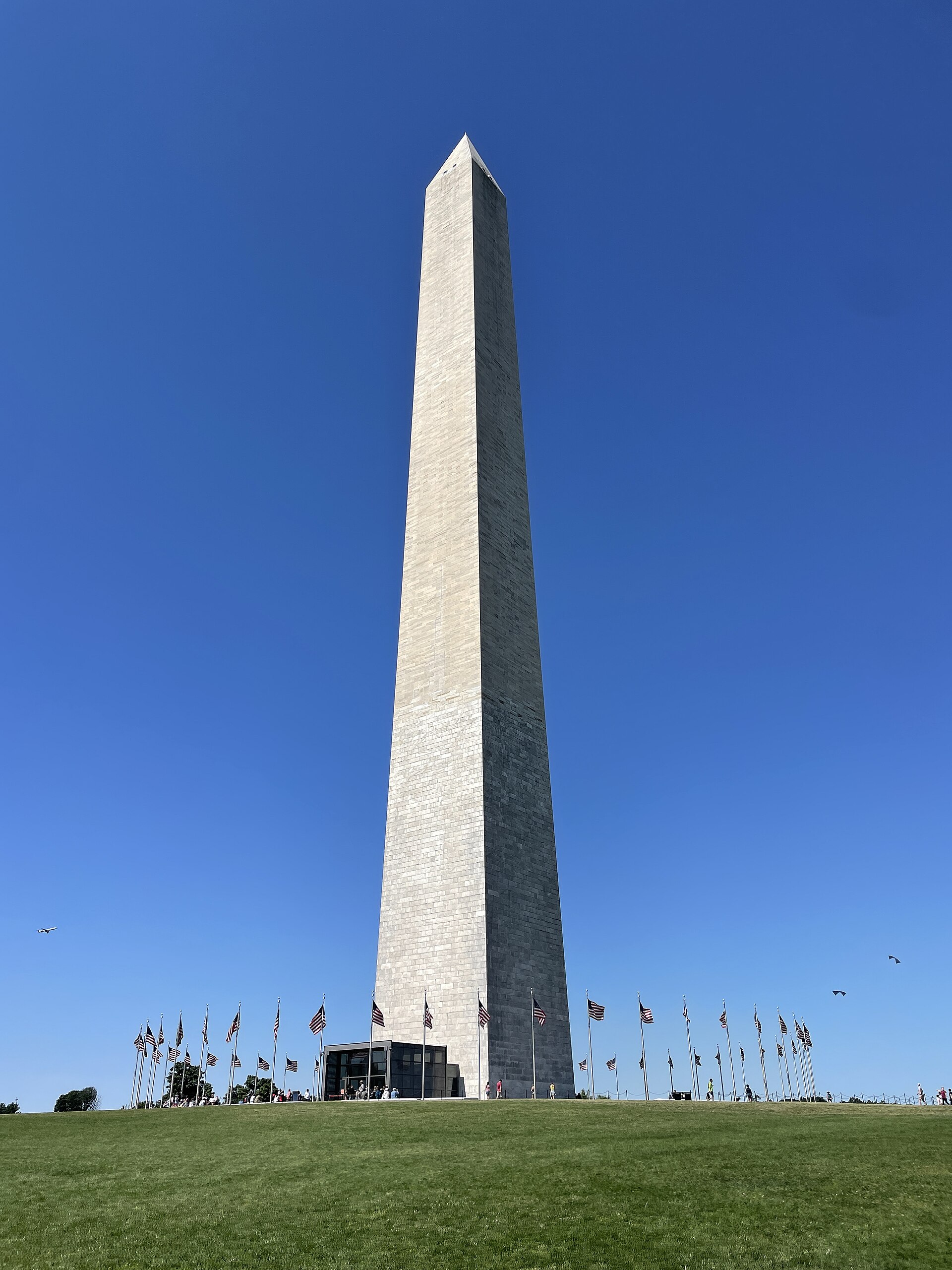
Washington D.C.,United States of America
Washington Monument
The Washington Monument is a massive white marble obelisk located on the National Mall in Washington, D.C., built to commemorate George Washington, the first President of the United States. Standing at 554 feet and 7 1/8 inches tall, it remains the world's tallest predominantly stone structure and the world's tallest obelisk.
Construction occurred in two distinct phases: the first from 1848 to 1854, and the second from 1877 to 1884. The project was delayed for over two decades due to a lack of funds and the onset of the American Civil War, which is visually evident in the slight color variation of the marble blocks used in the lower and upper sections of the shaft.
Key Facts
- Materials
- White marble, Granite, Bluestone gneiss
- Civilization
- United States
- Accessibility
- Elevator access to observation deck
- Date(s)
- 1848-1884
- Condition
- Well-preserved, active tourist site
- Original Function
- Commemorative monument
- Key Figures
- George Washington, Robert Mills, Thomas Lincoln Casey
Conception and Design
1833-1848The Washington National Monument Society was formed in 1833 to raise funds for a memorial. Architect Robert Mills won a design competition with a plan for a massive obelisk surrounded by a circular colonnade, though the colonnade was later abandoned due to budget constraints.
Initial Construction and Stagnation
1848-1854Construction began in 1848, but progress halted in 1854 after the Society ran out of funds and political tensions rose. The monument sat as a truncated stump for over 20 years, becoming a symbol of national division.
Completion
1877-1884The U.S. Army Corps of Engineers took over the project in 1877. Lieutenant Colonel Thomas Lincoln Casey redesigned the foundation and completed the shaft, capping it with a pyramidion made of aluminum, a rare and expensive metal at the time.
Modern Restoration
20th-21st CenturyThe monument has undergone several major restorations, most notably following the 2011 Virginia earthquake, which caused structural cracks in the marble. It reopened in 2014 after extensive repairs and seismic retrofitting.
Cultural Significance
The Washington Monument serves as a central anchor for the National Mall, symbolizing the foundational role of George Washington in American democracy. It is a focal point for national celebrations, protests, and civic gatherings, representing the enduring legacy of the American presidency.
Beyond its political symbolism, the monument is a landmark of engineering history. Its completion marked a period of post-Civil War national reconciliation, and it remains one of the most recognizable silhouettes in the American capital.
Interpretive Notes
Scholarly debates and areas of uncertainty
Debate exists regarding the aesthetic impact of the color discrepancy in the marble, with some arguing it should be unified and others maintaining that the visible 'seam' is a vital historical record of the monument's interrupted construction.
Visiting Information
Entry Rules
Open daily. Tickets are required for the observation deck and must be reserved in advance online or at the lodge. Security screening is mandatory for all visitors.
Best Times to Visit
Early morning or late afternoon to avoid peak heat and midday crowds. Weekdays generally offer shorter wait times for security screening.
Photography
Personal photography is permitted. Commercial photography requires a permit from the National Park Service.
Preservation Notes
The structure is monitored for seismic stability. Visitors are prohibited from climbing the exterior or defacing the interior walls.
Nearby POIs
11 shown- National Museum of African American History and Culture0.3 km
- Smithsonian National Museum of American History0.5 km
- Smithsonian National Museum of Natural History0.8 km
- Martin Luther King Jr. Memorial0.9 km
- Jefferson Memorial0.9 km
- White House0.9 km
- International Spy Museum1 km
- National Archives Building1.1 km
- Lincoln Memorial1.3 km
- National Gallery of Art1.3 km
- Smithsonian National Air and Space Museum1.3 km
Key Facts
- Materials
- White marble, Granite, Bluestone gneiss
- Civilization
- United States
- Accessibility
- Elevator access to observation deck
- Date(s)
- 1848-1884
- Condition
- Well-preserved, active tourist site
- Original Function
- Commemorative monument
- Key Figures
- George Washington, Robert Mills, Thomas Lincoln Casey
Nearby POIs
11 shown- National Museum of African American History and Culture0.3 km
- Smithsonian National Museum of American History0.5 km
- Smithsonian National Museum of Natural History0.8 km
- Martin Luther King Jr. Memorial0.9 km
- Jefferson Memorial0.9 km
- White House0.9 km
- International Spy Museum1 km
- National Archives Building1.1 km
- Lincoln Memorial1.3 km
- National Gallery of Art1.3 km
- Smithsonian National Air and Space Museum1.3 km