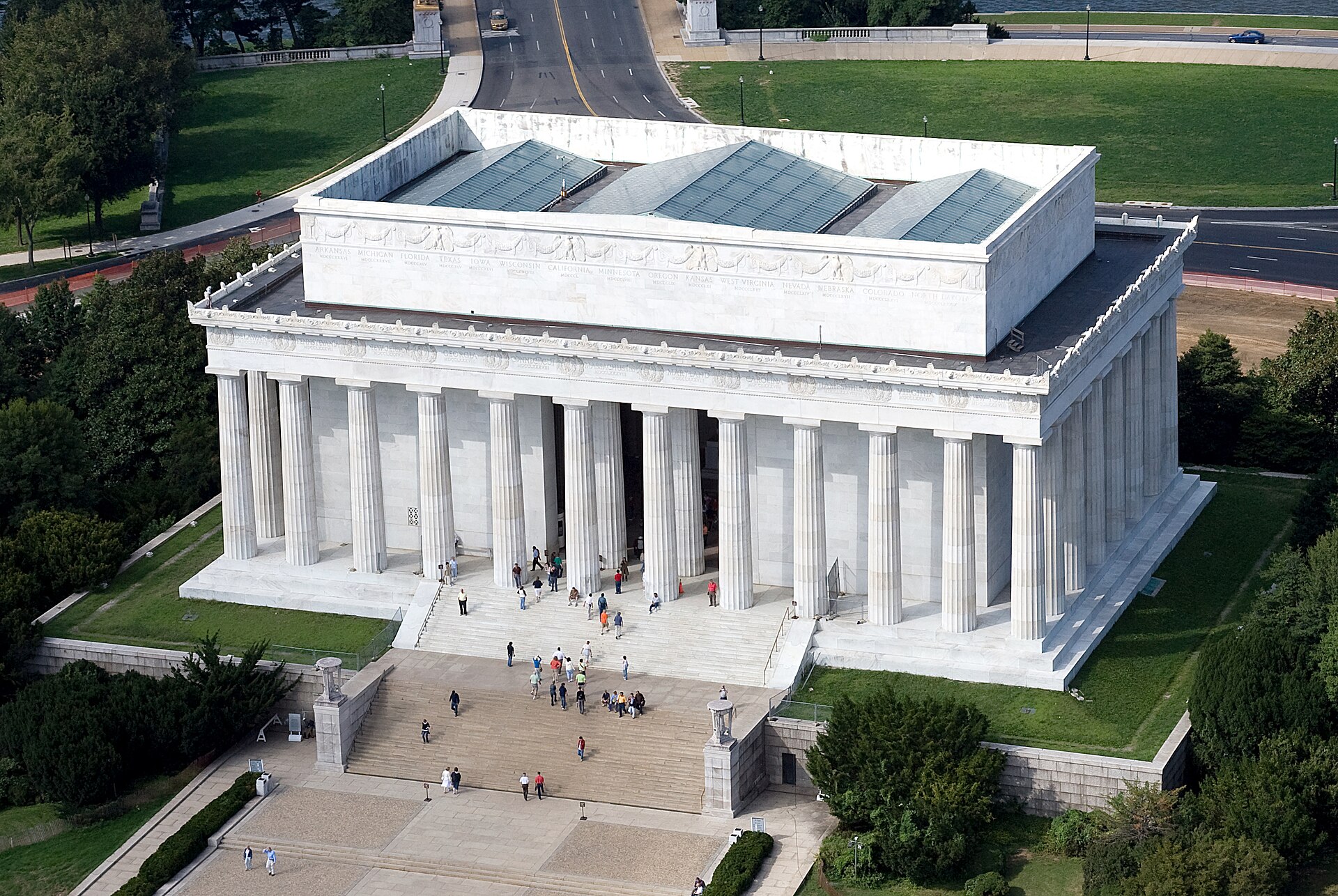
The Lincoln Memorial is a national monument built to honor the 16th President of the United States, Abraham Lincoln. Located on the western end of the National Mall in Washington, D.C., the structure was designed by architect Henry Bacon and features a large seated sculpture of Lincoln created by Daniel Chester French. The memorial is modeled after a Greek Doric temple, symbolizing the democratic ideals Lincoln sought to preserve during the American Civil War.
Since its dedication in 1922, the site has served as a significant venue for public gatherings and political demonstrations. It is perhaps most famously associated with the 1963 March on Washington for Jobs and Freedom, where Dr. Martin Luther King Jr. delivered his 'I Have a Dream' speech from the steps of the memorial, cementing its status as a landmark of the American Civil Rights Movement.
Key Facts
- Materials
- Colorado Yule marble, Georgia marble, Pink Tennessee marble, Indiana limestone
- Civilization
- United States
- Accessibility
- Fully accessible via elevator and ramp systems
- Date(s)
- 1914-1922
- Condition
- Well-preserved, active national monument
- Original Function
- Presidential memorial
- Key Figures
- Abraham Lincoln, Henry Bacon, Daniel Chester French, Jules Guérin
Conception and Design
1910-1914Following years of debate regarding the location and design of a memorial to Lincoln, Congress authorized the construction in 1910. Architect Henry Bacon was selected to design the structure, choosing a Greek temple style to represent the permanence of the Union.
Construction
1914-1922Construction began in 1914 on reclaimed land in West Potomac Park. The project required extensive foundation work due to the marshy soil. The memorial was officially dedicated on May 30, 1922, in a ceremony attended by Robert Todd Lincoln, the president's only surviving son.
Civil Rights Landmark
1939-1963The memorial became a focal point for civil rights when Marian Anderson performed there in 1939 after being denied a venue at Constitution Hall. This set a precedent for the site's use as a platform for social justice, culminating in the 1963 March on Washington.
Modern Preservation
21st CenturyThe National Park Service maintains the site, conducting periodic restoration projects to clean the marble and stabilize the structure. Recent efforts have focused on improving visitor accessibility and updating the undercroft museum.
Cultural Significance
The Lincoln Memorial stands as a primary symbol of American democracy and the struggle for equality. Its architectural design links the American presidency to the classical traditions of ancient Greece, while its history as a site for protest has transformed it into a living monument to the ongoing pursuit of civil rights and social justice in the United States.
Interpretive Notes
Scholarly debates and areas of uncertainty
Scholarly discussion often centers on the interpretation of the memorial's design as a 'temple' and whether this deifies Lincoln in a way that obscures his political humanity. Additionally, debates exist regarding the balance between preserving the site as a static historical monument versus its role as a dynamic space for contemporary political expression.
Visiting Information
Entry Rules
Open 24 hours a day, 365 days a year. Admission is free. Park rangers are on duty to provide information and assistance during standard operating hours.
Best Times to Visit
Early morning or late evening to avoid peak tourist crowds and midday heat. The memorial is particularly noted for its visual impact when illuminated at night.
Photography
Personal photography is permitted. Commercial photography and filming require a permit from the National Park Service.
Preservation Notes
Visitors are requested to remain on designated paths and refrain from touching the marble surfaces or the sculpture. Food and drink are prohibited inside the memorial chamber.
Nearby POIs
11 shown- Martin Luther King Jr. Memorial0.6 km
- United States Holocaust Memorial Museum1.2 km
- Washington Monument1.3 km
- Jefferson Memorial1.5 km
- White House1.5 km
- National Museum of African American History and Culture1.5 km
- Smithsonian National Museum of American History1.8 km
- Smithsonian National Museum of Natural History2.1 km
- International Spy Museum2.2 km
- National Archives Building2.4 km
- National Gallery of Art2.6 km
Sources & Further Reading
- [1]
- [2]The Lincoln Memorial and American Life — Merrill D. Peterson. Oxford University Press (1994)
Key Facts
- Materials
- Colorado Yule marble, Georgia marble, Pink Tennessee marble, Indiana limestone
- Civilization
- United States
- Accessibility
- Fully accessible via elevator and ramp systems
- Date(s)
- 1914-1922
- Condition
- Well-preserved, active national monument
- Original Function
- Presidential memorial
- Key Figures
- Abraham Lincoln, Henry Bacon, Daniel Chester French, Jules Guérin
Nearby POIs
11 shown- Martin Luther King Jr. Memorial0.6 km
- United States Holocaust Memorial Museum1.2 km
- Washington Monument1.3 km
- Jefferson Memorial1.5 km
- White House1.5 km
- National Museum of African American History and Culture1.5 km
- Smithsonian National Museum of American History1.8 km
- Smithsonian National Museum of Natural History2.1 km
- International Spy Museum2.2 km
- National Archives Building2.4 km
- National Gallery of Art2.6 km