Washington D.C.,United States of America
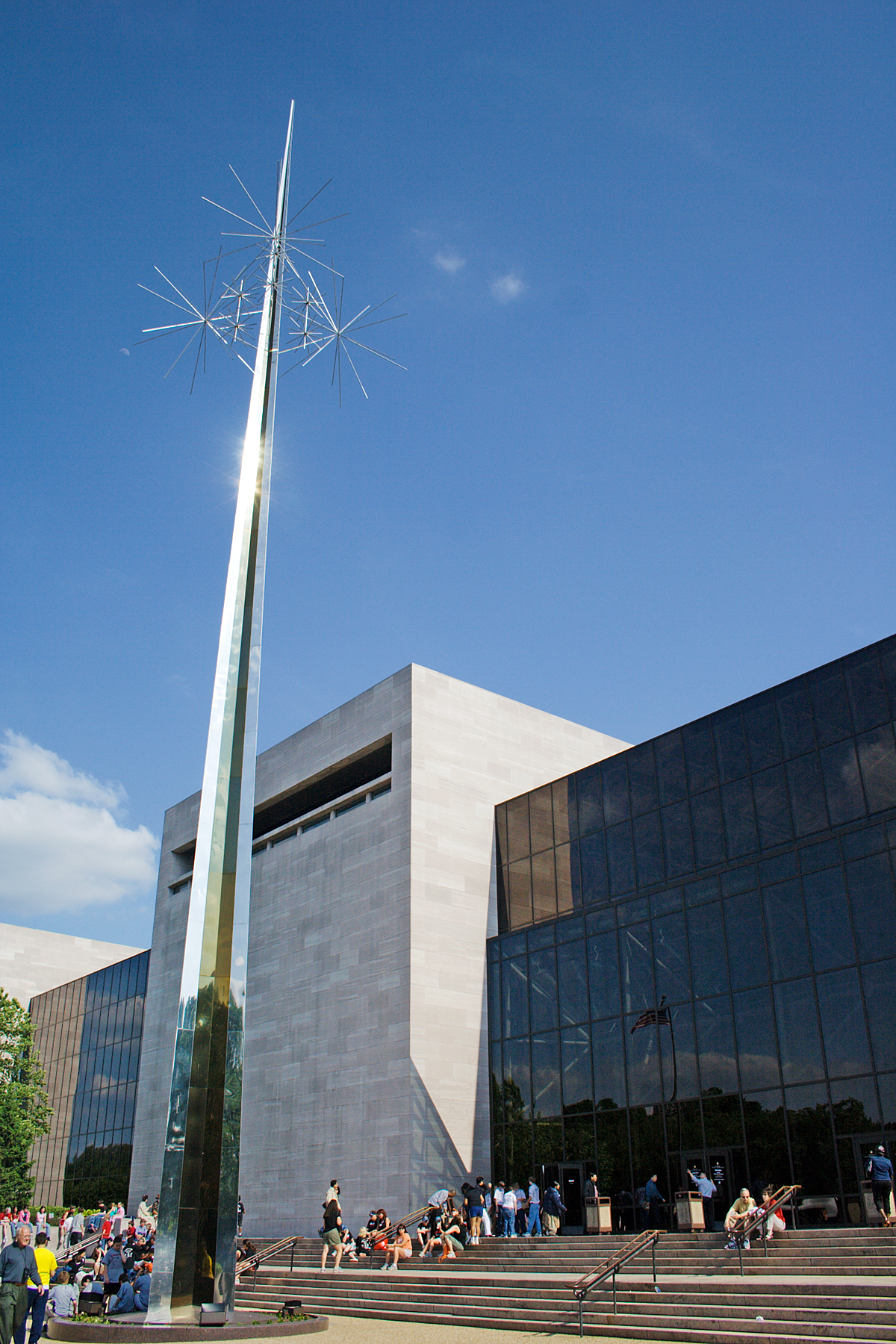
Smithsonian National Air and Space Museum
The National Air and Space Museum, part of the Smithsonian Institution, holds the world's largest collection of historic aircraft and spacecraft. Located on the National Mall in Washington, D.C., the museum serves as a center for research into the history, science, and technology of aviation and spaceflight.
The museum's collection includes iconic artifacts such as the 1903 Wright Flyer, the Spirit of St. Louis, and the Apollo 11 Command Module Columbia. Through its extensive galleries, the institution documents the evolution of flight from early ballooning and powered aircraft to the complexities of modern orbital exploration.
Key Facts
- Materials
- Tennessee pink marble, Steel, Glass
- Civilization
- United States
- Accessibility
- Fully wheelchair accessible
- Date(s)
- 1972-1976
- Condition
- Active, undergoing phased renovation
- Original Function
- Museum and research facility
- Key Figures
- Gyo Obata, S. Dillon Ripley
Establishment
1946The National Air Museum was established by an act of Congress in 1946 to memorialize the development of aviation and preserve aeronautical equipment.
Construction of the Mall Building
1972-1976Designed by architect Gyo Obata of HOK, the current building on the National Mall was constructed to accommodate the growing collection. It opened to the public on July 1, 1976, as part of the United States Bicentennial celebrations.
Expansion and Modernization
2003-PresentThe museum expanded its footprint with the opening of the Steven F. Udvar-Hazy Center in Chantilly, Virginia, in 2003. Since 2018, the Mall building has been undergoing a comprehensive, multi-year renovation to modernize its infrastructure and gallery spaces.
Cultural Significance
The museum acts as a primary repository for American technological achievements in aerospace. It plays a critical role in public education regarding the history of flight and the scientific advancements that enabled human exploration of the atmosphere and beyond.
Interpretive Notes
Scholarly debates and areas of uncertainty
Debates have historically centered on the museum's role in interpreting sensitive historical events, most notably the 1994 controversy surrounding the planned exhibition of the Enola Gay, which sparked significant public and academic discourse regarding the museum's responsibility to provide balanced historical context.
Visiting Information
Entry Rules
Admission is free, but timed-entry passes are currently required for all visitors. The museum is open daily except December 25th.
Best Times to Visit
Weekday mornings are generally less crowded. The museum experiences peak attendance during spring break and summer months.
Photography
Personal photography is permitted in most galleries. Tripods and flash photography are generally prohibited to protect artifacts and ensure visitor safety.
Preservation Notes
Artifacts are maintained in climate-controlled environments. Visitors are requested not to touch any displays or climb on exhibit structures.
Nearby POIs
11 shown- National Museum of the American Indian0.3 km
- National Gallery of Art0.4 km
- National Archives Building0.6 km
- Smithsonian National Museum of Natural History0.6 km
- International Spy Museum0.7 km
- Smithsonian National Museum of American History0.9 km
- United States Capitol1 km
- National Museum of African American History and Culture1.2 km
- Library of Congress1.3 km
- Washington Monument1.3 km
- Jefferson Memorial1.6 km
Sources & Further Reading
- [1]Smithsonian National Air and Space Museum: Official History — Smithsonian Institution. Smithsonian Institution Press (2020)View
- [2]The National Air and Space Museum: A History — Andrew K. Johnston. Smithsonian Books (2010)
Key Facts
- Materials
- Tennessee pink marble, Steel, Glass
- Civilization
- United States
- Accessibility
- Fully wheelchair accessible
- Date(s)
- 1972-1976
- Condition
- Active, undergoing phased renovation
- Original Function
- Museum and research facility
- Key Figures
- Gyo Obata, S. Dillon Ripley
Nearby POIs
11 shown- National Museum of the American Indian0.3 km
- National Gallery of Art0.4 km
- National Archives Building0.6 km
- Smithsonian National Museum of Natural History0.6 km
- International Spy Museum0.7 km
- Smithsonian National Museum of American History0.9 km
- United States Capitol1 km
- National Museum of African American History and Culture1.2 km
- Library of Congress1.3 km
- Washington Monument1.3 km
- Jefferson Memorial1.6 km