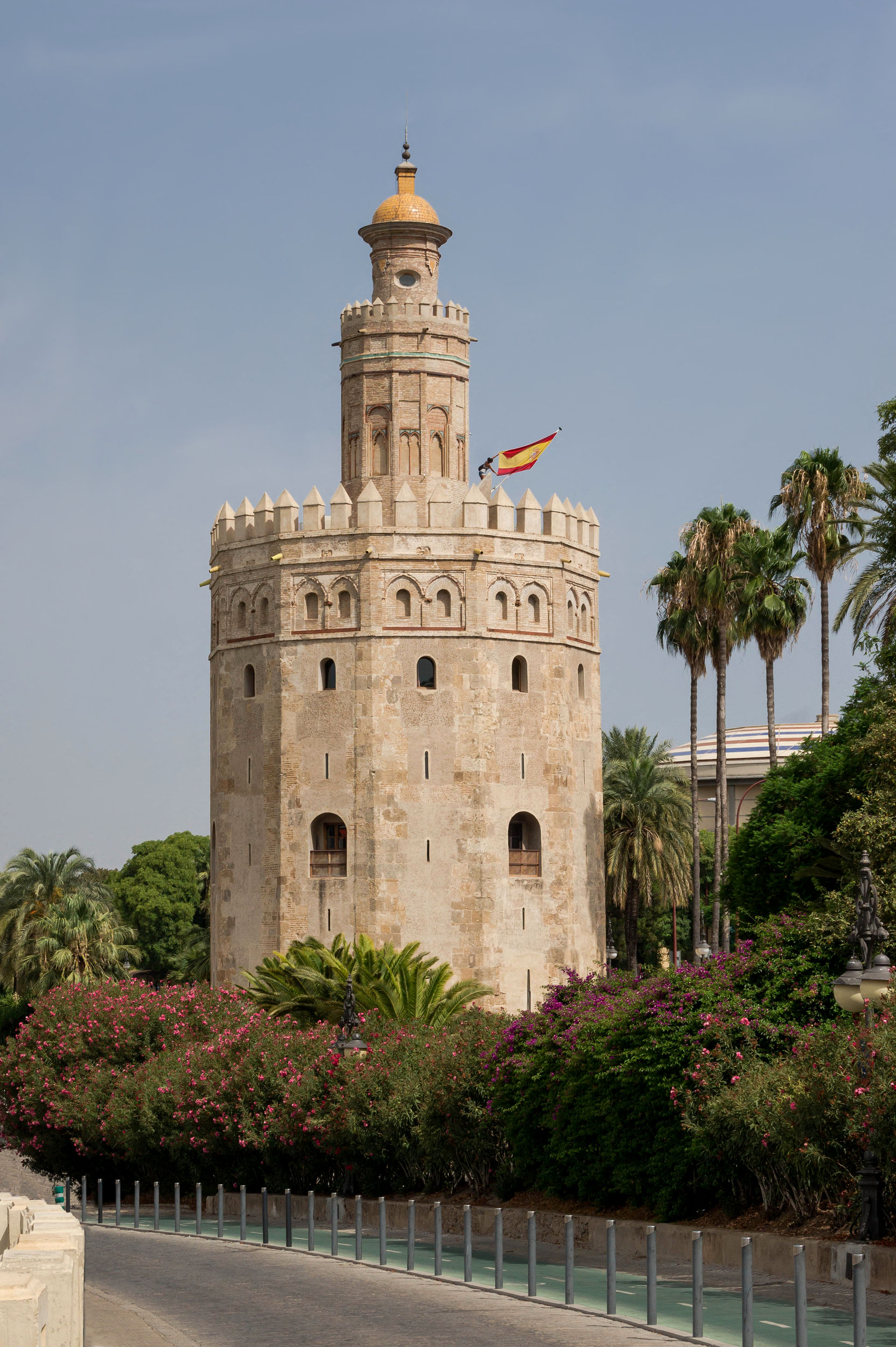
The Torre del Oro is a dodecagonal military watchtower located on the left bank of the Guadalquivir River in Seville. Constructed in the early 13th century by the Almohad Caliphate, it served as a critical defensive structure designed to control river access to the city by means of a heavy chain stretched across the water to the opposite bank.
Following the Reconquista, the tower underwent several modifications, including the addition of a third level in the 18th century. Throughout its history, it has functioned as a prison, a chapel, and a storage facility for precious metals arriving from the Americas, which contributed to its enduring name and historical significance in Spanish maritime history.
Key Facts
- Materials
- Brick, Mortar, Stone
- Civilization
- Almohad
- Accessibility
- Ground floor accessible; upper levels via stairs
- Date(s)
- 1220-1221 CE
- Condition
- Well-preserved, houses the Naval Museum
- Original Function
- Military watchtower and river defense
- Key Figures
- Abu al-Ula Idris al-Ma'mun
Almohad Construction
1220-1221The tower was commissioned by the Almohad governor of Seville, Abu al-Ula, to serve as the final defensive point of the city walls along the riverfront.
Christian Conquest
1248Following the capture of Seville by Ferdinand III of Castile, the tower was utilized as a defensive bastion and occasionally as a prison for political figures.
Colonial Era
16th-17th centuryDuring the height of the Spanish Empire, the tower served as a secure location for storing gold and silver brought from the New World, reinforcing its popular name.
Modern Restoration
19th century - presentThe tower was declared a national monument in 1931. It currently houses the Museo Marítimo de Sevilla, displaying artifacts related to the city's naval and colonial history.
Cultural Significance
The Torre del Oro stands as a symbol of Seville's maritime heritage and its role as the gateway to the Americas during the Age of Discovery. It represents the architectural synthesis of Almohad defensive engineering and subsequent Christian modifications, reflecting the layered history of Andalusia.
Interpretive Notes
Scholarly debates and areas of uncertainty
The origin of the name 'Torre del Oro' remains a subject of minor debate. While popular tradition attributes it to the storage of gold from the Americas, some historians suggest it refers to the golden-hued lime mortar and tile finish used during the Almohad period.
Visiting Information
Entry Rules
Open daily. Tickets are required for entry to the museum. No specific dress code is enforced, but respectful attire is expected.
Best Times to Visit
Early morning or late afternoon to avoid peak heat and cruise ship tourist crowds.
Photography
Personal photography is permitted throughout the museum. Tripods and professional lighting equipment require prior authorization.
Preservation Notes
The structure is subject to ongoing maintenance due to its proximity to the river. Visitors are requested to refrain from touching the historic brickwork.
Nearby POIs
11 shown- Archivo General de Indias0.4 km
- Catedral de Sevilla0.5 km
- Real Fabrica de Tabacos0.5 km
- Royal Alcazar of Seville0.6 km
- Iglesia del Salvador0.9 km
- Lebrija Palace1.1 km
- Museo de Bellas Artes de Sevilla1.2 km
- Casa de Pilatos1.2 km
- Setas de Sevilla1.3 km
- Archeological Museum of Seville1.5 km
- Palacio de las Duenas1.6 km
Sources & Further Reading
- [1]Seville: The History of a City — Julián González. University of Seville Press (2015)
- [2]The Almohad Architecture of Andalusia — Antonio Almagro. Journal of Islamic Archaeology (2018)
Key Facts
- Materials
- Brick, Mortar, Stone
- Civilization
- Almohad
- Accessibility
- Ground floor accessible; upper levels via stairs
- Date(s)
- 1220-1221 CE
- Condition
- Well-preserved, houses the Naval Museum
- Original Function
- Military watchtower and river defense
- Key Figures
- Abu al-Ula Idris al-Ma'mun
Nearby POIs
11 shown- Archivo General de Indias0.4 km
- Catedral de Sevilla0.5 km
- Real Fabrica de Tabacos0.5 km
- Royal Alcazar of Seville0.6 km
- Iglesia del Salvador0.9 km
- Lebrija Palace1.1 km
- Museo de Bellas Artes de Sevilla1.2 km
- Casa de Pilatos1.2 km
- Setas de Sevilla1.3 km
- Archeological Museum of Seville1.5 km
- Palacio de las Duenas1.6 km