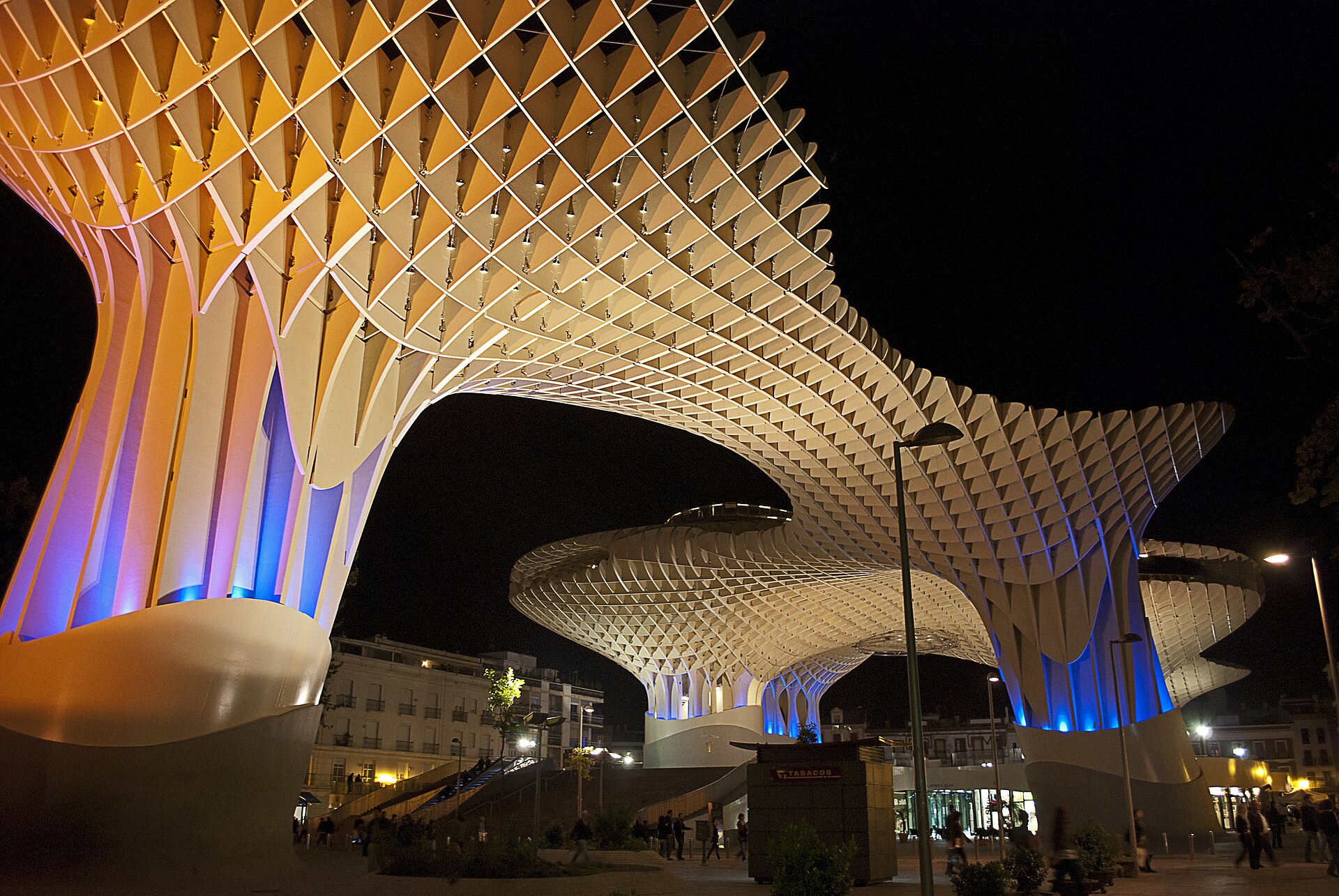
Metropol Parasol, colloquially known as Las Setas de Sevilla (The Mushrooms of Seville), is a massive timber structure located at the Plaza de la Encarnación in the historic center of Seville, Spain. Designed by German architect Jürgen Mayer and completed in 2011, the structure is composed of six parasols in the form of giant mushrooms, rising from a concrete base that houses an archaeological museum.
The complex serves as a multi-functional urban space, integrating a traditional market, restaurants, an open-air performance square, and a rooftop walkway that offers panoramic views of the city. Its design was intended to revitalize the plaza, which had remained largely unused for decades, while creating a contemporary architectural landmark that contrasts with the surrounding medieval urban fabric.
Key Facts
- Materials
- Polyurethane-coated laminated timber, Concrete, Steel
- Civilization
- Contemporary Spanish
- Accessibility
- Fully accessible via elevators to the rooftop
- Date(s)
- 2005-2011
- Condition
- Well-maintained, active public facility
- Original Function
- Urban redevelopment and public space
- Key Figures
- Jürgen Mayer
Urban Redevelopment Competition
2004The city of Seville launched an international competition to revitalize the Plaza de la Encarnación, which had been used as a parking lot and market space for years. The winning design by Jürgen Mayer was selected for its innovative use of wood and its ability to integrate archaeological remains found on the site.
Archaeological Discovery
2005-2007During the initial excavation for an underground parking garage, significant Roman and Moorish ruins were discovered. This necessitated a major redesign of the project, shifting the focus from a parking facility to the Antiquarium museum, which now preserves these findings beneath the structure.
Construction and Completion
2007-2011The construction process faced technical challenges due to the complex geometry of the timber structure. The parasols were assembled using thousands of individual wood panels joined by steel rods and coated in a protective polyurethane finish. The site officially opened to the public in April 2011.
Cultural Significance
Las Setas has become a polarizing yet iconic symbol of modern Seville. While initially criticized by some for its stark contrast to the traditional architecture of the city, it has since become one of the most visited tourist attractions in the region. It represents a successful attempt to blend contemporary design with the preservation of historical layers, effectively activating a previously dormant urban space.
The structure serves as a hub for local social life, hosting markets and cultural events, and has fundamentally altered the pedestrian flow of the city center. It is frequently cited in architectural discourse as a prime example of 'urban acupuncture'—the use of small-scale interventions to trigger larger urban regeneration.
Interpretive Notes
Scholarly debates and areas of uncertainty
Debate persists regarding the long-term maintenance of the timber structure in the extreme heat of Seville, as well as the aesthetic impact of such a large-scale contemporary intervention within a historic district. Some critics argue the structure overshadows the surrounding heritage, while proponents highlight the successful integration of the Antiquarium and the economic revitalization of the neighborhood.
Visiting Information
Entry Rules
The plaza and market level are open to the public. Access to the rooftop walkway and the panoramic viewpoint requires a ticket. The Antiquarium museum has separate entry hours and ticketing.
Best Times to Visit
Sunset is the most popular time to visit the rooftop for views of the city skyline. Weekday mornings are recommended to avoid large crowds on the walkway.
Photography
Personal photography is permitted. Commercial photography or professional filming requires prior authorization from the management.
Preservation Notes
The timber structure is subject to ongoing monitoring and maintenance due to the local climate. Visitors are requested to stay on designated paths on the rooftop terrace.
Nearby POIs
11 shown- Lebrija Palace0.2 km
- Palacio de las Duenas0.3 km
- Iglesia del Salvador0.3 km
- Casa de Pilatos0.5 km
- Museo de Bellas Artes de Sevilla0.7 km
- Catedral de Sevilla0.8 km
- Archivo General de Indias0.9 km
- Royal Alcazar of Seville1.1 km
- Torre del Oro1.3 km
- Real Fabrica de Tabacos1.3 km
- Archeological Museum of Seville2.5 km
Sources & Further Reading
- [1]
- [2]Seville's Metropol Parasol: A Case Study in Urban Regeneration — Maria Gonzalez. Journal of Urban Design (2015)
Key Facts
- Materials
- Polyurethane-coated laminated timber, Concrete, Steel
- Civilization
- Contemporary Spanish
- Accessibility
- Fully accessible via elevators to the rooftop
- Date(s)
- 2005-2011
- Condition
- Well-maintained, active public facility
- Original Function
- Urban redevelopment and public space
- Key Figures
- Jürgen Mayer
Nearby POIs
11 shown- Lebrija Palace0.2 km
- Palacio de las Duenas0.3 km
- Iglesia del Salvador0.3 km
- Casa de Pilatos0.5 km
- Museo de Bellas Artes de Sevilla0.7 km
- Catedral de Sevilla0.8 km
- Archivo General de Indias0.9 km
- Royal Alcazar of Seville1.1 km
- Torre del Oro1.3 km
- Real Fabrica de Tabacos1.3 km
- Archeological Museum of Seville2.5 km