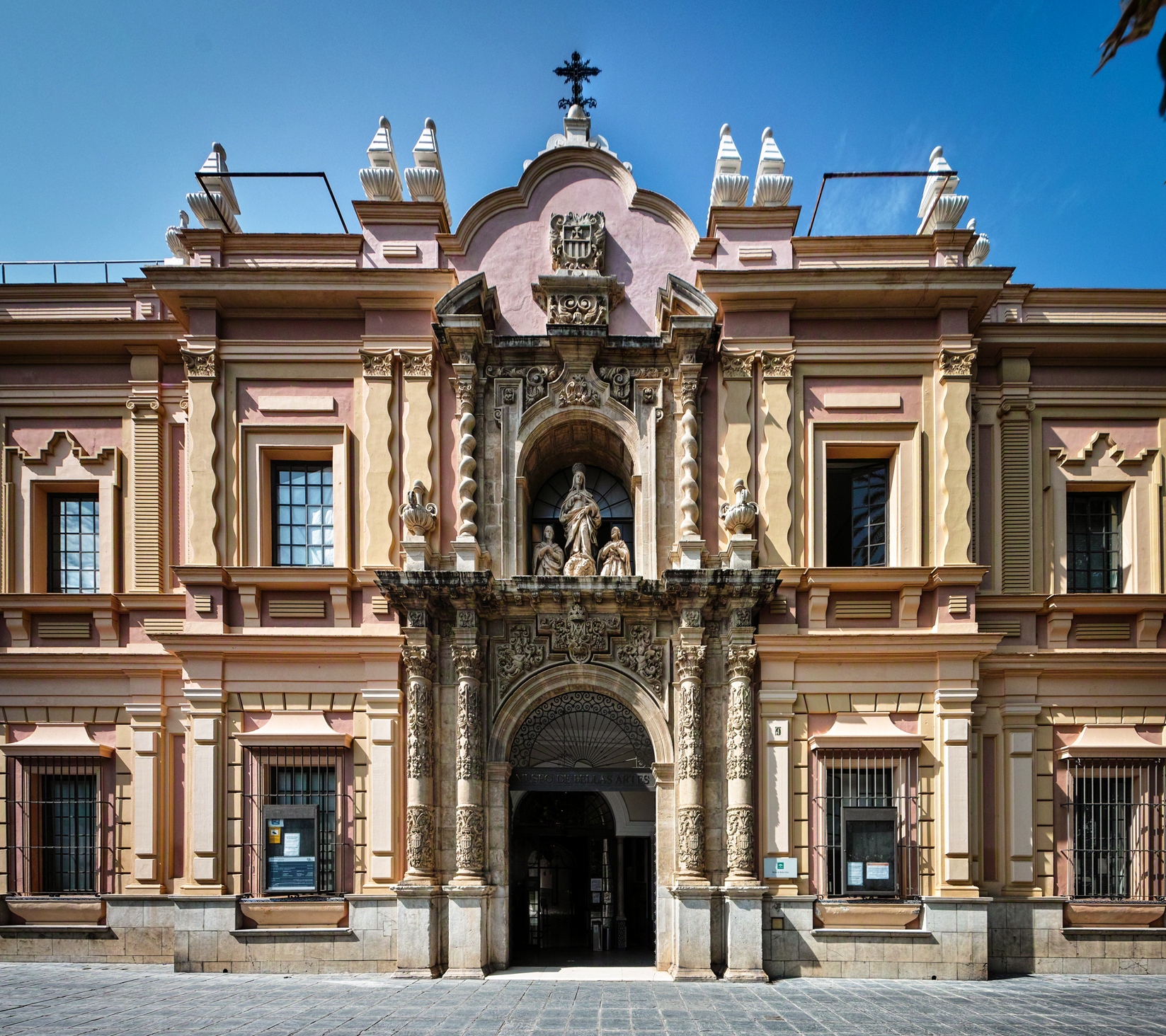
The Museum of Fine Arts of Seville is one of Spain's most significant art galleries, housed within the former Convent of La Merced Calzada. The building itself is a notable example of Sevillian architecture, featuring a series of courtyards and a church that date back to the 17th century, which were adapted for museum use following the ecclesiastical confiscations of the 19th century.
The collection focuses primarily on Spanish visual arts, with a particular emphasis on the Golden Age of Sevillian painting. It holds an extensive array of works by masters such as Bartolomé Esteban Murillo, Francisco de Zurbarán, and Juan de Valdés Leal, alongside significant pieces from the medieval period through the early 20th century.
Key Facts
- Materials
- Brick, Stone, Ceramic tile
- Civilization
- Spanish
- Accessibility
- Wheelchair accessible
- Date(s)
- 1603-1612 (Convent), 1841 (Museum establishment)
- Condition
- Well-preserved and active museum
- Original Function
- Convent of La Merced Calzada
- Key Figures
- Bartolomé Esteban Murillo, Francisco de Zurbarán, Juan de Valdés Leal
Monastic Origins
17th CenturyThe site was originally established as the Convent of the Mercedarians. The church and the main cloister were constructed in the early 1600s, serving as a center for the Mercedarian order until the mid-19th century.
Establishment of the Museum
1835-1841Following the Mendizábal confiscations, which dissolved many religious orders in Spain, the convent was secularized. The museum was officially founded in 1835 to house artworks salvaged from suppressed convents and monasteries in the region, opening to the public in 1841.
Expansion and Modernization
20th Century - PresentThroughout the 20th century, the museum underwent several renovations to better accommodate its growing collection and improve visitor facilities. It remains the primary repository for Sevillian art, continuing to serve as a vital cultural institution for the city.
Cultural Significance
The museum is central to the cultural identity of Seville, preserving the visual legacy of the city's most prolific artistic era. It serves as the primary institution for understanding the development of the Sevillian School of painting, which had a profound influence on Spanish Baroque art.
Beyond its permanent collection, the museum acts as a guardian of regional heritage, housing works that were saved from destruction during periods of political and social upheaval in the 19th century. It remains a focal point for academic research into Spanish religious and secular art.
Interpretive Notes
Scholarly debates and areas of uncertainty
Debates often center on the attribution of certain works from the 17th-century Sevillian school, particularly those produced in large workshops where multiple hands were involved. Additionally, there is ongoing scholarly discussion regarding the best methods for the conservation of the museum's large-scale religious canvases, which require specific environmental controls to prevent degradation.
Visiting Information
Entry Rules
Open Tuesday through Sunday. Admission is free for EU citizens and requires a nominal fee for non-EU visitors. Large bags must be stored in lockers. Modest dress is recommended as the building retains its historical character.
Best Times to Visit
Weekday mornings are generally quieter. Avoid weekends and public holidays to ensure a more focused viewing experience of the main galleries.
Photography
Non-commercial photography is permitted without flash or tripods. Video recording is generally prohibited without prior authorization.
Preservation Notes
Do not touch the paintings or frames. Maintain a respectful distance from all artworks. Flash photography is strictly prohibited as it can damage the pigments of older oil paintings.
Nearby POIs
11 shownSources & Further Reading
- [1]The Museum of Fine Arts of Seville — Ignacio Cano Rivero. Editorial Planeta (2005)
- [2]Spanish Art in the 17th Century — Jonathan Brown. Yale University Press (1991)
Key Facts
- Materials
- Brick, Stone, Ceramic tile
- Civilization
- Spanish
- Accessibility
- Wheelchair accessible
- Date(s)
- 1603-1612 (Convent), 1841 (Museum establishment)
- Condition
- Well-preserved and active museum
- Original Function
- Convent of La Merced Calzada
- Key Figures
- Bartolomé Esteban Murillo, Francisco de Zurbarán, Juan de Valdés Leal