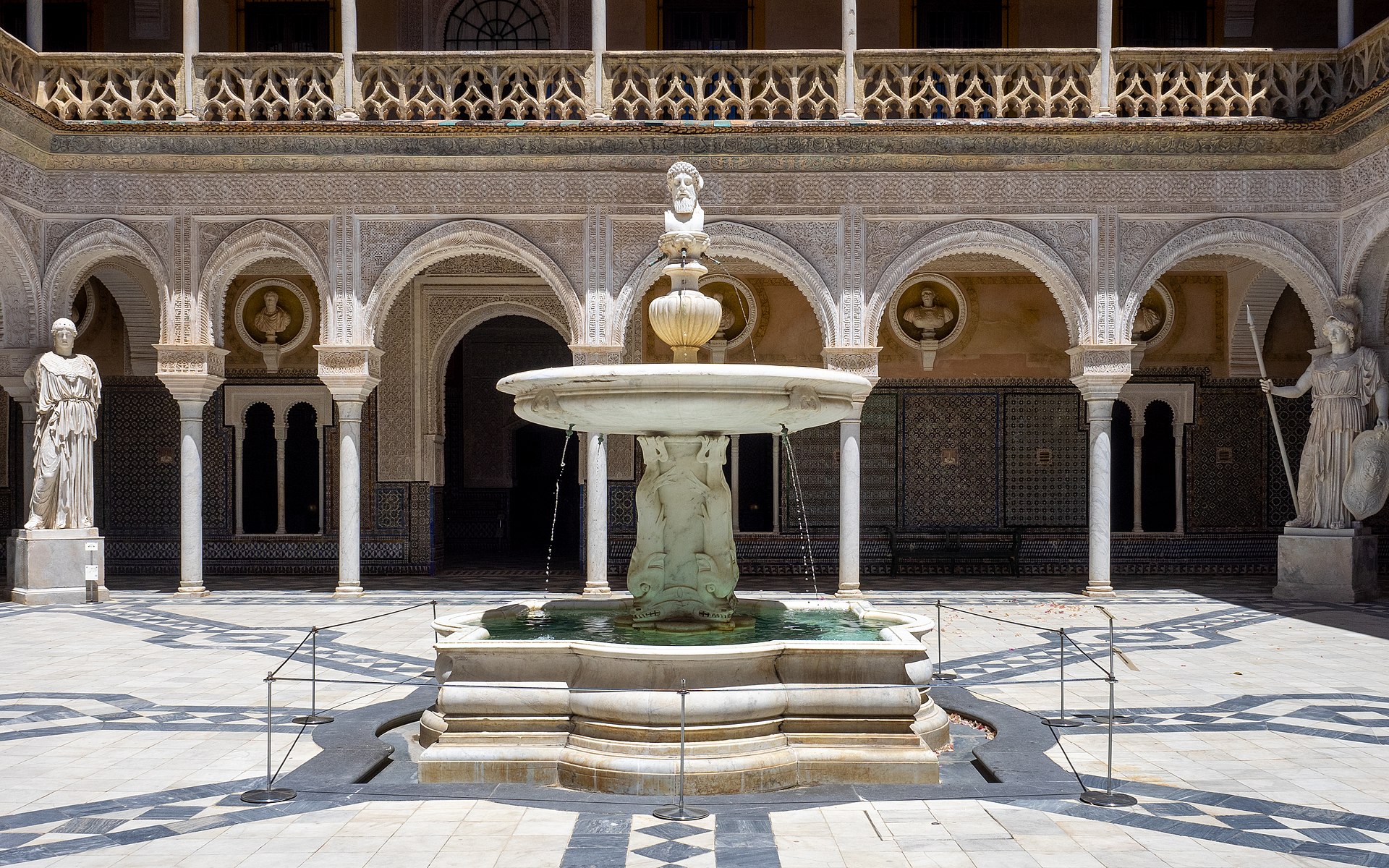
Casa de Pilatos is a 15th-century Andalusian palace located in Seville, Spain, serving as the permanent residence of the Dukes of Medinaceli. It is widely considered the prototype of the Sevillian palace, blending Italian Renaissance architecture with traditional Mudejar decorative elements. The structure is renowned for its extensive collection of azulejos, which are among the most significant and well-preserved examples of early-modern ceramic tile work in the world.
The palace layout centers around a grand main courtyard, or patio, featuring a fountain and a collection of classical Roman statues. The interior spaces are characterized by intricate plasterwork, coffered ceilings, and a series of gardens that reflect the transition between late medieval and early modern aristocratic aesthetics in southern Spain.
Key Facts
- Materials
- Marble, Ceramic tiles (azulejos), Plaster, Wood
- Civilization
- Spanish
- Accessibility
- Ground floor accessible, upper floors restricted
- Date(s)
- 1483 - 1533
- Condition
- Well-preserved, private residence and museum
- Original Function
- Private residence
- Key Figures
- Pedro Enríquez de Quiñones, Fadrique Enríquez de Rivera, Dukes of Medinaceli
Origins and Construction
15th centuryThe palace was initiated by Pedro Enríquez de Quiñones and his wife Catalina de Ribera. Construction began in the late 15th century, establishing the core structure that would eventually evolve into a sprawling aristocratic complex.
Renaissance Expansion
16th centuryFadrique Enríquez de Rivera, upon returning from a pilgrimage to Jerusalem, significantly expanded the palace. He introduced Italian Renaissance architectural features, including the marble gate and the courtyard, blending them with the existing Mudejar style.
Modern Era
19th century - presentThe palace has remained in the hands of the Medinaceli family for centuries. In the modern era, it has been opened to the public as a museum, preserving its extensive art collection and serving as a site for cultural events and film productions.
Cultural Significance
Casa de Pilatos represents the cultural synthesis of the Spanish Renaissance, where the influence of the Italian humanistic movement met the enduring legacy of Islamic-inspired Mudejar craftsmanship. It serves as a vital record of the lifestyle and artistic patronage of the Andalusian nobility during the transition to the early modern period.
Beyond its architectural value, the palace is a repository of historical memory, housing a significant collection of Roman antiquities and early ceramic art. It remains a central landmark in Seville, illustrating the city's historical role as a bridge between European and Mediterranean artistic traditions.
Interpretive Notes
Scholarly debates and areas of uncertainty
There is ongoing scholarly discussion regarding the extent to which the palace's design was intended to replicate the layout of Pontius Pilate's house in Jerusalem, a theory that gave the palace its name. While the connection to the Via Crucis is documented, the degree to which the architectural plan serves as a literal topographical recreation remains a subject of debate among architectural historians.
Visiting Information
Entry Rules
Open daily. Tickets are required for entry, with separate pricing for the ground floor and the full palace tour. Visitors are expected to maintain a quiet demeanor and follow designated paths.
Best Times to Visit
Weekday mornings are recommended to avoid weekend tourist crowds. Spring is ideal for viewing the gardens in bloom.
Photography
Personal photography is permitted for non-commercial use. Flash and tripods are prohibited inside the palace rooms.
Preservation Notes
The azulejo tiles are fragile; visitors must refrain from touching walls or decorative surfaces. Stay within marked areas to protect the historic flooring.
Nearby POIs
11 shown- Iglesia del Salvador0.5 km
- Setas de Sevilla0.5 km
- Palacio de las Duenas0.6 km
- Lebrija Palace0.6 km
- Catedral de Sevilla0.7 km
- Archivo General de Indias0.8 km
- Royal Alcazar of Seville0.8 km
- Real Fabrica de Tabacos1.1 km
- Museo de Bellas Artes de Sevilla1.2 km
- Torre del Oro1.2 km
- Archeological Museum of Seville2.1 km
Sources & Further Reading
- [1]The Casa de Pilatos in Seville — Rafael Manzano Martos. Fundación Casa Ducal de Medinaceli (2005)
- [2]Mudejar Architecture in Andalusia — Antonio Almagro. Journal of Islamic Architecture (2012)
Key Facts
- Materials
- Marble, Ceramic tiles (azulejos), Plaster, Wood
- Civilization
- Spanish
- Accessibility
- Ground floor accessible, upper floors restricted
- Date(s)
- 1483 - 1533
- Condition
- Well-preserved, private residence and museum
- Original Function
- Private residence
- Key Figures
- Pedro Enríquez de Quiñones, Fadrique Enríquez de Rivera, Dukes of Medinaceli
Nearby POIs
11 shown- Iglesia del Salvador0.5 km
- Setas de Sevilla0.5 km
- Palacio de las Duenas0.6 km
- Lebrija Palace0.6 km
- Catedral de Sevilla0.7 km
- Archivo General de Indias0.8 km
- Royal Alcazar of Seville0.8 km
- Real Fabrica de Tabacos1.1 km
- Museo de Bellas Artes de Sevilla1.2 km
- Torre del Oro1.2 km
- Archeological Museum of Seville2.1 km