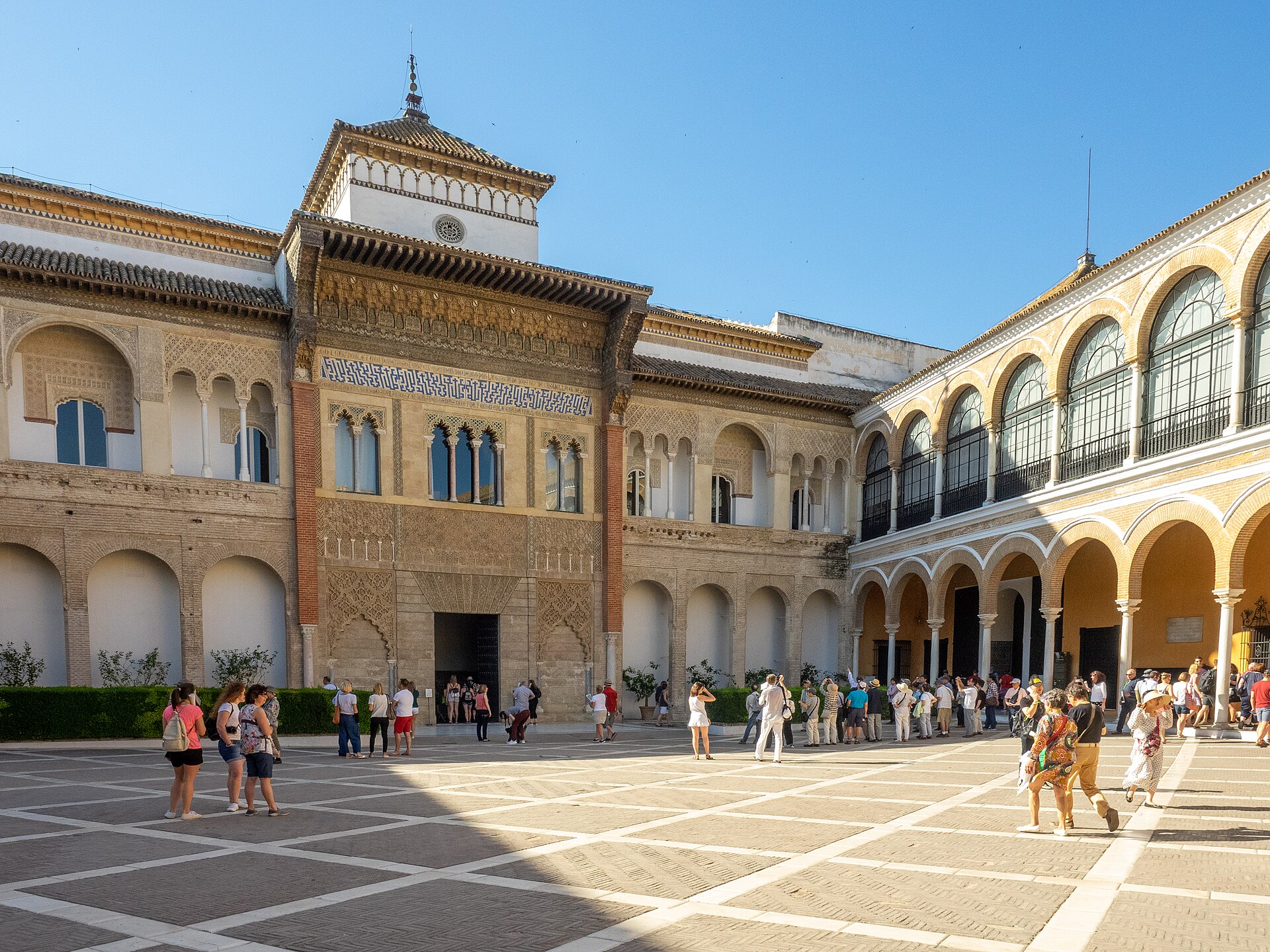
The Royal Alcázar of Seville is a royal palace originally developed by Moorish Muslim kings. It is recognized as the oldest royal palace still in use in Europe and was registered in 1987 by UNESCO as a World Heritage Site. The palace is renowned as one of the most beautiful in Spain, being one of the most outstanding examples of Mudéjar architecture, which combines Islamic design with Christian architectural influences.
The complex has undergone numerous expansions and modifications over the centuries. While the lower levels retain the layout of the original Almohad palace, the upper levels are still used by the Spanish royal family as their official Seville residence. The site is famous for its intricate tile work, ornate plaster carvings, and expansive gardens that blend Renaissance and Romantic styles.
Key Facts
- Materials
- Brick, Ceramic tiles, Plaster, Marble
- Civilization
- Almohad, Castilian, Spanish
- Accessibility
- Partially accessible; some historic areas have stairs
- Date(s)
- 10th century - 16th century
- Condition
- Well-preserved, active royal residence
- Original Function
- Fortress and royal residence
- Key Figures
- Peter I of Castile, Isabella I of Castile, Charles V, Holy Roman Emperor
Almohad Origins
10th - 12th centuryThe site began as a fortress (al-qasr) built by the Almohad Caliphate. The original structure served as the administrative and defensive center for the governor of Seville, establishing the foundational layout that persists in the lower palace levels today.
The Mudéjar Palace of Peter I
14th centuryIn 1364, King Peter I of Castile commissioned the construction of the Palacio de Don Pedro. Utilizing Mudéjar craftsmen, the palace was built to reflect the aesthetic of the previous Islamic rulers, resulting in the iconic Patio de las Doncellas and the ornate facade.
Renaissance and Baroque Expansions
16th - 18th centuryFollowing the Reconquista, the palace was expanded to accommodate the needs of the Spanish monarchy. Significant additions included the Patio de las Muñecas and the integration of Renaissance elements during the reign of Charles V, alongside later Baroque modifications.
Cultural Significance
The Alcázar serves as a physical manifestation of the 'convivencia'—the historical period of coexistence between Christian, Muslim, and Jewish cultures in medieval Spain. Its architecture acts as a bridge between the Islamic past of Al-Andalus and the Christian identity of the Spanish Crown.
Today, it is a cornerstone of Sevillian identity and a major cultural landmark. Its gardens and halls are frequently used for state functions and have become globally recognized through their use as a filming location for major international media productions.
Interpretive Notes
Scholarly debates and areas of uncertainty
Scholars often debate the extent to which the Mudéjar style was a conscious political choice by Christian monarchs to legitimize their rule through the appropriation of Islamic prestige, versus a purely aesthetic preference for the highly skilled labor of local Moorish artisans.
Visiting Information
Entry Rules
Open daily. Tickets should be purchased online in advance due to high demand. Security screening is mandatory at the entrance. Modest dress is recommended, though no strict religious dress code is enforced.
Best Times to Visit
Early morning or late afternoon to avoid peak heat and large tour groups. Spring is ideal for viewing the gardens in bloom.
Photography
Personal photography is permitted throughout the palace and gardens. Tripods and professional equipment require prior authorization.
Preservation Notes
The site is fragile; do not touch the plasterwork or tile surfaces. Stay on marked paths in the gardens to protect the historic vegetation.
Nearby POIs
11 shownSources & Further Reading
- [1]The Alcázar of Seville: A History — Rafael Manzano Martos. Patrimonio Nacional (2002)
- [2]Mudéjar Architecture in Seville — Jerrilynn Dodds. Yale University Press (1992)
Key Facts
- Materials
- Brick, Ceramic tiles, Plaster, Marble
- Civilization
- Almohad, Castilian, Spanish
- Accessibility
- Partially accessible; some historic areas have stairs
- Date(s)
- 10th century - 16th century
- Condition
- Well-preserved, active royal residence
- Original Function
- Fortress and royal residence
- Key Figures
- Peter I of Castile, Isabella I of Castile, Charles V, Holy Roman Emperor