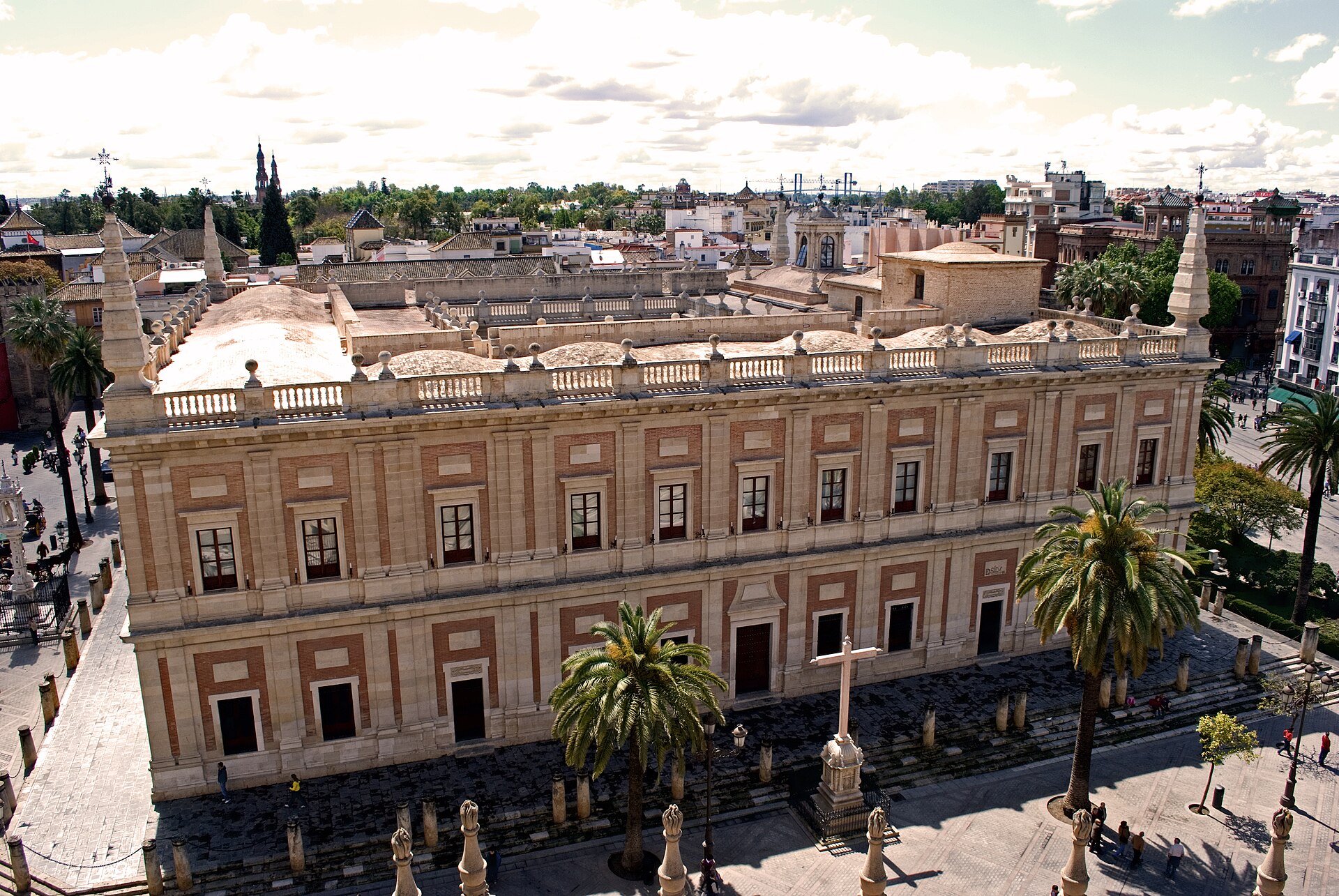
The Archivo General de Indias is housed in the former Casa Lonja de Mercaderes, a building designed by Juan de Herrera and completed in 1598 to serve as the merchant exchange for the city of Seville. Its architecture is a prime example of Spanish Renaissance style, characterized by its austere, balanced proportions and a central courtyard that reflects the wealth and administrative power of the Spanish Empire during the 16th and 17th centuries.
In 1785, King Charles III ordered the creation of the archive to centralize the scattered documentation regarding the Spanish administration of the Americas and the Philippines. Today, it preserves over 43,000 documents, comprising approximately 80 million pages, which serve as the primary historical record for the study of Spanish colonial history, navigation, and global trade.
Key Facts
- Materials
- Stone, Brick, Marble
- Civilization
- Spanish Empire
- Accessibility
- Wheelchair accessible
- Date(s)
- 1584-1598
- Condition
- Well-preserved, active archive and museum
- Original Function
- Merchant Exchange (Casa Lonja)
- Key Figures
- Juan de Herrera, King Charles III, Christopher Columbus
The Casa Lonja
16th CenturyCommissioned by King Philip II, the building was constructed to provide a dedicated space for merchants to conduct business, moving them away from the steps of the Seville Cathedral. Architect Juan de Herrera, also known for the El Escorial monastery, designed the structure with a focus on functional, geometric order.
Establishment of the Archive
1785Under the direction of José de Gálvez, the Minister of the Indies, the building was repurposed to house the vast collection of administrative records previously dispersed across various locations in Spain, including Simancas and Cádiz. This centralization aimed to facilitate historical research and administrative efficiency.
Modern Preservation
1987-PresentThe site was designated a UNESCO World Heritage site in 1987. Ongoing efforts focus on the digitization of the massive collection to ensure long-term preservation while providing global access to researchers and the public.
Cultural Significance
The archive is the most significant repository for the study of the Spanish Empire's global reach. It represents the intersection of European mercantilism and colonial expansion, holding records that detail the social, economic, and political interactions between Spain and the Americas for over three centuries.
Beyond its administrative value, the building itself stands as a symbol of Seville's historical status as the gateway to the New World. It remains a focal point for international scholarship and a testament to the bureaucratic rigor of the Spanish crown.
Interpretive Notes
Scholarly debates and areas of uncertainty
Debates often center on the ethics of colonial record-keeping and the interpretation of the documents within the context of indigenous history. Scholars frequently discuss the 'silences' in the archive, noting that the records primarily reflect the perspective of the Spanish colonial administration rather than the voices of the colonized populations.
Visiting Information
Entry Rules
Open to the public. Entry is free. Visitors must pass through a security checkpoint. Large bags are not permitted in the exhibition areas.
Best Times to Visit
Weekday mornings are generally quieter. Avoid peak tourist seasons in spring and autumn to ensure a more focused experience.
Photography
Personal photography is permitted without flash. Tripods and professional equipment require prior authorization.
Preservation Notes
Maintain a quiet environment. Do not touch the display cases or historical documents. Follow all signage regarding restricted areas.
Nearby POIs
11 shownSources & Further Reading
- [1]Archivo General de Indias: Guía del Investigador — Ministerio de Cultura y Deporte. Gobierno de España (2020)View
- [2]The Spanish Empire: A Historical Perspective — Henry Kamen. Yale University Press (2003)
Key Facts
- Materials
- Stone, Brick, Marble
- Civilization
- Spanish Empire
- Accessibility
- Wheelchair accessible
- Date(s)
- 1584-1598
- Condition
- Well-preserved, active archive and museum
- Original Function
- Merchant Exchange (Casa Lonja)
- Key Figures
- Juan de Herrera, King Charles III, Christopher Columbus