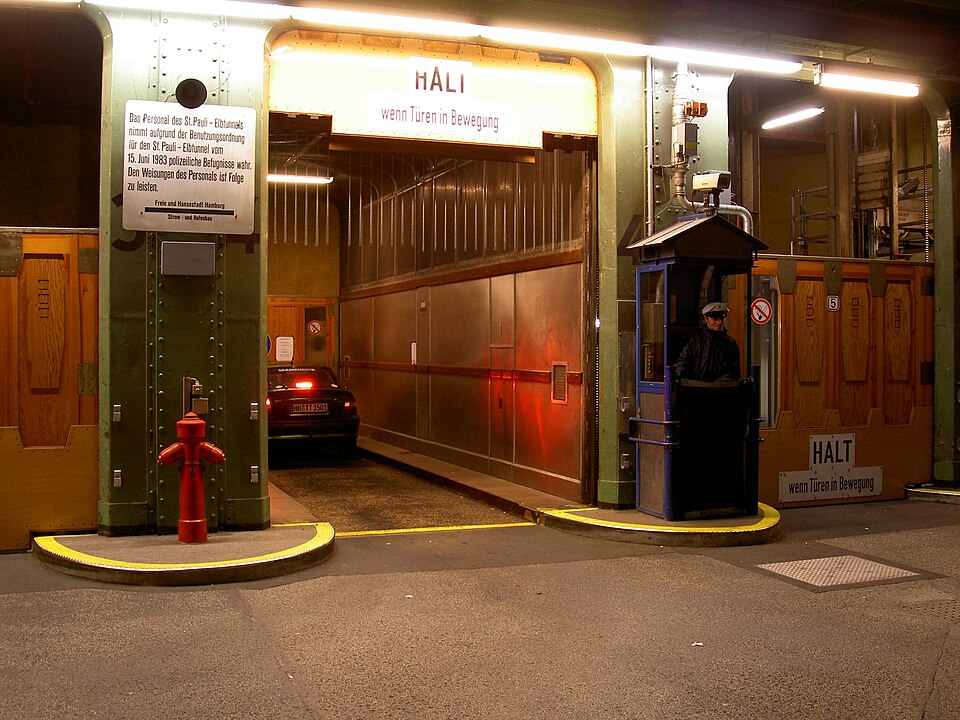
The St. Pauli Elbtunnel, officially known as the Alter Elbtunnel, is a historic river tunnel in Hamburg, Germany, that connects the St. Pauli district with the Steinwerder industrial area. Opened in 1911, the tunnel was a pioneering feat of engineering, designed to provide a direct route for dock workers to reach the shipyards on the south bank of the Elbe River without relying on ferry services.
The structure consists of two parallel tunnels, each 426 meters long, situated 24 meters below the water level. The interior is lined with decorative ceramic tiles and features ornate relief work depicting marine life and local history. Today, the tunnel serves as a pedestrian and cyclist thoroughfare and remains a protected historic monument, retaining its original large-scale mechanical lifts that once transported vehicles between the street level and the tunnel floor.
Key Facts
- Materials
- Steel, Concrete, Ceramic tiles
- Civilization
- German Empire
- Accessibility
- Accessible via historic elevators
- Date(s)
- 1907-1911
- Condition
- Fully operational and preserved as a historic monument
- Original Function
- Pedestrian and vehicular river crossing
- Key Figures
- Otto von Wesendonk
Planning and Construction
1907-1911Designed by Otto von Wesendonk, the tunnel was constructed using the compressed air method, a hazardous technique that required workers to operate in high-pressure environments. It was inaugurated on September 7, 1911, as a vital link for the city's expanding port infrastructure.
Operational History
1911-1975For decades, the tunnel served as a primary route for thousands of shipyard workers. It was also one of the few ways for vehicles to cross the Elbe before the construction of the modern Elbe Tunnel (A7) in 1975, which significantly reduced the older tunnel's vehicular traffic.
Preservation and Modern Use
1975-PresentFollowing the opening of the new tunnel, the St. Pauli Elbtunnel was designated a protected monument. Extensive restoration work was completed in the early 21st century to preserve the original tile work and mechanical lift systems, ensuring its continued use as a pedestrian and cycling landmark.
Cultural Significance
The St. Pauli Elbtunnel is a symbol of Hamburg's maritime identity and industrial heritage. It represents the city's historical reliance on the Elbe River and the ingenuity of early 20th-century German engineering. It is deeply embedded in the local culture of St. Pauli, serving as both a functional transit point and a popular destination for tourists and residents alike.
Interpretive Notes
Scholarly debates and areas of uncertainty
There is ongoing discussion regarding the long-term maintenance of the original mechanical lift systems. While they are essential to the site's historical integrity, their age and the difficulty of sourcing replacement parts for such specialized machinery present significant logistical challenges for the city's preservation authorities.
Visiting Information
Entry Rules
Open 24 hours a day for pedestrians and cyclists. Entry is free of charge. Motor vehicles are generally prohibited from using the tunnel except during special events or specific maintenance windows.
Best Times to Visit
Early mornings or weekdays to avoid heavy weekend foot traffic. The tunnel is particularly atmospheric during the evening hours when the historic lighting is active.
Photography
Personal photography is permitted. Commercial photography or filming requires a permit from the Hamburg Port Authority.
Preservation Notes
The tunnel is a protected monument. Visitors are strictly prohibited from touching the historic ceramic tiles or interfering with the mechanical lift operations. Stay within marked pedestrian lanes.
Nearby POIs
11 shown- Rickmer Rickmers0.5 km
- Museum of Hamburg History0.7 km
- Soviet submarine B-5150.8 km
- Hauptkirche St. Michaelis0.9 km
- Miniatur Wunderland1.5 km
- St. Nikolai Kirche1.6 km
- Hamburg City Hall1.8 km
- Internationales Maritimes Museum Hamburg2.2 km
- Hamburger Kunsthalle2.6 km
- Deichtorhallen2.7 km
- Museum of Art and Design Hamburg2.9 km
Sources & Further Reading
- [1]Der Alte Elbtunnel: Ein technisches Denkmal — Hamburg Port Authority. HPA Historical Archives (2018)View
- [2]Engineering the Elbe: The 1911 Tunnel — Schmidt, H.. Journal of German Industrial History (2012)
Key Facts
- Materials
- Steel, Concrete, Ceramic tiles
- Civilization
- German Empire
- Accessibility
- Accessible via historic elevators
- Date(s)
- 1907-1911
- Condition
- Fully operational and preserved as a historic monument
- Original Function
- Pedestrian and vehicular river crossing
- Key Figures
- Otto von Wesendonk
Nearby POIs
11 shown- Rickmer Rickmers0.5 km
- Museum of Hamburg History0.7 km
- Soviet submarine B-5150.8 km
- Hauptkirche St. Michaelis0.9 km
- Miniatur Wunderland1.5 km
- St. Nikolai Kirche1.6 km
- Hamburg City Hall1.8 km
- Internationales Maritimes Museum Hamburg2.2 km
- Hamburger Kunsthalle2.6 km
- Deichtorhallen2.7 km
- Museum of Art and Design Hamburg2.9 km