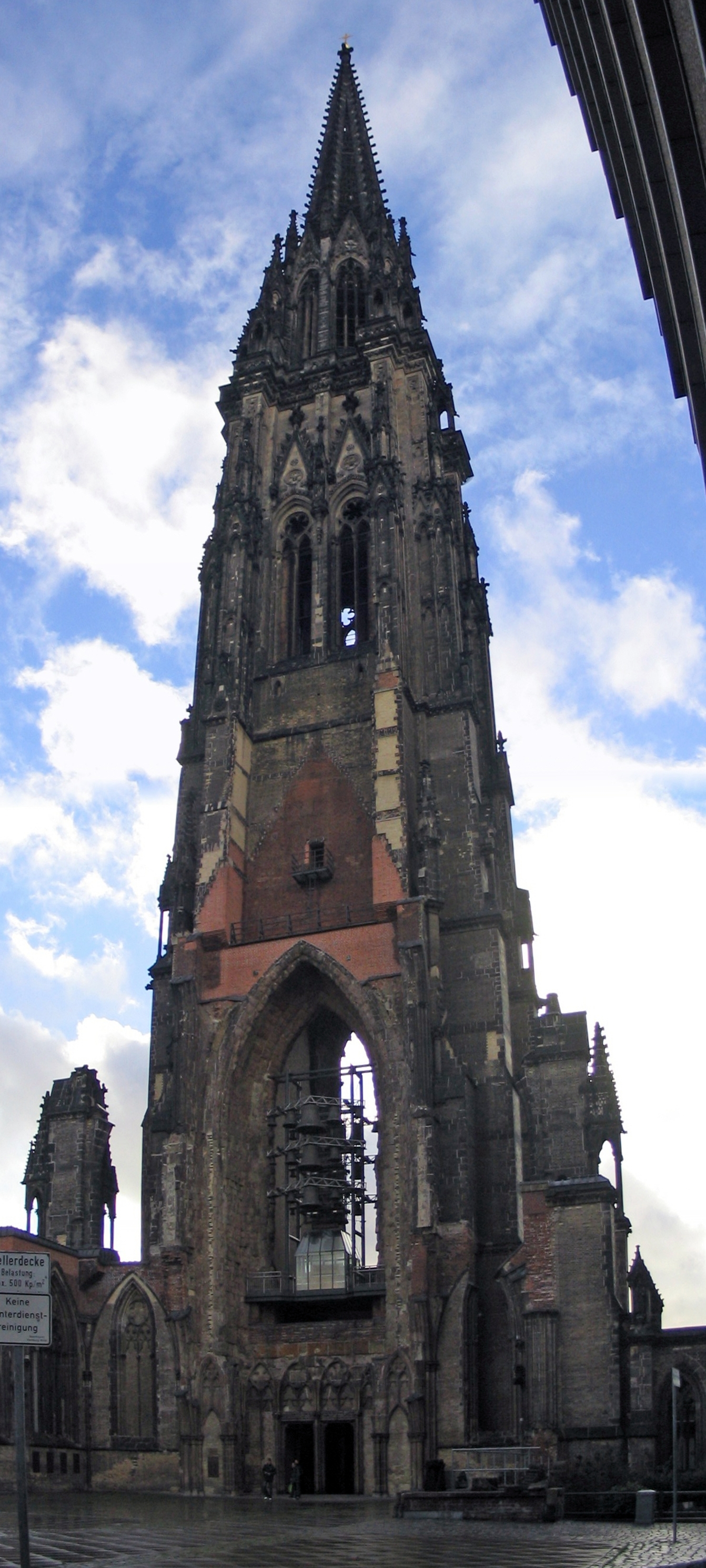
St. Nicholas Church in Hamburg was a monumental Neo-Gothic structure designed by the English architect George Gilbert Scott. Completed in 1874, its 147.3-meter spire briefly held the title of the tallest building in the world. The church served as one of the city's five main Lutheran parish churches for centuries before its destruction during the Allied bombing raids of Operation Gomorrah in July 1943.
Today, the site functions as a memorial and museum dedicated to the victims of war and the history of the church. The remaining ruins, including the spire and portions of the outer walls, serve as a stark reminder of the devastation wrought by World War II, while the crypt houses a permanent exhibition detailing the aerial warfare and the destruction of Hamburg.
Key Facts
- Materials
- Sandstone, Brick
- Civilization
- German
- Accessibility
- Ground level accessible; elevator to observation platform
- Date(s)
- 1846-1874
- Condition
- Ruined, preserved as a memorial
- Original Function
- Parish Church
- Key Figures
- George Gilbert Scott
Early History
12th-19th centuryThe original St. Nicholas Church was a smaller wooden structure built in the 12th century. It was replaced by a brick Gothic building in the 14th century, which was subsequently destroyed in the Great Fire of Hamburg in 1842.
Neo-Gothic Reconstruction
1846-1874Following the fire, a competition was held for a new design. George Gilbert Scott's Neo-Gothic plan was selected. The new church was consecrated in 1863, and the spire was completed in 1874, making it the tallest structure in the world at that time.
Destruction in World War II
1943During the intense Allied bombing raids of Operation Gomorrah in July 1943, the church was severely damaged. The roof collapsed and the nave was largely destroyed, though the spire remained standing.
Memorialization
1950s-presentPost-war plans to rebuild the church were abandoned. The ruins were secured and designated as a memorial. In 2005, an elevator was installed in the spire to provide access to an observation platform, and the crypt was converted into a museum.
Cultural Significance
St. Nicholas Church serves as a central site of remembrance in Hamburg, symbolizing the destruction of the city during World War II. It acts as a bridge between the city's architectural past and its commitment to peace and reconciliation. The site is a focal point for annual commemorations and educational programs regarding the impact of total war on civilian populations.
Interpretive Notes
Scholarly debates and areas of uncertainty
There is ongoing discussion regarding the extent of restoration versus preservation of the ruins. While some argue for further stabilization to prevent decay, others maintain that the current state of the ruins is essential to its function as a 'memento mori' and a testament to the events of 1943.
Visiting Information
Entry Rules
Open daily. Admission fee required for the museum and the elevator to the observation platform. No specific dress code, but respectful behavior is expected as it is a memorial site.
Best Times to Visit
Morning hours are best for visiting the observation platform to avoid afternoon glare and crowds. The site is particularly poignant during the anniversary of the 1943 air raids in late July.
Photography
Personal photography is permitted. Commercial photography requires prior authorization from the memorial administration.
Preservation Notes
The site is an active archaeological and historical ruin. Visitors must stay on designated paths and refrain from touching the fragile sandstone masonry.
Nearby POIs
11 shown- Hamburg City Hall0.3 km
- Miniatur Wunderland0.4 km
- Internationales Maritimes Museum Hamburg0.8 km
- Hauptkirche St. Michaelis0.8 km
- Deichtorhallen1.1 km
- Hamburger Kunsthalle1.2 km
- Rickmer Rickmers1.2 km
- Museum of Hamburg History1.2 km
- Museum of Art and Design Hamburg1.3 km
- St. Pauli Elbtunnel1.6 km
- Soviet submarine B-5152.4 km
Sources & Further Reading
- [1]The Destruction of Hamburg — Martin Middlebrook. Cassell Military Paperbacks (2000)
- [2]St. Nikolai Memorial: History and Documentation — Stiftung St. Nikolai. Hamburg Cultural Heritage Office (2018)
Key Facts
- Materials
- Sandstone, Brick
- Civilization
- German
- Accessibility
- Ground level accessible; elevator to observation platform
- Date(s)
- 1846-1874
- Condition
- Ruined, preserved as a memorial
- Original Function
- Parish Church
- Key Figures
- George Gilbert Scott
Nearby POIs
11 shown- Hamburg City Hall0.3 km
- Miniatur Wunderland0.4 km
- Internationales Maritimes Museum Hamburg0.8 km
- Hauptkirche St. Michaelis0.8 km
- Deichtorhallen1.1 km
- Hamburger Kunsthalle1.2 km
- Rickmer Rickmers1.2 km
- Museum of Hamburg History1.2 km
- Museum of Art and Design Hamburg1.3 km
- St. Pauli Elbtunnel1.6 km
- Soviet submarine B-5152.4 km