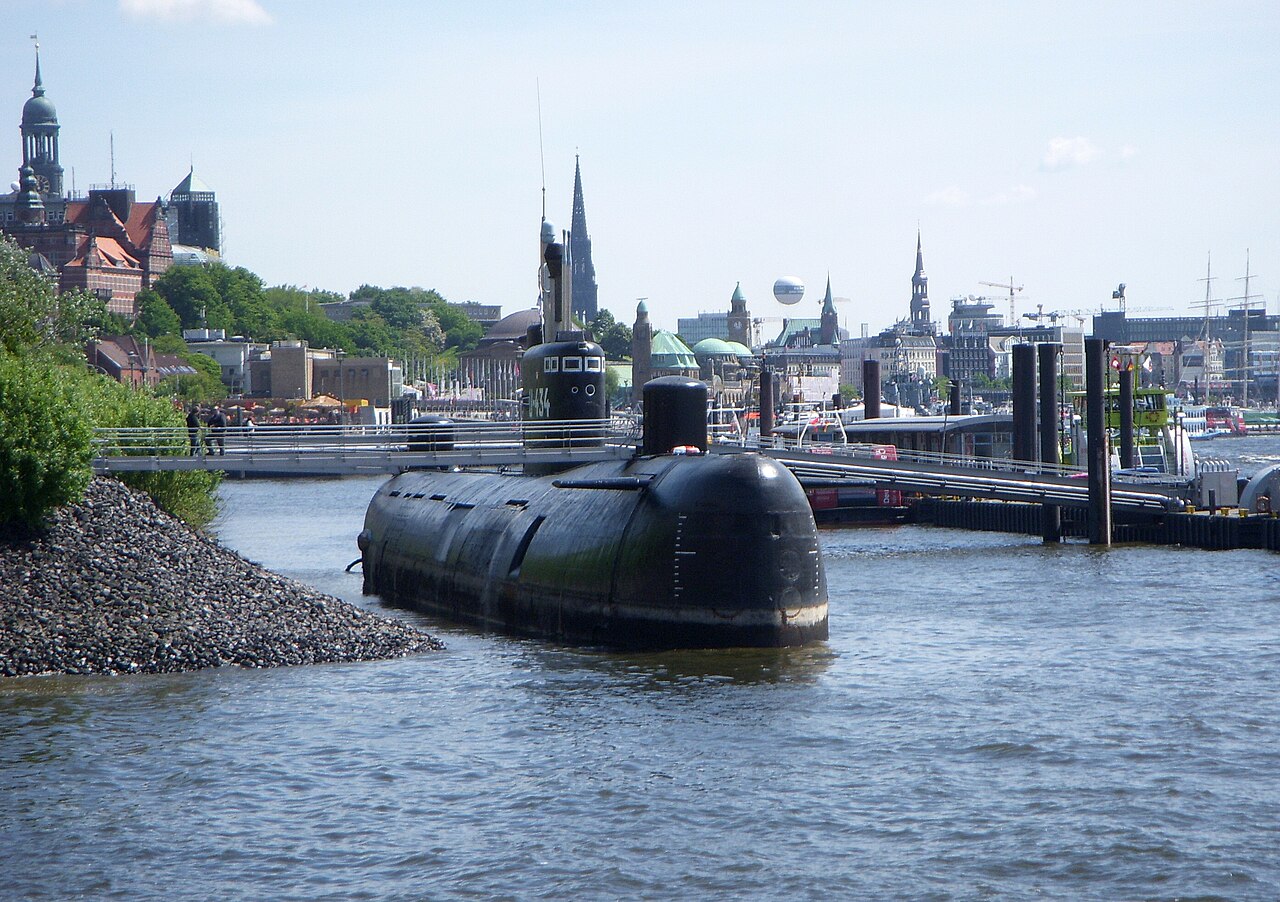
The B-515 is a Project 641B Som-class (NATO reporting name: Tango-class) diesel-electric submarine that served in the Soviet Northern Fleet from 1976 until its decommissioning in 2001. Designed for long-range patrol and anti-submarine warfare, it represents the final generation of Soviet diesel-powered attack submarines before the transition to nuclear-only fleets.
Following its service, the vessel was acquired for exhibition and towed to Hamburg, Germany, where it is permanently moored in the harbor. It serves as a technical memorial, allowing visitors to explore the cramped, highly specialized interior of a Cold War-era naval vessel, highlighting the technological and human conditions of submarine warfare during the late 20th century.
Key Facts
- Materials
- Steel, Lead-acid batteries
- Civilization
- Soviet Union
- Accessibility
- Limited; involves steep ladders and narrow hatches
- Date(s)
- 1976
- Condition
- Museum ship
- Original Function
- Long-range patrol submarine
- Key Figures
- Soviet Northern Fleet
Commissioning and Service
1976-2001The B-515 was built at the Krasnoye Sormovo shipyard in Gorky. As a Tango-class submarine, it featured improved battery capacity and sonar systems compared to its predecessors, enabling longer submerged endurance. It operated primarily in the North Atlantic and Arctic regions as part of the Soviet Northern Fleet.
Decommissioning and Acquisition
2001-2002Following the collapse of the Soviet Union and the subsequent downsizing of the Russian Navy, the B-515 was decommissioned in 2001. It was purchased by a private investor and transported to Hamburg to be repurposed as a floating museum.
Museum Operations
2002-PresentSince 2002, the submarine has been open to the public in Hamburg. It remains one of the few accessible examples of Soviet naval engineering from the late Cold War period, preserved in a configuration that reflects its operational state.
Cultural Significance
The B-515 serves as a tangible artifact of the Cold War, illustrating the intense naval competition between the Soviet Union and NATO. It provides a rare perspective on the daily lives of Soviet submariners, who operated in extreme isolation and high-pressure environments. Its presence in Hamburg acts as a bridge between the former Eastern Bloc military history and contemporary European maritime tourism.
Interpretive Notes
Scholarly debates and areas of uncertainty
There is ongoing discussion regarding the long-term preservation of steel-hulled museum submarines, as the corrosive environment of the harbor poses significant challenges to the structural integrity of the vessel compared to land-based exhibits.
Visiting Information
Entry Rules
Open daily. Tickets can be purchased at the pier. Due to the original design of the submarine, the interior is not wheelchair accessible and requires physical agility to navigate through hatches.
Best Times to Visit
Weekdays during the off-season to avoid large tour groups, as the narrow corridors become congested quickly.
Photography
Personal photography is permitted throughout the vessel. Tripods are generally prohibited due to limited space.
Preservation Notes
Visitors are requested to refrain from touching sensitive instrumentation and to follow the marked path to ensure the safety of both the visitor and the historical equipment.
Nearby POIs
11 shown- St. Pauli Elbtunnel0.8 km
- Rickmer Rickmers1.2 km
- Museum of Hamburg History1.4 km
- Hauptkirche St. Michaelis1.6 km
- Miniatur Wunderland2.2 km
- St. Nikolai Kirche2.4 km
- Hamburg City Hall2.6 km
- Internationales Maritimes Museum Hamburg3 km
- Hamburger Kunsthalle3.4 km
- Deichtorhallen3.4 km
- Museum of Art and Design Hamburg3.7 km
Sources & Further Reading
- [1]Soviet Submarines: 1945 to the Present — John Jordan. Arms and Armour Press (1996)
- [2]The Tango Class Submarines — Norman Polmar. Naval Institute Press (2003)
Key Facts
- Materials
- Steel, Lead-acid batteries
- Civilization
- Soviet Union
- Accessibility
- Limited; involves steep ladders and narrow hatches
- Date(s)
- 1976
- Condition
- Museum ship
- Original Function
- Long-range patrol submarine
- Key Figures
- Soviet Northern Fleet
Nearby POIs
11 shown- St. Pauli Elbtunnel0.8 km
- Rickmer Rickmers1.2 km
- Museum of Hamburg History1.4 km
- Hauptkirche St. Michaelis1.6 km
- Miniatur Wunderland2.2 km
- St. Nikolai Kirche2.4 km
- Hamburg City Hall2.6 km
- Internationales Maritimes Museum Hamburg3 km
- Hamburger Kunsthalle3.4 km
- Deichtorhallen3.4 km
- Museum of Art and Design Hamburg3.7 km