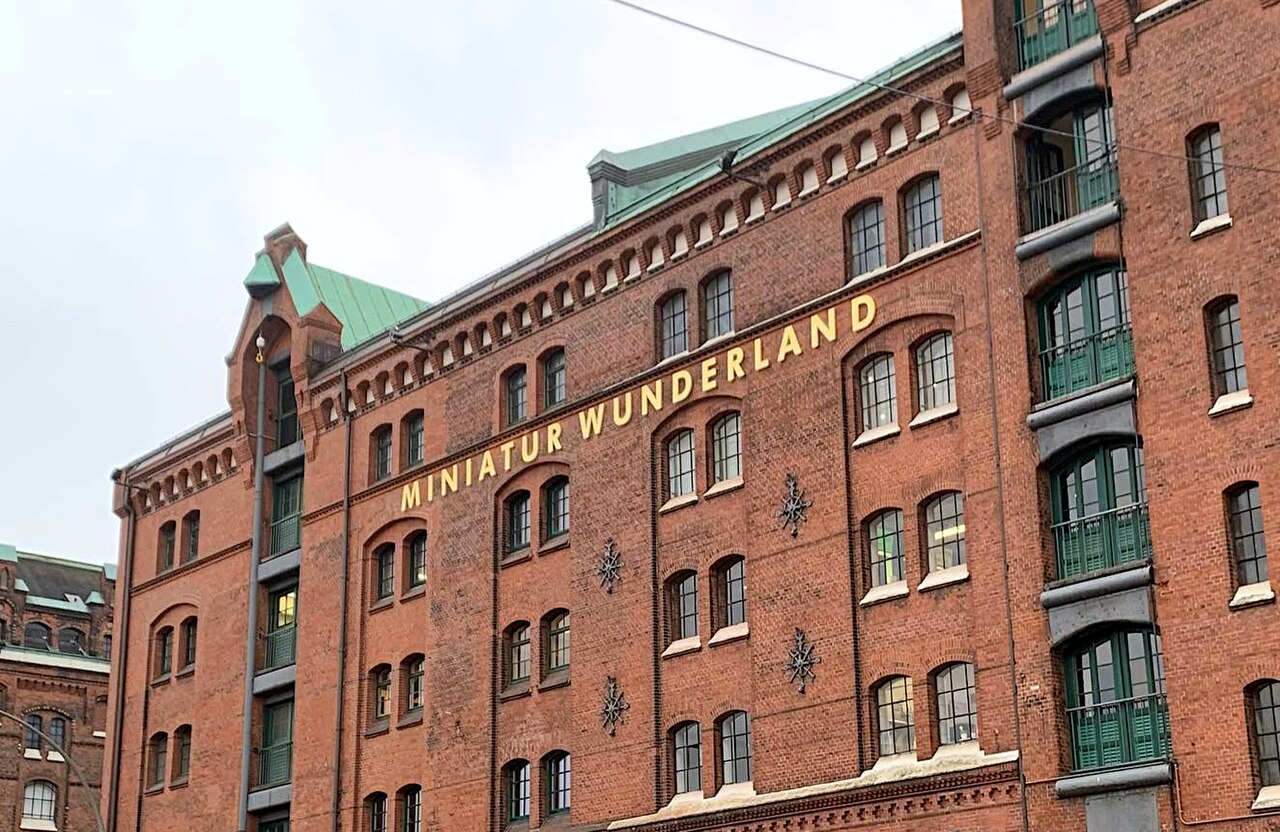
Miniatur Wunderland is the world's largest model railway system, located in the historic Speicherstadt district of Hamburg, Germany. Housed within a converted warehouse, the exhibition features over 16,000 meters of track and thousands of meticulously crafted model trains, vehicles, and buildings that simulate various international regions, including Germany, Scandinavia, Switzerland, and the United States.
The attraction is renowned for its technical complexity and attention to detail, incorporating thousands of automated vehicles, ships, and aircraft. The system operates on a sophisticated computer-controlled network that simulates day-night cycles, weather patterns, and complex logistical operations, drawing millions of visitors annually to experience its immersive, large-scale dioramas.
Key Facts
- Materials
- Wood, Plastic, Metal, Electronic components
- Civilization
- Contemporary German
- Accessibility
- Fully wheelchair accessible
- Date(s)
- 2000 - present
- Condition
- Active, continuously expanding
- Original Function
- Warehouse
- Key Figures
- Frederik Braun, Gerrit Braun, Stephan Hertz
Founding and Early Development
2000-2001The project was initiated by twin brothers Frederik and Gerrit Braun, who sought to build the world's largest model railway. Construction began in December 2000 in the Speicherstadt warehouse complex, with the first three sections—Harz, Knuffingen, and the Austrian Alps—opening to the public in August 2001.
Expansion and Internationalization
2002-2015Following initial success, the exhibition underwent rapid expansion. New sections were added periodically, including Hamburg (2002), America (2003), Scandinavia (2005), Switzerland (2007), and Knuffingen Airport (2011), which features a fully functional model flight system.
Recent Developments
2016-presentThe exhibition continues to grow with the addition of Italy (2016), Venice (2018), and Monaco (2020). Recent efforts have focused on expanding into adjacent warehouse buildings to accommodate new themes, including South America and the Caribbean, while upgrading existing digital control systems.
Cultural Significance
Miniatur Wunderland has become a significant cultural landmark in Hamburg, representing a unique intersection of engineering, art, and popular entertainment. It serves as a major tourist destination that highlights German precision and innovation in the field of model building.
Beyond its role as a museum, the site is recognized for its contribution to the local economy and its status as a global benchmark for large-scale model simulation. It is frequently cited in discussions regarding the preservation of industrial heritage, as its location in the Speicherstadt—a UNESCO World Heritage site—integrates modern technology into a historic architectural framework.
Interpretive Notes
Scholarly debates and areas of uncertainty
Discussions regarding the site often center on the classification of the exhibition: whether it should be viewed primarily as a technical marvel, a work of art, or a form of immersive digital storytelling. Additionally, there is ongoing academic interest in the psychological impact of scale and the 'miniature world' effect on visitor perception.
Visiting Information
Entry Rules
Open daily, including holidays. Tickets should be booked in advance online to guarantee entry, as time slots frequently sell out. Visitors are encouraged to arrive at their designated entry time.
Best Times to Visit
Weekday mornings or late evenings are recommended to avoid peak crowds. The exhibition is open year-round, making it a reliable destination regardless of weather conditions.
Photography
Personal photography is permitted. Tripods and selfie sticks are generally prohibited due to space constraints and visitor safety.
Preservation Notes
Do not touch the models or track components. The exhibition is maintained by a dedicated team of technicians and model builders; visitors are asked to remain on designated paths to ensure the integrity of the delicate dioramas.
Nearby POIs
11 shown- St. Nikolai Kirche0.4 km
- Internationales Maritimes Museum Hamburg0.7 km
- Hamburg City Hall0.8 km
- Hauptkirche St. Michaelis0.8 km
- Rickmer Rickmers1.1 km
- Deichtorhallen1.2 km
- Museum of Hamburg History1.3 km
- St. Pauli Elbtunnel1.5 km
- Hamburger Kunsthalle1.6 km
- Museum of Art and Design Hamburg1.6 km
- Soviet submarine B-5152.2 km
Key Facts
- Materials
- Wood, Plastic, Metal, Electronic components
- Civilization
- Contemporary German
- Accessibility
- Fully wheelchair accessible
- Date(s)
- 2000 - present
- Condition
- Active, continuously expanding
- Original Function
- Warehouse
- Key Figures
- Frederik Braun, Gerrit Braun, Stephan Hertz
Nearby POIs
11 shown- St. Nikolai Kirche0.4 km
- Internationales Maritimes Museum Hamburg0.7 km
- Hamburg City Hall0.8 km
- Hauptkirche St. Michaelis0.8 km
- Rickmer Rickmers1.1 km
- Deichtorhallen1.2 km
- Museum of Hamburg History1.3 km
- St. Pauli Elbtunnel1.5 km
- Hamburger Kunsthalle1.6 km
- Museum of Art and Design Hamburg1.6 km
- Soviet submarine B-5152.2 km