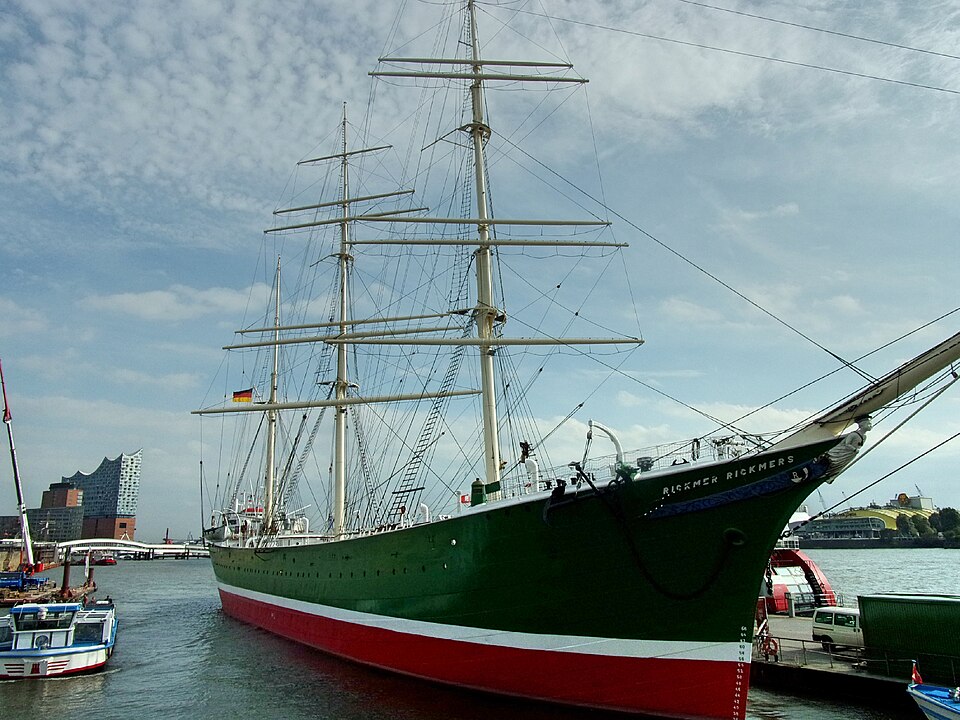
The Rickmer Rickmers is a three-masted steel-hulled barque launched in 1896 in Bremerhaven, Germany. Originally built for the Rickmers shipping company, the vessel was designed for the long-haul transport of rice and jute between Europe and East Asia. Throughout its active service, the ship underwent several name changes and reconfigurations, including a period as a Portuguese naval training vessel named the Flores.
In 1983, the ship was returned to Hamburg and underwent extensive restoration to serve as a floating museum. Permanently moored at the Landungsbrücken, it now functions as a cultural landmark documenting the history of German merchant shipping and the life of sailors during the late 19th and early 20th centuries.
Key Facts
- Materials
- Steel, Wood
- Civilization
- German
- Accessibility
- Limited due to historic ship structure
- Date(s)
- 1896
- Condition
- Restored, active museum ship
- Original Function
- Merchant sailing vessel
- Key Figures
- Rickmer Clasen Rickmers
Construction and Early Service
1896-1912Built by the Rickmers shipyard, the vessel was designed for the demanding trade routes to Hong Kong. It operated primarily as a cargo ship, carrying heavy goods across the globe under the German flag.
Portuguese Service
1912-1962The ship was sold to Portugal, renamed the Flores, and later the Sagres. It served as a naval training vessel for the Portuguese Navy, playing a significant role in maritime education for several decades.
Restoration and Museum Conversion
1983-presentAfter being acquired by the 'Windjammer für Hamburg' association, the ship was returned to its original name and home port. It was restored to its 19th-century appearance and opened to the public as a museum ship, serving as a key attraction in the Port of Hamburg.
Cultural Significance
The Rickmer Rickmers serves as a tangible link to Hamburg's identity as a global port city. It represents the transition from sail to steam in the late 19th century and preserves the technical heritage of steel-hulled merchant barques, which were once the backbone of international trade.
Visiting Information
Entry Rules
Open daily. Tickets can be purchased at the gangway or online. The ship is a historic vessel with steep ladders and narrow passages, which may pose challenges for visitors with limited mobility.
Best Times to Visit
Weekdays during the morning hours to avoid weekend crowds at the Landungsbrücken.
Photography
Personal photography is permitted throughout the museum. Commercial photography requires prior authorization from the museum administration.
Preservation Notes
Visitors are requested to follow marked paths and refrain from touching historical artifacts or sensitive equipment. The ship is subject to ongoing maintenance to protect the steel hull from saltwater corrosion.
Nearby POIs
11 shown- St. Pauli Elbtunnel0.5 km
- Hauptkirche St. Michaelis0.6 km
- Museum of Hamburg History0.7 km
- Miniatur Wunderland1.1 km
- Soviet submarine B-5151.2 km
- St. Nikolai Kirche1.2 km
- Hamburg City Hall1.4 km
- Internationales Maritimes Museum Hamburg1.8 km
- Deichtorhallen2.3 km
- Hamburger Kunsthalle2.3 km
- Museum of Art and Design Hamburg2.5 km
Sources & Further Reading
- [1]Rickmer Rickmers: Die Geschichte eines Windjammers — Jürgen Ruszkowski. Koehler Verlag (1996)
- [2]
Key Facts
- Materials
- Steel, Wood
- Civilization
- German
- Accessibility
- Limited due to historic ship structure
- Date(s)
- 1896
- Condition
- Restored, active museum ship
- Original Function
- Merchant sailing vessel
- Key Figures
- Rickmer Clasen Rickmers
Nearby POIs
11 shown- St. Pauli Elbtunnel0.5 km
- Hauptkirche St. Michaelis0.6 km
- Museum of Hamburg History0.7 km
- Miniatur Wunderland1.1 km
- Soviet submarine B-5151.2 km
- St. Nikolai Kirche1.2 km
- Hamburg City Hall1.4 km
- Internationales Maritimes Museum Hamburg1.8 km
- Deichtorhallen2.3 km
- Hamburger Kunsthalle2.3 km
- Museum of Art and Design Hamburg2.5 km