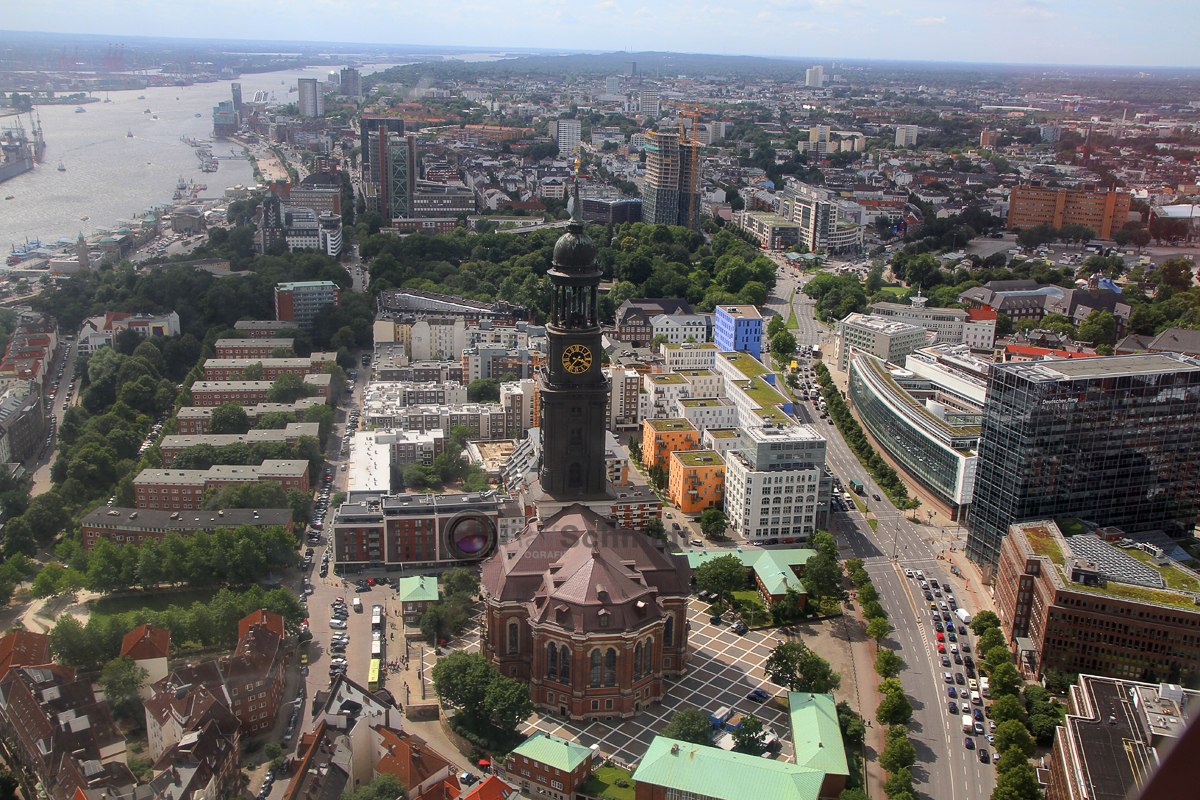
Hauptkirche St. Michaelis, commonly known as 'Michel', is the most famous church in Hamburg and a prominent landmark of the city. The current structure, completed in 1786, is the third iteration of the church on this site, designed by architects Johann Leonhard Prey and Ernst Georg Sonnin. It is celebrated for its massive copper-covered spire, which has served as a navigational aid for ships sailing up the Elbe River for centuries.
The interior is designed in a grand, white-and-gold Baroque style, featuring a capacity of over 2,500 seats. It houses five distinct organs, including a large main organ and a historic Carl Philipp Emanuel Bach memorial organ. The church remains an active place of worship and a central cultural venue for the city of Hamburg.
Key Facts
- Materials
- Brick, Copper, Sandstone
- Civilization
- German
- Accessibility
- Wheelchair accessible via elevator to the crypt and main floor
- Date(s)
- 1750-1786
- Condition
- Well-preserved, active church
- Original Function
- Protestant Church
- Key Figures
- Ernst Georg Sonnin, Carl Philipp Emanuel Bach
Early Foundations
1647-1669The first St. Michaelis church was built as a new parish church for the 'New Town' of Hamburg. It was designed by Peter Marquardt and Christoph Corbinus and consecrated in 1669.
Destruction and Rebuilding
1750-1786The original church was destroyed by lightning in 1750. The current building was constructed shortly thereafter, incorporating advanced engineering for its time, including a spire structure that could withstand high winds.
Fire and Restoration
1906-1912A devastating fire caused by welding work during renovations in 1906 destroyed the church's interior and spire. It was rebuilt to its original design, though the structure was reinforced with steel and concrete.
World War II and Modern Era
1944-presentThe church suffered damage during Allied bombing raids in 1944 and 1945. Extensive repairs were carried out in the post-war decades, and the church continues to undergo periodic conservation to maintain its historic fabric.
Cultural Significance
St. Michaelis is the definitive symbol of Hamburg. Its spire, visible from the harbor, has historically linked the city's religious life with its maritime identity. It serves as a site of civic pride and a major venue for sacred music in Northern Germany.
Interpretive Notes
Scholarly debates and areas of uncertainty
There is ongoing discussion among architectural historians regarding the extent to which the 1912 reconstruction successfully replicated the original 18th-century acoustic properties of the nave, given the introduction of modern structural steel elements.
Visiting Information
Entry Rules
Open daily for visitors. Entry to the church is free, though donations are encouraged. Access to the tower and crypt requires a paid ticket. Modest dress is expected as it is an active place of worship.
Best Times to Visit
Weekday mornings are generally quieter. Visiting during a midday organ concert provides the best experience of the church's acoustic environment.
Photography
Personal photography is permitted without flash. Tripods and professional equipment require prior authorization from the church administration.
Preservation Notes
The copper cladding of the spire requires regular maintenance to prevent corrosion. Visitors are asked to respect the silence during prayer times and avoid touching the historic organ casings.
Nearby POIs
11 shown- Museum of Hamburg History0.5 km
- Rickmer Rickmers0.6 km
- St. Nikolai Kirche0.8 km
- Miniatur Wunderland0.8 km
- St. Pauli Elbtunnel0.9 km
- Hamburg City Hall0.9 km
- Internationales Maritimes Museum Hamburg1.5 km
- Soviet submarine B-5151.6 km
- Hamburger Kunsthalle1.8 km
- Deichtorhallen1.9 km
- Museum of Art and Design Hamburg2 km
Sources & Further Reading
- [1]Die Hamburger Hauptkirche St. Michaelis — Renate Hauschild-Thiessen. Dölling und Galitz (1998)
- [2]St. Michaelis: Geschichte und Architektur — Ernst Georg Sonnin. Hamburg University Press (2012)
Key Facts
- Materials
- Brick, Copper, Sandstone
- Civilization
- German
- Accessibility
- Wheelchair accessible via elevator to the crypt and main floor
- Date(s)
- 1750-1786
- Condition
- Well-preserved, active church
- Original Function
- Protestant Church
- Key Figures
- Ernst Georg Sonnin, Carl Philipp Emanuel Bach
Nearby POIs
11 shown- Museum of Hamburg History0.5 km
- Rickmer Rickmers0.6 km
- St. Nikolai Kirche0.8 km
- Miniatur Wunderland0.8 km
- St. Pauli Elbtunnel0.9 km
- Hamburg City Hall0.9 km
- Internationales Maritimes Museum Hamburg1.5 km
- Soviet submarine B-5151.6 km
- Hamburger Kunsthalle1.8 km
- Deichtorhallen1.9 km
- Museum of Art and Design Hamburg2 km