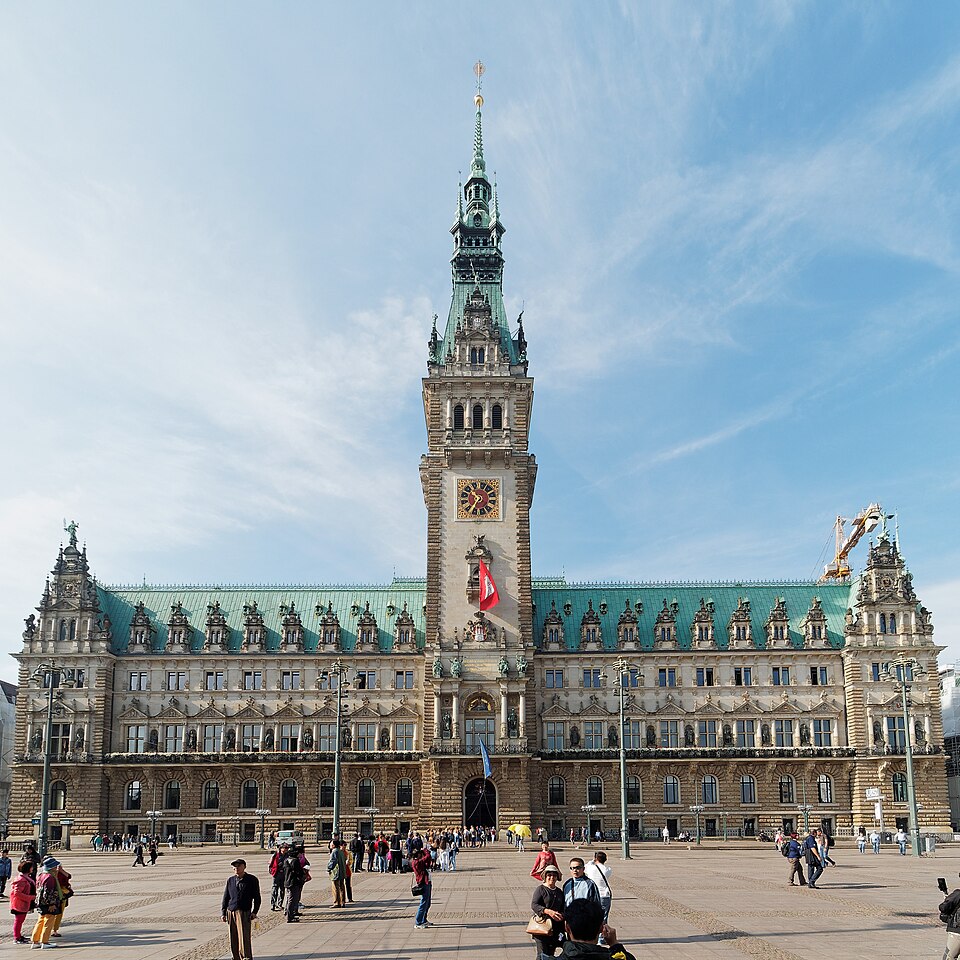
The Hamburg City Hall (Hamburger Rathaus) is the seat of the local government of the Free and Hanseatic City of Hamburg, housing both the Hamburg Parliament and the Senate. Constructed between 1886 and 1897, the building replaced the previous city hall which was destroyed in the Great Fire of 1842. It stands as a prominent example of the Neo-Renaissance architectural style, characterized by its ornate sandstone facade and a 112-meter central tower.
The structure is famously built on a foundation of 4,447 oak piles driven into the marshy ground near the Alster river. Its interior is equally elaborate, featuring a grand staircase, a large ballroom, and numerous representative halls that reflect the wealth and civic pride of Hamburg during the late 19th century.
Key Facts
- Materials
- Sandstone, Oak piles, Granite
- Civilization
- German Empire
- Accessibility
- Wheelchair accessible with elevator access to main halls
- Date(s)
- 1886-1897
- Condition
- Active administrative building
- Original Function
- Seat of government and parliament
- Key Figures
- Martin Haller, Bernhard Hanssen, Emil Meerwein
The Great Fire and Planning
1842-1886Following the destruction of the old city hall in the Great Fire of 1842, the city government operated from various temporary locations for over four decades. An architectural competition was held in 1886 to design a new, permanent seat of power that would reflect Hamburg's status as a major port city.
Construction
1886-1897A group of seven architects led by Martin Haller designed the building. The construction required complex engineering to stabilize the site, resulting in the installation of thousands of wooden piles. The building was officially inaugurated on October 26, 1897.
Modern Era
20th century - presentThe City Hall survived the heavy bombing of Hamburg during World War II with relatively minor damage. It continues to serve as the center of Hamburg's political life, hosting state receptions and parliamentary sessions, while also functioning as a major tourist landmark.
Cultural Significance
The Hamburg City Hall serves as a symbol of the city's independence as a Free and Hanseatic City. Its architecture, which blends various Renaissance influences, was intended to project the city's historical connection to the Hanseatic League and its economic prosperity as a global trading hub.
It remains the focal point of civic life in Hamburg, representing the continuity of democratic governance in the city-state. The building is frequently used for official state visits and public ceremonies, reinforcing its role as the heart of Hamburg's political identity.
Interpretive Notes
Scholarly debates and areas of uncertainty
There is occasional academic discussion regarding the stylistic classification of the building. While primarily categorized as Neo-Renaissance, some architectural historians point to the eclectic integration of Baroque and Gothic elements, debating whether it should be classified as a pure historicist structure or a transitional work of the late 19th century.
Visiting Information
Entry Rules
Open to the public for guided tours and visits to the lobby and exhibition areas. Security screening is required for all visitors. Parliament sessions are open to the public from the gallery, subject to space availability.
Best Times to Visit
Weekday mornings are generally quieter for tours. The building is particularly significant during the annual 'Long Night of Museums' and during official state receptions.
Photography
Photography is permitted in the lobby and public areas. Tripods and professional equipment require prior authorization from the Senate Chancellery.
Preservation Notes
The building is subject to ongoing maintenance due to its foundation on wooden piles, which requires constant monitoring of groundwater levels to prevent decay.
Nearby POIs
11 shown- St. Nikolai Kirche0.3 km
- Miniatur Wunderland0.8 km
- Hamburger Kunsthalle0.9 km
- Internationales Maritimes Museum Hamburg0.9 km
- Hauptkirche St. Michaelis0.9 km
- Deichtorhallen1 km
- Museum of Art and Design Hamburg1.1 km
- Museum of Hamburg History1.3 km
- Rickmer Rickmers1.4 km
- St. Pauli Elbtunnel1.8 km
- Soviet submarine B-5152.6 km
Sources & Further Reading
- [1]Das Hamburger Rathaus — Wilhelm Melhop. Hamburg University Press (1913)
- [2]Architectural History of Hamburg — Hermann Hipp. Dietrich Reimer Verlag (1990)
Key Facts
- Materials
- Sandstone, Oak piles, Granite
- Civilization
- German Empire
- Accessibility
- Wheelchair accessible with elevator access to main halls
- Date(s)
- 1886-1897
- Condition
- Active administrative building
- Original Function
- Seat of government and parliament
- Key Figures
- Martin Haller, Bernhard Hanssen, Emil Meerwein
Nearby POIs
11 shown- St. Nikolai Kirche0.3 km
- Miniatur Wunderland0.8 km
- Hamburger Kunsthalle0.9 km
- Internationales Maritimes Museum Hamburg0.9 km
- Hauptkirche St. Michaelis0.9 km
- Deichtorhallen1 km
- Museum of Art and Design Hamburg1.1 km
- Museum of Hamburg History1.3 km
- Rickmer Rickmers1.4 km
- St. Pauli Elbtunnel1.8 km
- Soviet submarine B-5152.6 km