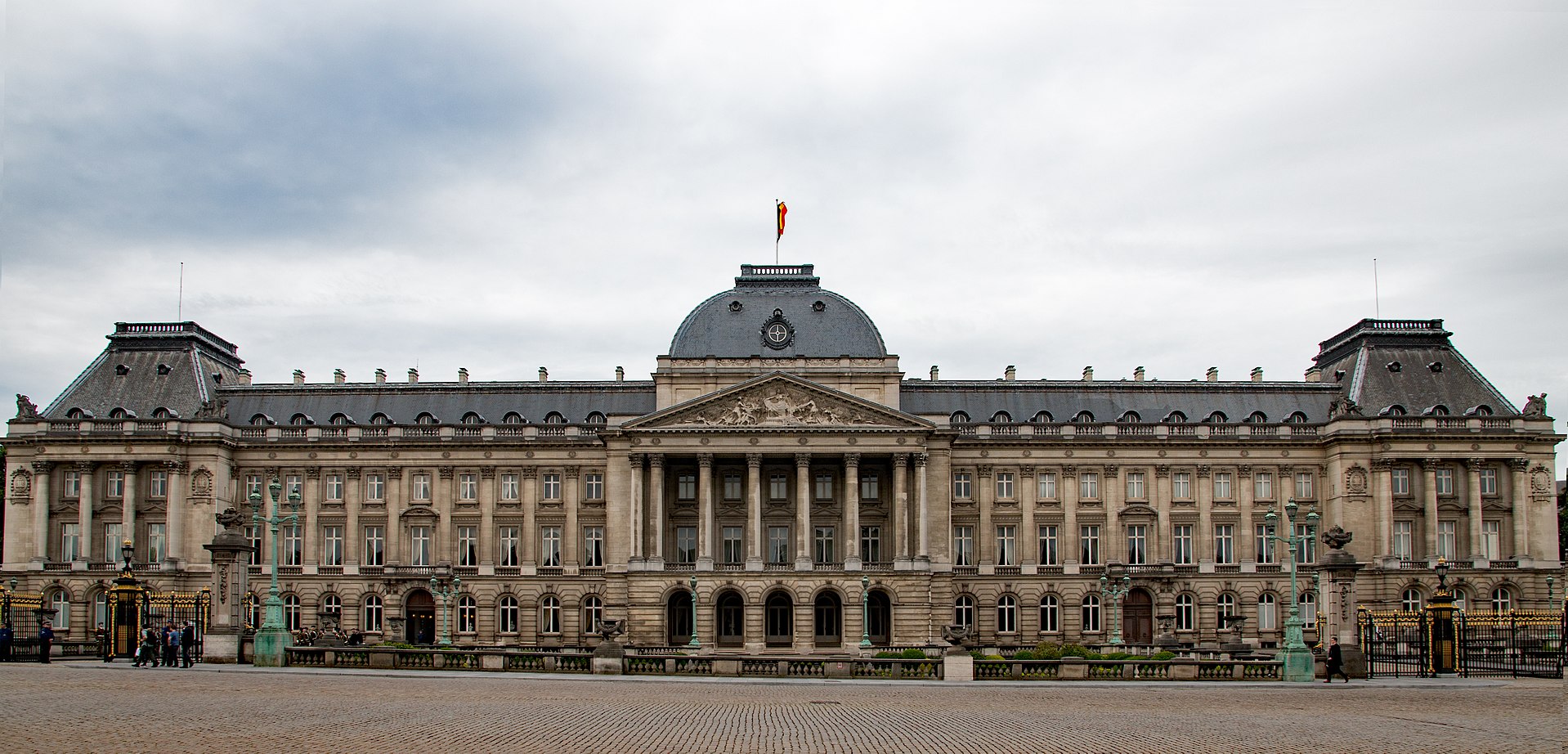
The Royal Palace of Brussels serves as the official administrative residence of the Belgian monarch. While the King and the royal family reside at the Royal Palace of Laeken, the Brussels palace is used for state functions, official receptions, and the daily operations of the royal household. The current structure is primarily the result of extensive renovations and expansions commissioned by King Leopold II in the late 19th and early 20th centuries.
The interior is renowned for its opulent state rooms, including the Throne Room, which features bas-reliefs by Auguste Rodin, and the Hall of Mirrors, famously decorated with 1.6 million jewel beetle wings. The palace stands as a symbol of the Belgian constitutional monarchy and remains a central site for national ceremonies and diplomatic events.
Key Facts
- Materials
- Stone, Marble, Gold leaf, Jewel beetle wings
- Civilization
- Belgian
- Accessibility
- Limited access during summer opening period
- Date(s)
- 1820 - 1934
- Condition
- Well-preserved, active administrative site
- Original Function
- Royal residence and administrative center
- Key Figures
- King Leopold II, Auguste Rodin, Alphonse Balat
Origins and Early Construction
1820-1830The palace was commissioned by King William I of the Netherlands on the site of the former Coudenberg Palace. The initial structure was designed by architect Tilman-François Suys, though it was significantly smaller than the current building.
Leopold II's Expansion
1900-1904King Leopold II oversaw a massive transformation of the palace. He tasked architect Henri Maquet with redesigning the facade and adding new wings, giving the building its current Neoclassical appearance and grand scale.
Modern Era
20th century - presentThe palace continues to function as the administrative heart of the Belgian monarchy. Since 1965, it has been opened to the public during the summer months, typically following the National Day celebrations, allowing visitors to view the state rooms.
Cultural Significance
The Royal Palace is a cornerstone of Belgian national identity, representing the continuity of the constitutional monarchy. It serves as the stage for the most significant events in the country's political life, including the swearing-in of new monarchs and the hosting of foreign heads of state. The palace's unique interior design, particularly the Hall of Mirrors, reflects the artistic ambitions of the Belgian royal court during the turn of the 20th century.
Interpretive Notes
Scholarly debates and areas of uncertainty
Debates often center on the architectural legacy of King Leopold II, whose extensive building projects were funded by the wealth generated from the Congo Free State. Scholars frequently analyze the palace not only as a royal residence but as a physical manifestation of the colonial-era power dynamics and the aesthetic choices of the period.
Visiting Information
Entry Rules
The palace is open to the public annually from late July to early September. Entry is free of charge, but visitors must pass through security screening. No large bags are permitted inside.
Best Times to Visit
Late July to early September, during the annual summer opening period.
Photography
Photography is permitted in most public areas for personal use; flash and tripods are prohibited.
Preservation Notes
Visitors are required to follow marked paths and refrain from touching the historic furnishings and wall decorations.
Nearby POIs
11 shown- Palace of Justice of Brussels0.1 km
- BELvue Museum0.1 km
- Musical Instruments Museum0.2 km
- Royal Museums of Fine Arts of Belgium0.3 km
- Mont des Arts0.4 km
- Church of Our Lady of Victories at the Sablon0.5 km
- Cathedral of St. Michael and St. Gudula0.7 km
- Brussels City Museum0.9 km
- Brussels Town Hall0.9 km
- Choco-Story Brussels1 km
- Belgian Comic Strip Center1 km
Sources & Further Reading
- [1]The Belgian Monarchy: The Royal Palace of Brussels — Belgian Royal Palace Administration. monarchie.be (2023)View
- [2]Brussels: A History of the City — Paul De Ridder. Brussels Heritage Press (2015)
Key Facts
- Materials
- Stone, Marble, Gold leaf, Jewel beetle wings
- Civilization
- Belgian
- Accessibility
- Limited access during summer opening period
- Date(s)
- 1820 - 1934
- Condition
- Well-preserved, active administrative site
- Original Function
- Royal residence and administrative center
- Key Figures
- King Leopold II, Auguste Rodin, Alphonse Balat
Nearby POIs
11 shown- Palace of Justice of Brussels0.1 km
- BELvue Museum0.1 km
- Musical Instruments Museum0.2 km
- Royal Museums of Fine Arts of Belgium0.3 km
- Mont des Arts0.4 km
- Church of Our Lady of Victories at the Sablon0.5 km
- Cathedral of St. Michael and St. Gudula0.7 km
- Brussels City Museum0.9 km
- Brussels Town Hall0.9 km
- Choco-Story Brussels1 km
- Belgian Comic Strip Center1 km