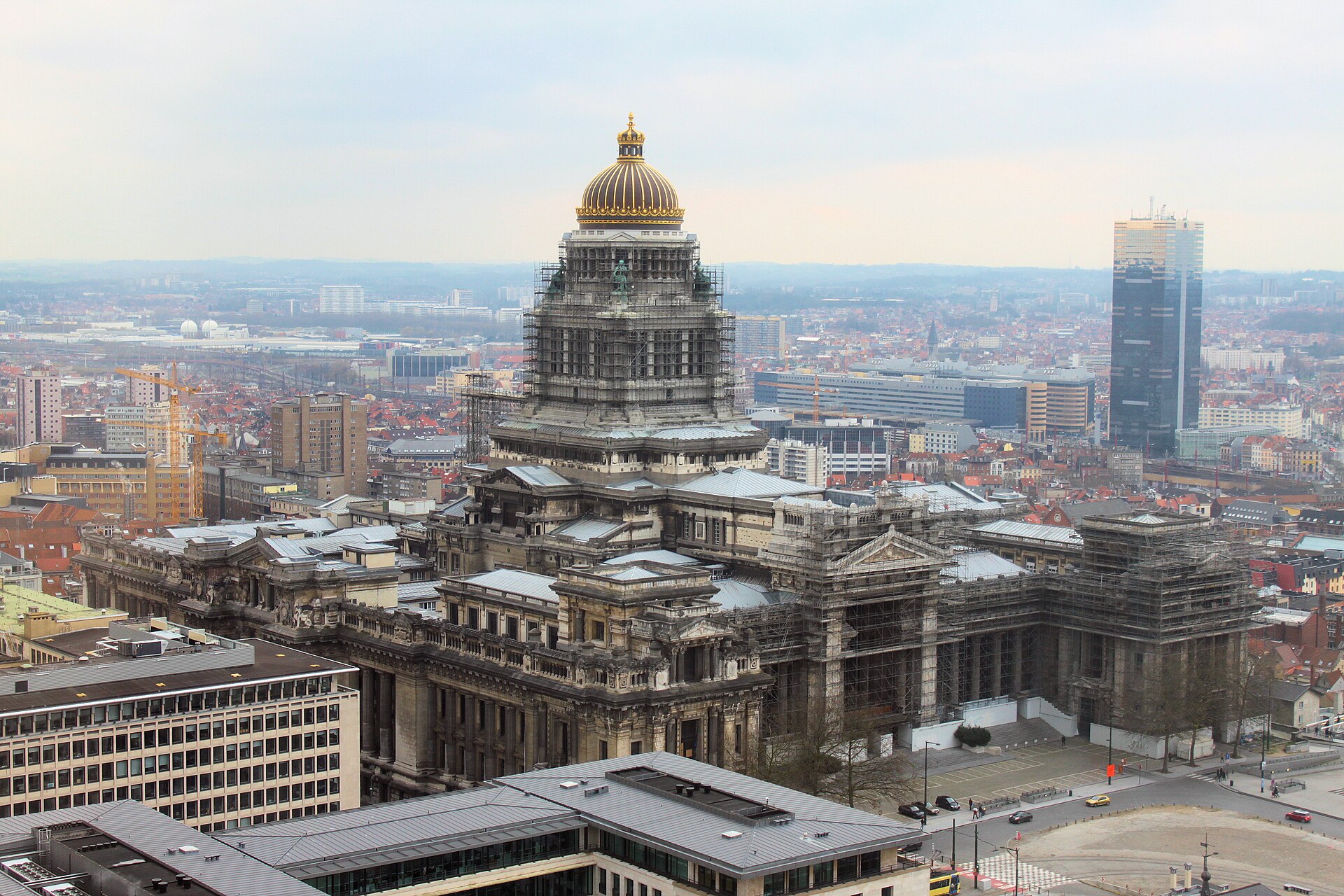
The Palace of Justice of Brussels is a monumental judicial building located on the Place Poelaert in the Marolles district. Designed by architect Joseph Poelaert and constructed between 1866 and 1883, it serves as the headquarters for the Belgian judicial system. The structure is one of the largest courthouses in the world, covering a ground area of 26,000 square meters.
Architecturally, the building is defined by its massive scale and eclectic style, blending elements of Neo-Baroque and Neo-Classical design. It is topped by a prominent 104-meter-high dome that dominates the Brussels skyline. The interior contains 27 large courtrooms and 245 smaller rooms, organized around eight internal courtyards, reflecting the grand ambitions of 19th-century Belgian civic architecture.
Key Facts
- Materials
- Stone, Iron, Concrete
- Civilization
- Belgian
- Accessibility
- Publicly accessible, security screening required
- Date(s)
- 1866-1883
- Condition
- Active, undergoing long-term restoration
- Original Function
- Judicial headquarters
- Key Figures
- Joseph Poelaert, King Leopold II
Conception and Construction
1860-1883Commissioned by the Belgian government to replace the aging Palais de Justice in the city center, the project was awarded to Joseph Poelaert. Construction required the demolition of a significant portion of the Marolles neighborhood, leading to local resentment.
World War II Damage
1944During the liberation of Brussels in September 1944, retreating German forces set fire to the building, causing the collapse of the original dome and significant interior damage. Restoration efforts began shortly after the war.
Modern Preservation
20th century - presentThe building has been under near-constant scaffolding for decades due to structural maintenance needs. It remains the functional center of the Belgian judiciary while serving as a landmark of the Brussels cityscape.
Cultural Significance
The Palace of Justice is a symbol of the Belgian state's authority and the architectural ambition of the late 19th century. Its construction remains a point of historical contention due to the displacement of the Marolles community, which has fostered a unique local identity among residents who refer to themselves as 'Marolliens'.
Interpretive Notes
Scholarly debates and areas of uncertainty
Debates persist regarding the long-term restoration strategy and the building's future utility. Some architectural historians argue for a complete modernization of the interior to meet contemporary legal needs, while others advocate for strict preservation of Poelaert's original design.
Visiting Information
Entry Rules
Open to the public during business hours. Visitors must pass through security checkpoints. Certain courtrooms may be closed to the public during sensitive trials.
Best Times to Visit
Weekday mornings to observe the building in its functional capacity. The Place Poelaert offers panoramic views of the city, which are best viewed at sunset.
Photography
Photography is permitted in public areas and the grand hall. Photography inside active courtrooms is strictly prohibited without authorization.
Preservation Notes
The building is currently undergoing a multi-phase restoration of its facade and structural elements. Visitors should expect scaffolding and restricted access to certain exterior sections.
Nearby POIs
11 shown- BELvue Museum0.1 km
- Musical Instruments Museum0.1 km
- Royal Palace of Brussels0.1 km
- Royal Museums of Fine Arts of Belgium0.2 km
- Mont des Arts0.3 km
- Church of Our Lady of Victories at the Sablon0.4 km
- Cathedral of St. Michael and St. Gudula0.6 km
- Brussels City Museum0.8 km
- Brussels Town Hall0.8 km
- Choco-Story Brussels0.8 km
- Belgian Comic Strip Center1 km
Sources & Further Reading
- [1]Joseph Poelaert et son Palais — Pierre Loze. Archives d'Architecture Moderne (1983)
- [2]The Palace of Justice: A History of Brussels' Landmark — Jean-Marie Duvosquel. Brussels Heritage Press (2010)
Key Facts
- Materials
- Stone, Iron, Concrete
- Civilization
- Belgian
- Accessibility
- Publicly accessible, security screening required
- Date(s)
- 1866-1883
- Condition
- Active, undergoing long-term restoration
- Original Function
- Judicial headquarters
- Key Figures
- Joseph Poelaert, King Leopold II
Nearby POIs
11 shown- BELvue Museum0.1 km
- Musical Instruments Museum0.1 km
- Royal Palace of Brussels0.1 km
- Royal Museums of Fine Arts of Belgium0.2 km
- Mont des Arts0.3 km
- Church of Our Lady of Victories at the Sablon0.4 km
- Cathedral of St. Michael and St. Gudula0.6 km
- Brussels City Museum0.8 km
- Brussels Town Hall0.8 km
- Choco-Story Brussels0.8 km
- Belgian Comic Strip Center1 km