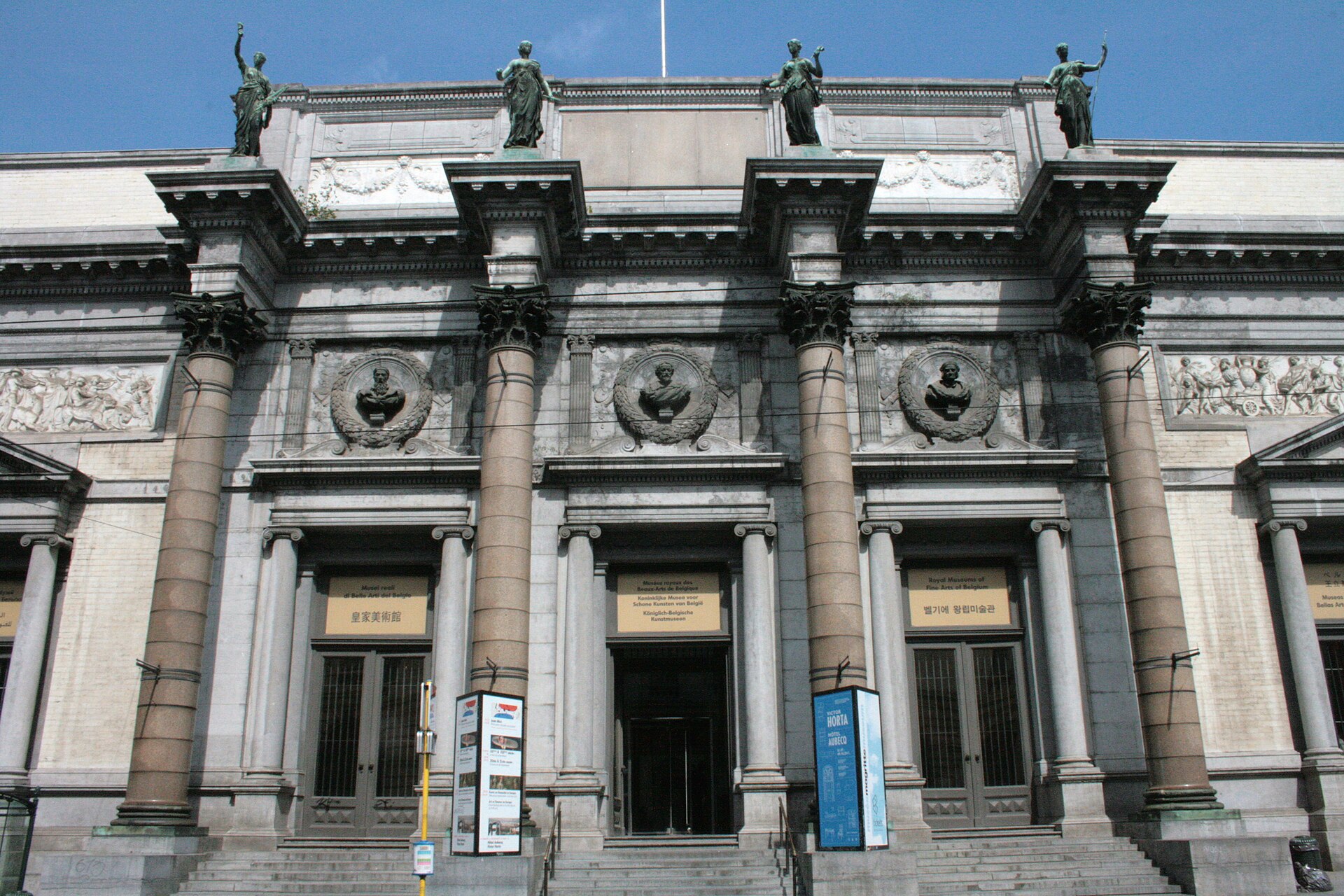
The Royal Museums of Fine Arts of Belgium is a group of six interconnected museums located in the heart of Brussels. Established in 1801 by decree of Napoleon Bonaparte, the institution houses an extensive collection of over 20,000 paintings, sculptures, and drawings spanning from the 15th century to the present day.
The complex includes the Oldmasters Museum, the Magritte Museum, the Fin-de-Siècle Museum, the Modern Museum, the Antoine Wiertz Museum, and the Constantin Meunier Museum. It serves as a primary repository for Flemish and Belgian art, featuring world-renowned works by masters such as Rogier van der Weyden, Peter Paul Rubens, and René Magritte.
Key Facts
- Materials
- Stone, Glass, Steel
- Civilization
- Belgian
- Accessibility
- Fully wheelchair accessible
- Date(s)
- 1887-1894 (Main building)
- Condition
- Well-preserved and active
- Original Function
- Art museum
- Key Figures
- Napoleon Bonaparte, Alphonse Balat, René Magritte
Foundation and Early Years
1801-1830The museum was founded in 1801 following a decree by Napoleon Bonaparte, who sought to centralize art collections in major cities of the French Empire. The initial collection was housed in the former Court of the Governors of the Netherlands.
Expansion and New Building
1887-1894As the collection grew, the need for a dedicated facility became apparent. Architect Alphonse Balat designed the current neoclassical main building, which opened to the public in 1894 to house the growing collection of Old Masters.
Modernization and Specialization
20th-21st CenturyThe institution expanded significantly in the 20th century, incorporating specialized museums such as the Magritte Museum in 2009 and the Fin-de-Siècle Museum in 2013, reflecting a broader commitment to documenting the full spectrum of Belgian visual arts.
Cultural Significance
The museum is the primary cultural institution for the study and preservation of Belgian artistic heritage. It plays a critical role in defining the national identity of Belgium through its focus on the Flemish Primitives and the Surrealist movement, which are central to the country's contribution to global art history.
Beyond its role as a repository, the museum acts as a hub for international research and public education, facilitating dialogue between historical European art and contemporary artistic practices.
Interpretive Notes
Scholarly debates and areas of uncertainty
Debates often center on the attribution of works from the Flemish Primitive period, as technical analysis frequently reveals new information about workshop practices and authorship. Additionally, there is ongoing scholarly discussion regarding the best methods for displaying and contextualizing the diverse collections within the interconnected museum complex.
Visiting Information
Entry Rules
Open Tuesday to Sunday. Tickets are required for entry and can be purchased online or at the box office. Some temporary exhibitions may require separate tickets.
Best Times to Visit
Weekday mornings are generally quieter. The museum is closed on Mondays.
Photography
Non-commercial photography is permitted without flash or tripods in most permanent collection galleries. Specific temporary exhibitions may prohibit photography.
Preservation Notes
Do not touch the artworks. Maintain a respectful distance from all displays. Large bags and backpacks must be stored in lockers.
Nearby POIs
11 shown- Musical Instruments Museum0.1 km
- Palace of Justice of Brussels0.2 km
- BELvue Museum0.2 km
- Church of Our Lady of Victories at the Sablon0.2 km
- Mont des Arts0.3 km
- Royal Palace of Brussels0.3 km
- Cathedral of St. Michael and St. Gudula0.7 km
- Brussels City Museum0.7 km
- Brussels Town Hall0.7 km
- Choco-Story Brussels0.7 km
- Belgian Comic Strip Center1.1 km
Sources & Further Reading
- [1]
- [2]The Flemish Primitives: Catalogue of the Collection — Till-Holger Borchert. Brepols (2005)
Key Facts
- Materials
- Stone, Glass, Steel
- Civilization
- Belgian
- Accessibility
- Fully wheelchair accessible
- Date(s)
- 1887-1894 (Main building)
- Condition
- Well-preserved and active
- Original Function
- Art museum
- Key Figures
- Napoleon Bonaparte, Alphonse Balat, René Magritte
Nearby POIs
11 shown- Musical Instruments Museum0.1 km
- Palace of Justice of Brussels0.2 km
- BELvue Museum0.2 km
- Church of Our Lady of Victories at the Sablon0.2 km
- Mont des Arts0.3 km
- Royal Palace of Brussels0.3 km
- Cathedral of St. Michael and St. Gudula0.7 km
- Brussels City Museum0.7 km
- Brussels Town Hall0.7 km
- Choco-Story Brussels0.7 km
- Belgian Comic Strip Center1.1 km