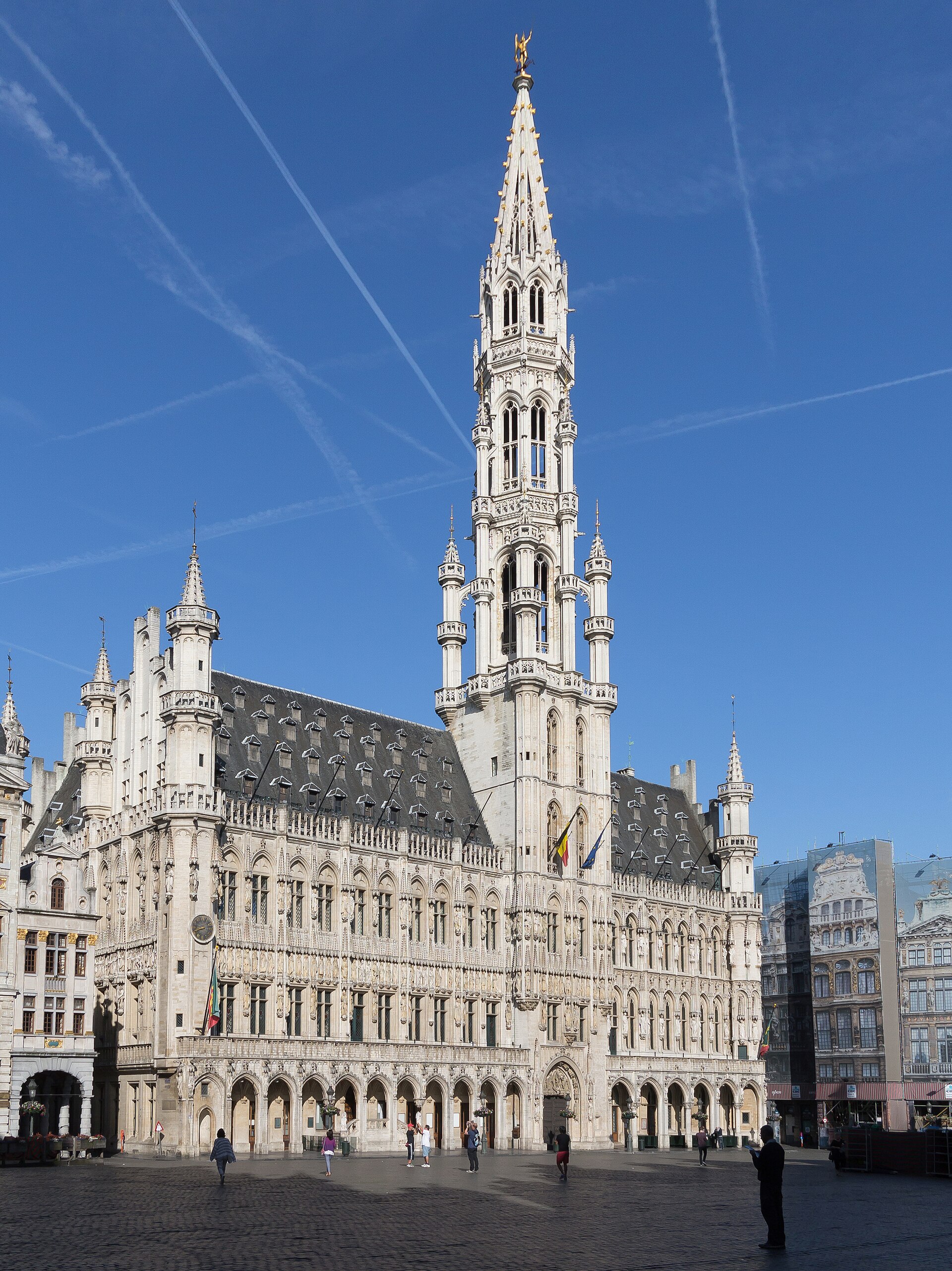
The Brussels Town Hall, located on the Grand Place, is a masterpiece of Brabantine Gothic architecture. The building was constructed in stages during the 15th century, with the east wing and the iconic 96-meter belfry completed first under the direction of Jacob van Thienen and Jan van Ruysbroeck. The tower is crowned by a gilded copper statue of Saint Michael, the patron saint of Brussels, slaying a dragon.
The structure is renowned for its asymmetrical facade, a result of the building's phased construction and the constraints of the surrounding medieval street plan. The interior houses a collection of 16th-century tapestries, ornate wood carvings, and paintings that reflect the city's historical significance as a center of trade and political power within the Burgundian Netherlands.
Key Facts
- Materials
- Sandstone, Copper, Oak
- Civilization
- Brabantine
- Accessibility
- Limited; guided tours only
- Date(s)
- 1401-1455
- Condition
- Well-preserved, active municipal building
- Original Function
- Administrative center of the City of Brussels
- Key Figures
- Jacob van Thienen, Jan van Ruysbroeck, Charles the Bold
Initial Construction
1401-1421The construction of the east wing began in 1401 under the architect Jacob van Thienen. This initial phase established the core administrative functions of the city government.
Tower and Expansion
1444-1455Jan van Ruysbroeck designed and oversaw the construction of the central tower. The tower's completion in 1455 marked the height of the building's Gothic architectural development.
Bombardment of Brussels
1695During the French bombardment of Brussels, the Town Hall was one of the few buildings on the Grand Place to survive the fire, though its interior was severely damaged.
19th Century Restoration
1840-1900The building underwent extensive restoration and decoration, including the addition of numerous statues to the facade to replace those lost or damaged over the centuries.
Cultural Significance
The Brussels Town Hall serves as the primary symbol of the city's civic autonomy and historical wealth. As part of the Grand Place, it represents the intersection of merchant power and political governance in the Low Countries. It remains a focal point for local celebrations and international tourism.
Interpretive Notes
Scholarly debates and areas of uncertainty
The asymmetry of the facade has long been a subject of architectural debate. While some scholars attribute it to the accidental nature of medieval urban planning, others argue it reflects a deliberate, albeit constrained, aesthetic choice by the architects to accommodate the existing street layout.
Visiting Information
Entry Rules
Access is restricted to guided tours organized by the City of Brussels. Visitors must book in advance via the official municipal website. Security screening is mandatory.
Best Times to Visit
Early morning or late afternoon for exterior photography. Guided tours are typically available on specific days of the week; check the official schedule in advance.
Photography
Photography is permitted in public areas. Flash and tripods are prohibited during interior guided tours.
Preservation Notes
The building is a protected heritage site. Visitors are required to follow marked paths and refrain from touching the tapestries or historical woodwork.
Nearby POIs
11 shown- Brussels City Museum0.1 km
- Choco-Story Brussels0.2 km
- Mont des Arts0.5 km
- Cathedral of St. Michael and St. Gudula0.6 km
- Musical Instruments Museum0.7 km
- Royal Museums of Fine Arts of Belgium0.7 km
- Church of Our Lady of Victories at the Sablon0.8 km
- BELvue Museum0.8 km
- Palace of Justice of Brussels0.8 km
- Belgian Comic Strip Center0.8 km
- Royal Palace of Brussels0.9 km
Sources & Further Reading
- [1]The Grand Place in Brussels — Victor-Gaston Martiny. Brussels Heritage Publications (1989)
- [2]Brabantine Gothic Architecture — Jean-Pierre Sosson. University of Leuven Press (2002)
Key Facts
- Materials
- Sandstone, Copper, Oak
- Civilization
- Brabantine
- Accessibility
- Limited; guided tours only
- Date(s)
- 1401-1455
- Condition
- Well-preserved, active municipal building
- Original Function
- Administrative center of the City of Brussels
- Key Figures
- Jacob van Thienen, Jan van Ruysbroeck, Charles the Bold
Nearby POIs
11 shown- Brussels City Museum0.1 km
- Choco-Story Brussels0.2 km
- Mont des Arts0.5 km
- Cathedral of St. Michael and St. Gudula0.6 km
- Musical Instruments Museum0.7 km
- Royal Museums of Fine Arts of Belgium0.7 km
- Church of Our Lady of Victories at the Sablon0.8 km
- BELvue Museum0.8 km
- Palace of Justice of Brussels0.8 km
- Belgian Comic Strip Center0.8 km
- Royal Palace of Brussels0.9 km