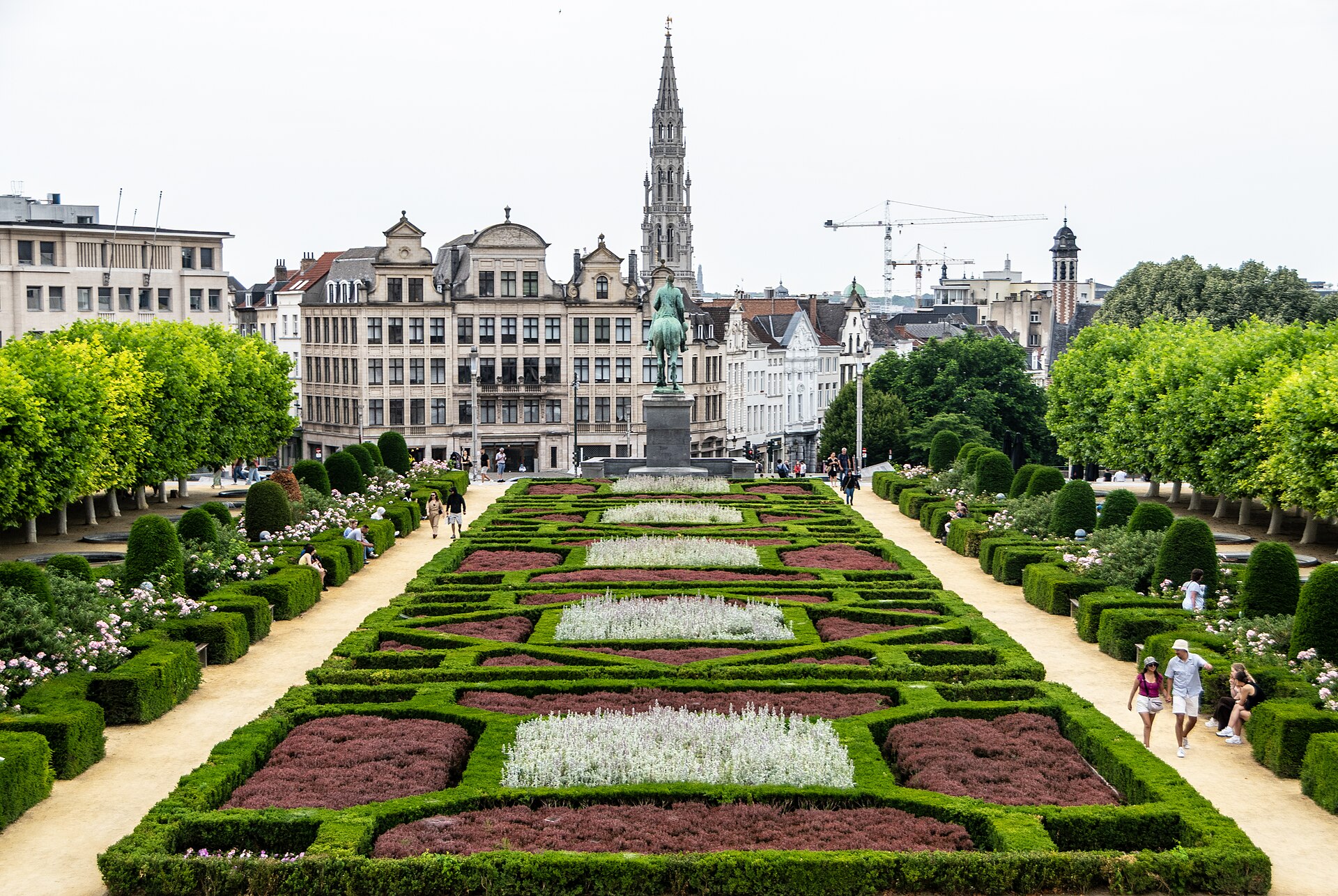
The Mont des Arts (Kunstberg) is a historic urban complex in central Brussels that serves as a vital link between the city's upper and lower districts. Originally conceived as a grand architectural project to showcase Belgian national identity, the site underwent significant transformation during the 20th century, culminating in the current layout which features a terraced garden and a series of monumental buildings.
The complex houses major cultural institutions, including the Royal Library of Belgium (KBR) and the National Archives. The architecture reflects a transition from neoclassical influences to the modernist principles prevalent during the post-war reconstruction of Brussels, providing a panoramic view of the city center from its elevated position.
Key Facts
- Materials
- Stone, Concrete, Glass
- Civilization
- Belgian
- Accessibility
- Accessible via stairs and public elevators
- Date(s)
- 1954-1965
- Condition
- Well-maintained, active public space
- Original Function
- Urban redevelopment and cultural center
- Key Figures
- King Leopold II, Jules Ghobert
Origins and Royal Vision
1910King Leopold II envisioned a 'Mount of the Arts' to elevate the cultural prestige of Brussels. The initial site was cleared for the 1910 World's Fair, though the permanent structures were not realized until decades later.
Post-War Reconstruction
1954-1965Following the destruction of the old neighborhood, the current complex was designed by architects Jules Ghobert and others. It was officially inaugurated in 1965, establishing the Royal Library and the National Archives as the anchors of the site.
Modern Integration
21st CenturyThe site has been integrated into the modern urban fabric of Brussels, serving as both a transit hub and a popular public park. Recent renovations have focused on preserving the modernist aesthetic while improving pedestrian access.
Cultural Significance
The Mont des Arts represents the intersection of Belgian political ambition and urban planning. It serves as a symbolic bridge between the aristocratic upper city and the commercial lower city, housing the collective memory of the nation within its library and archives.
Interpretive Notes
Scholarly debates and areas of uncertainty
The demolition of the historic 'Saint-Roch' neighborhood to make way for the Mont des Arts remains a subject of debate among urban historians, who often cite it as a controversial example of mid-century 'urban renewal' that erased significant medieval street patterns.
Visiting Information
Entry Rules
The gardens and public spaces are open 24/7. Access to the Royal Library and National Archives requires adherence to their specific reading room regulations and opening hours.
Best Times to Visit
Late afternoon for sunset views over the Brussels Town Hall spire. Weekdays are recommended for visiting the library and archives.
Photography
Public photography is permitted. Commercial shoots require authorization from the City of Brussels.
Preservation Notes
The site is a protected urban landscape. Visitors are requested to remain on designated paths in the gardens and respect the quiet zones near the library entrance.
Nearby POIs
11 shown- Musical Instruments Museum0.2 km
- Royal Museums of Fine Arts of Belgium0.3 km
- BELvue Museum0.3 km
- Palace of Justice of Brussels0.3 km
- Church of Our Lady of Victories at the Sablon0.4 km
- Royal Palace of Brussels0.4 km
- Brussels City Museum0.4 km
- Brussels Town Hall0.5 km
- Cathedral of St. Michael and St. Gudula0.5 km
- Choco-Story Brussels0.5 km
- Belgian Comic Strip Center0.9 km
Sources & Further Reading
- [1]Brussels: A History of the City — Paul De Ridder. Brussels Heritage Press (2012)
- [2]The Mont des Arts: Urbanism and Memory — Geert Bekaert. Belgian Journal of Architecture (2005)
Key Facts
- Materials
- Stone, Concrete, Glass
- Civilization
- Belgian
- Accessibility
- Accessible via stairs and public elevators
- Date(s)
- 1954-1965
- Condition
- Well-maintained, active public space
- Original Function
- Urban redevelopment and cultural center
- Key Figures
- King Leopold II, Jules Ghobert
Nearby POIs
11 shown- Musical Instruments Museum0.2 km
- Royal Museums of Fine Arts of Belgium0.3 km
- BELvue Museum0.3 km
- Palace of Justice of Brussels0.3 km
- Church of Our Lady of Victories at the Sablon0.4 km
- Royal Palace of Brussels0.4 km
- Brussels City Museum0.4 km
- Brussels Town Hall0.5 km
- Cathedral of St. Michael and St. Gudula0.5 km
- Choco-Story Brussels0.5 km
- Belgian Comic Strip Center0.9 km