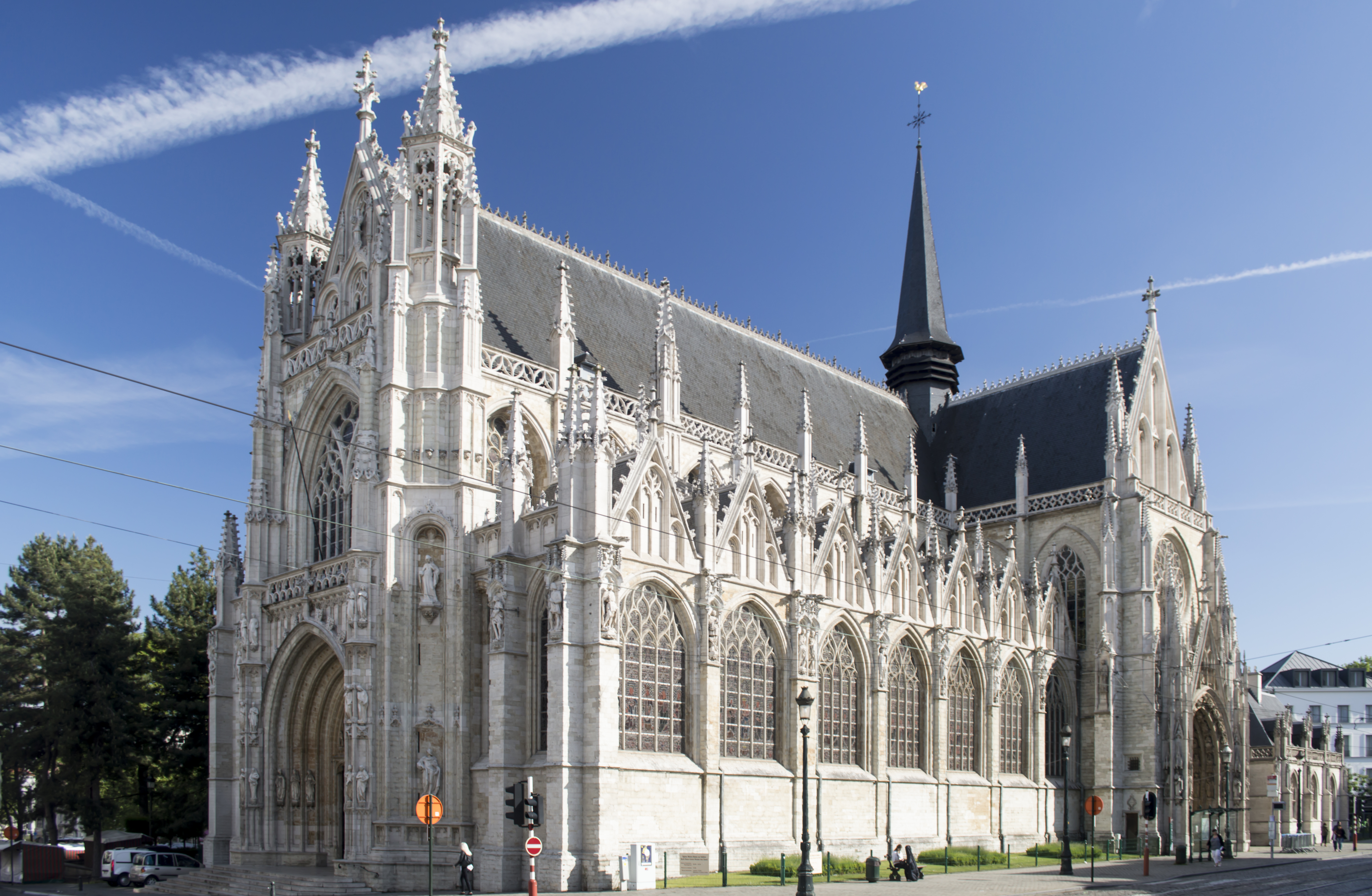
The Church of Our Lady of Victories at the Sablon is a prominent 15th-century Gothic church located in the Sablon district of Brussels. Originally built as a small chapel for the Guild of Crossbowmen in 1304, it was expanded into its current flamboyant Gothic form between the 15th and 16th centuries to accommodate the growing number of pilgrims visiting a miraculous statue of the Virgin Mary.
The interior is noted for its exceptional 15-meter-high stained glass windows that illuminate the nave. The church also features two elaborate Baroque funerary chapels, most notably the Chapel of Saint Ursula and the Chapel of Saint Marcouf, which serve as the final resting place for members of the Thurn und Taxis family, the aristocratic dynasty that established the first international postal service in Europe.
Key Facts
- Materials
- Sandstone, Stained glass
- Civilization
- Brabantine
- Accessibility
- Ground level access available
- Date(s)
- 1400 - 1550
- Condition
- Well-preserved, active parish church
- Original Function
- Guild chapel
- Key Figures
- Thurn und Taxis family, Guild of Crossbowmen
Origins as a Guild Chapel
1304The site began as a small chapel commissioned by the Guild of Crossbowmen on land donated by the City of Brussels. It was intended to serve as a place of worship for the guild members and a repository for a miraculous statue of the Virgin Mary.
Gothic Expansion
15th - 16th centuryDue to the increasing popularity of the site among pilgrims, the original chapel was replaced by the current, much larger flamboyant Gothic structure. The construction spanned over a century, resulting in the characteristic Brabantine Gothic style.
Baroque Additions
17th centuryDuring the 17th century, the church was enriched with two significant Baroque funerary chapels. These were commissioned by the Thurn und Taxis family, who had become prominent figures in Brussels society and sought a prestigious burial site.
Modern Restoration
19th - 20th centuryThe church underwent extensive restoration efforts in the 19th and 20th centuries to repair damage from historical conflicts and environmental decay, ensuring the preservation of its intricate stonework and stained glass.
Cultural Significance
The church stands as a symbol of the historical influence of Brussels' craft guilds and the later aristocratic power of the Thurn und Taxis family. It remains a focal point of the Sablon district, which is historically associated with the city's elite and the development of international trade networks through the postal service.
Interpretive Notes
Scholarly debates and areas of uncertainty
There is ongoing academic discussion regarding the exact provenance of the miraculous statue of the Virgin Mary and the extent to which the church's architectural design was influenced by the specific liturgical requirements of the Crossbowmen's Guild versus broader regional Gothic trends.
Visiting Information
Entry Rules
Open to the public daily. Entry is free, though donations are encouraged. Visitors are expected to maintain a respectful demeanor as it is an active place of worship.
Best Times to Visit
Weekday mornings are generally quiet. The church is particularly atmospheric during the late afternoon when sunlight filters through the high stained glass windows.
Photography
Personal photography is permitted without flash. Tripods and professional equipment require prior authorization from the parish office.
Preservation Notes
The stained glass windows are fragile and subject to ongoing conservation monitoring. Please refrain from touching the stonework or the funerary monuments.
Nearby POIs
11 shown- Royal Museums of Fine Arts of Belgium0.2 km
- Musical Instruments Museum0.3 km
- Palace of Justice of Brussels0.4 km
- Mont des Arts0.4 km
- BELvue Museum0.4 km
- Royal Palace of Brussels0.5 km
- Choco-Story Brussels0.7 km
- Brussels Town Hall0.8 km
- Brussels City Museum0.8 km
- Cathedral of St. Michael and St. Gudula0.9 km
- Belgian Comic Strip Center1.2 km
Sources & Further Reading
- [1]The Sablon: A History of the District and its Church — Jean-Pierre Van den Bossche. Brussels Historical Society (2015)
- [2]Gothic Architecture in the Low Countries — Herman De Vilder. Leuven University Press (2008)
Key Facts
- Materials
- Sandstone, Stained glass
- Civilization
- Brabantine
- Accessibility
- Ground level access available
- Date(s)
- 1400 - 1550
- Condition
- Well-preserved, active parish church
- Original Function
- Guild chapel
- Key Figures
- Thurn und Taxis family, Guild of Crossbowmen
Nearby POIs
11 shown- Royal Museums of Fine Arts of Belgium0.2 km
- Musical Instruments Museum0.3 km
- Palace of Justice of Brussels0.4 km
- Mont des Arts0.4 km
- BELvue Museum0.4 km
- Royal Palace of Brussels0.5 km
- Choco-Story Brussels0.7 km
- Brussels Town Hall0.8 km
- Brussels City Museum0.8 km
- Cathedral of St. Michael and St. Gudula0.9 km
- Belgian Comic Strip Center1.2 km