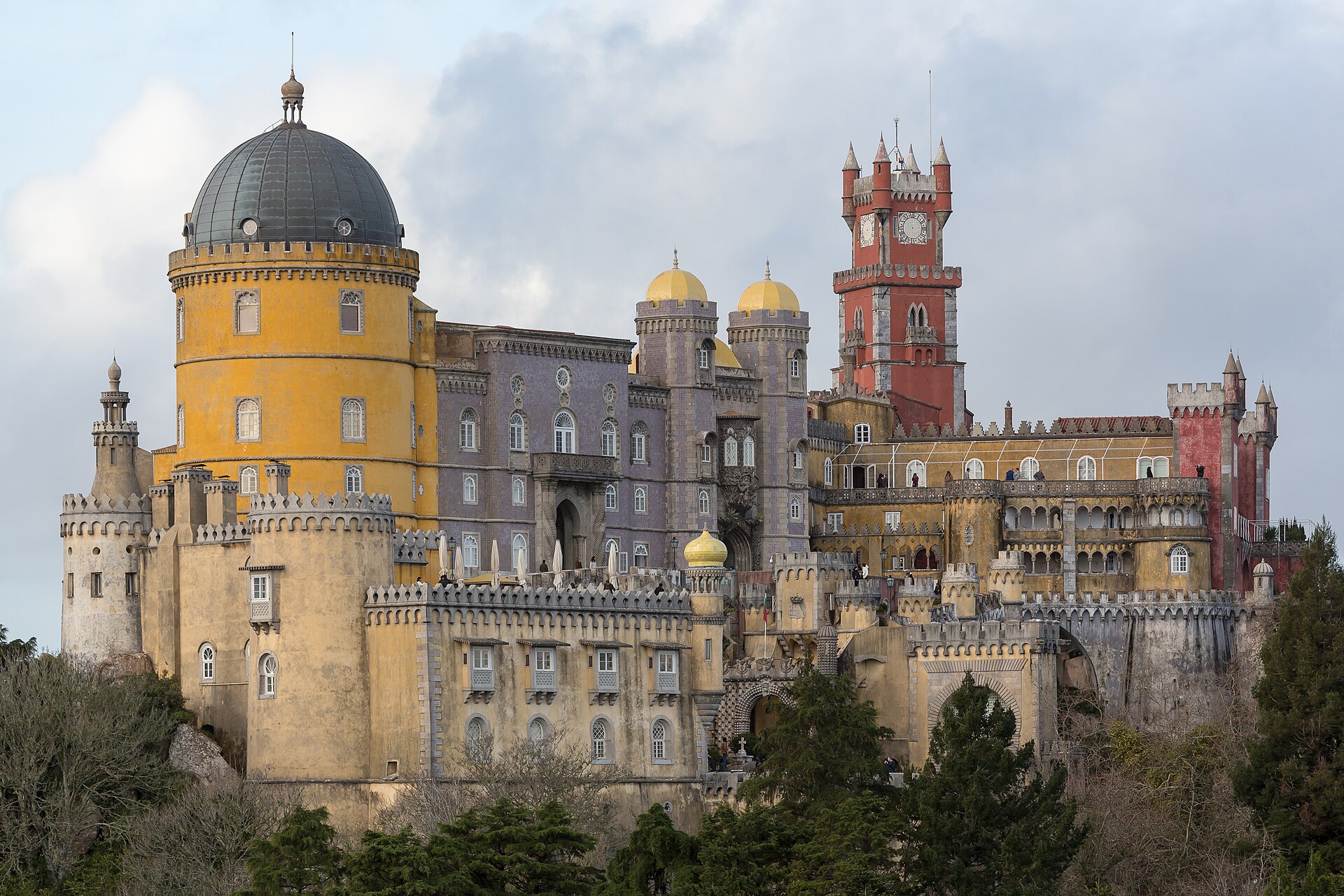
The Pena Palace is a Romanticist castle located on the summit of the São Pedro de Penaferrim in the Sintra Mountains. Commissioned by King Ferdinand II, the palace was built on the site of a former 15th-century Hieronymite monastery, which had been largely abandoned and damaged by the 1755 Lisbon earthquake and subsequent lightning strikes.
Designed by Wilhelm Ludwig von Eschwege, the structure is a quintessential example of 19th-century Romantic architecture, characterized by its eclectic mix of Neo-Gothic, Neo-Manueline, Neo-Islamic, and Neo-Renaissance styles. The palace served as a summer residence for the Portuguese royal family until the 1910 revolution, after which it was converted into a museum and opened to the public.
Key Facts
- Materials
- Granite, Ceramic tiles, Stucco
- Civilization
- Portuguese
- Accessibility
- Limited due to steep terrain and historic architecture
- Date(s)
- 1842-1854
- Condition
- Well-preserved, museum and national monument
- Original Function
- Royal summer residence
- Key Figures
- King Ferdinand II, Queen Maria II, Wilhelm Ludwig von Eschwege
Monastic Origins
1493-1755The site originated as a chapel dedicated to Our Lady of Pena, later becoming a monastery for the Order of Saint Jerome. It remained a place of pilgrimage for centuries until the 1755 earthquake left the buildings in ruins.
Royal Transformation
1838-1854King Ferdinand II acquired the ruins and the surrounding lands in 1838. He tasked the German architect Baron von Eschwege with transforming the site into a summer palace, blending the existing monastic ruins with a new, highly decorative structure.
Royal Residence
1854-1910The palace became the preferred summer retreat for the Portuguese monarchy. It was the site of significant royal events and served as a private sanctuary for the royal family until the fall of the monarchy in 1910.
Public Museum
1910-PresentFollowing the proclamation of the Portuguese Republic, the palace was classified as a national monument and opened as a museum. It is now part of the Cultural Landscape of Sintra, a UNESCO World Heritage site.
Cultural Significance
The Pena Palace is a primary symbol of the Romantic movement in Portugal, reflecting the 19th-century fascination with historical revivalism and exoticism. Its eclectic design serves as a physical manifestation of the era's desire to synthesize diverse cultural influences into a cohesive national identity.
Beyond its architectural value, the palace is central to the cultural landscape of Sintra. It represents the intersection of royal power, artistic patronage, and the preservation of historical memory, standing as one of the most visited and iconic landmarks in the country.
Interpretive Notes
Scholarly debates and areas of uncertainty
Debates often center on the palace's stylistic classification. While universally recognized as Romantic, scholars frequently discuss the extent to which the 'Neo-Manueline' elements were intended as a genuine revival of Portuguese maritime history versus a superficial decorative choice influenced by German Romanticism.
Visiting Information
Entry Rules
Open daily. Tickets are required for entry to the palace interior and the surrounding park. Visitors are encouraged to purchase tickets online in advance to secure specific entry time slots.
Best Times to Visit
Early morning or late afternoon to avoid peak tourist crowds. Weekdays during the shoulder seasons (spring and autumn) offer the most comfortable climate for exploring the extensive park grounds.
Photography
Personal photography is permitted in the park and exterior areas. Flash photography is strictly prohibited inside the palace rooms to protect historical artifacts.
Preservation Notes
The palace requires constant maintenance due to its exposed hilltop location and the delicate nature of its polychromatic exterior. Visitors must stay on marked paths and refrain from touching the historic furniture and decorative surfaces.
Nearby POIs
11 shown- Castelo dos Mouros0.6 km
- Quinta da Regaleira1 km
- Palacio de Sintra1.1 km
- Palácio de Monserrate2.7 km
- Convento da Ordem do Carmo4.7 km
- Palácio de Queluz12.2 km
- Basilica of Our Lady and Saint Anthony of Mafra17.5 km
- Belem Tower18.5 km
- Jeronimos Monastery18.9 km
- Palace of Ajuda19 km
- Padrao dos Descobrimentos19.2 km
Sources & Further Reading
- [1]The Romantic Palace of Pena — José Custódio Vieira da Silva. Scala Publishers (2007)
- [2]
Key Facts
- Materials
- Granite, Ceramic tiles, Stucco
- Civilization
- Portuguese
- Accessibility
- Limited due to steep terrain and historic architecture
- Date(s)
- 1842-1854
- Condition
- Well-preserved, museum and national monument
- Original Function
- Royal summer residence
- Key Figures
- King Ferdinand II, Queen Maria II, Wilhelm Ludwig von Eschwege
Nearby POIs
11 shown- Castelo dos Mouros0.6 km
- Quinta da Regaleira1 km
- Palacio de Sintra1.1 km
- Palácio de Monserrate2.7 km
- Convento da Ordem do Carmo4.7 km
- Palácio de Queluz12.2 km
- Basilica of Our Lady and Saint Anthony of Mafra17.5 km
- Belem Tower18.5 km
- Jeronimos Monastery18.9 km
- Palace of Ajuda19 km
- Padrao dos Descobrimentos19.2 km