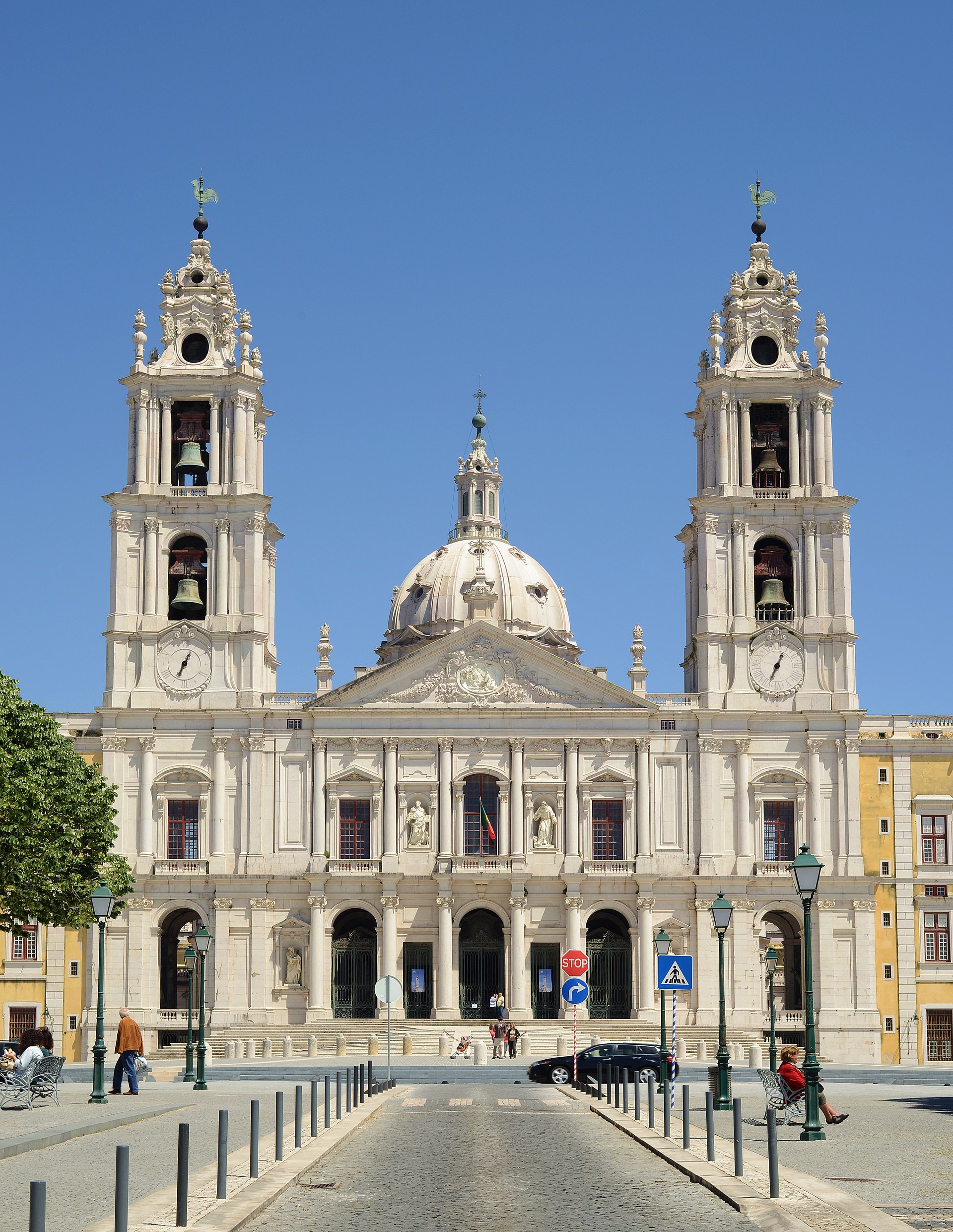
The Basilica of Our Lady and Saint Anthony is the central component of the Mafra National Palace, commissioned by King John V of Portugal in 1717. Designed by Johann Friedrich Ludwig, the structure serves as a prime example of Italian-influenced Baroque architecture, featuring a grand facade of Lioz limestone and a central dome that dominates the surrounding landscape.
The interior is renowned for its extensive use of marble and its unique musical heritage. It houses six historic pipe organs, which were designed to be played in concert, and a massive carillon system consisting of 92 bells cast in Antwerp. These instruments were integral to the royal ceremonial life of the Portuguese court and remain among the most significant collections of 18th-century musical technology in Europe.
Key Facts
- Materials
- Lioz limestone, Marble, Wood
- Civilization
- Portuguese
- Accessibility
- Ground level accessible, some areas restricted
- Date(s)
- 1717-1735
- Condition
- Well-preserved, active religious site and museum
- Original Function
- Royal Basilica and Convent Church
- Key Figures
- King John V, Johann Friedrich Ludwig, Mateus Vicente de Oliveira
Royal Vow and Foundation
1717King John V vowed to build a convent if his wife, Queen Maria Anna of Austria, bore him an heir. Following the birth of Princess Maria Barbara, the project commenced, eventually expanding from a modest convent into a massive palace-basilica complex.
Construction and Design
1717-1735The architect Johann Friedrich Ludwig, known as Ludovice, oversaw the construction. The basilica was consecrated in 1730, though work on the broader complex continued for several years, involving thousands of laborers and artisans.
Musical Legacy
18th centuryThe basilica was equipped with six organs and two carillons, a rare configuration intended to project royal power and religious devotion through complex polyphonic music during state ceremonies.
Modern Preservation
20th century - presentThe site was designated a UNESCO World Heritage site in 2019 as part of the 'Royal Building of Mafra'. Ongoing restoration focuses on the conservation of the historic organs and the structural integrity of the limestone facade.
Cultural Significance
The Basilica represents the height of Portuguese Baroque power and the immense wealth generated by the Brazilian gold trade during the reign of John V. It serves as a symbol of the close relationship between the Portuguese monarchy and the Catholic Church.
Today, the site is a focal point for musicology, particularly for the study of 18th-century organ performance and carillon composition. It remains a site of national pride and a key destination for cultural tourism in Portugal.
Interpretive Notes
Scholarly debates and areas of uncertainty
Debate exists regarding the extent of the influence of Roman Baroque models versus local Portuguese architectural traditions in the basilica's design. Additionally, scholars continue to analyze the specific liturgical use of the six-organ configuration, as no other site in the world possesses a similar arrangement designed for simultaneous performance.
Visiting Information
Entry Rules
Open daily. The basilica is part of the Mafra National Palace museum complex; tickets are required for the palace, while the basilica may have specific access hours for religious services. Modest dress is requested.
Best Times to Visit
Mid-morning or early afternoon to avoid tour groups. Visiting during scheduled organ recitals provides the best experience of the site's unique acoustic properties.
Photography
Photography is permitted without flash. Tripods and commercial equipment require prior authorization from the palace administration.
Preservation Notes
The limestone exterior is highly susceptible to environmental erosion. Visitors are asked to refrain from touching the marble surfaces and to follow all marked paths to protect the historic flooring.
Nearby POIs
11 shownSources & Further Reading
- [1]The Royal Building of Mafra: A Monument of the Enlightenment — João Castel-Branco Pereira. Scala Publishers (2007)
- [2]The Organs of the Basilica of Mafra — Luís Henriques. Journal of Portuguese Musicology (2015)
Key Facts
- Materials
- Lioz limestone, Marble, Wood
- Civilization
- Portuguese
- Accessibility
- Ground level accessible, some areas restricted
- Date(s)
- 1717-1735
- Condition
- Well-preserved, active religious site and museum
- Original Function
- Royal Basilica and Convent Church
- Key Figures
- King John V, Johann Friedrich Ludwig, Mateus Vicente de Oliveira