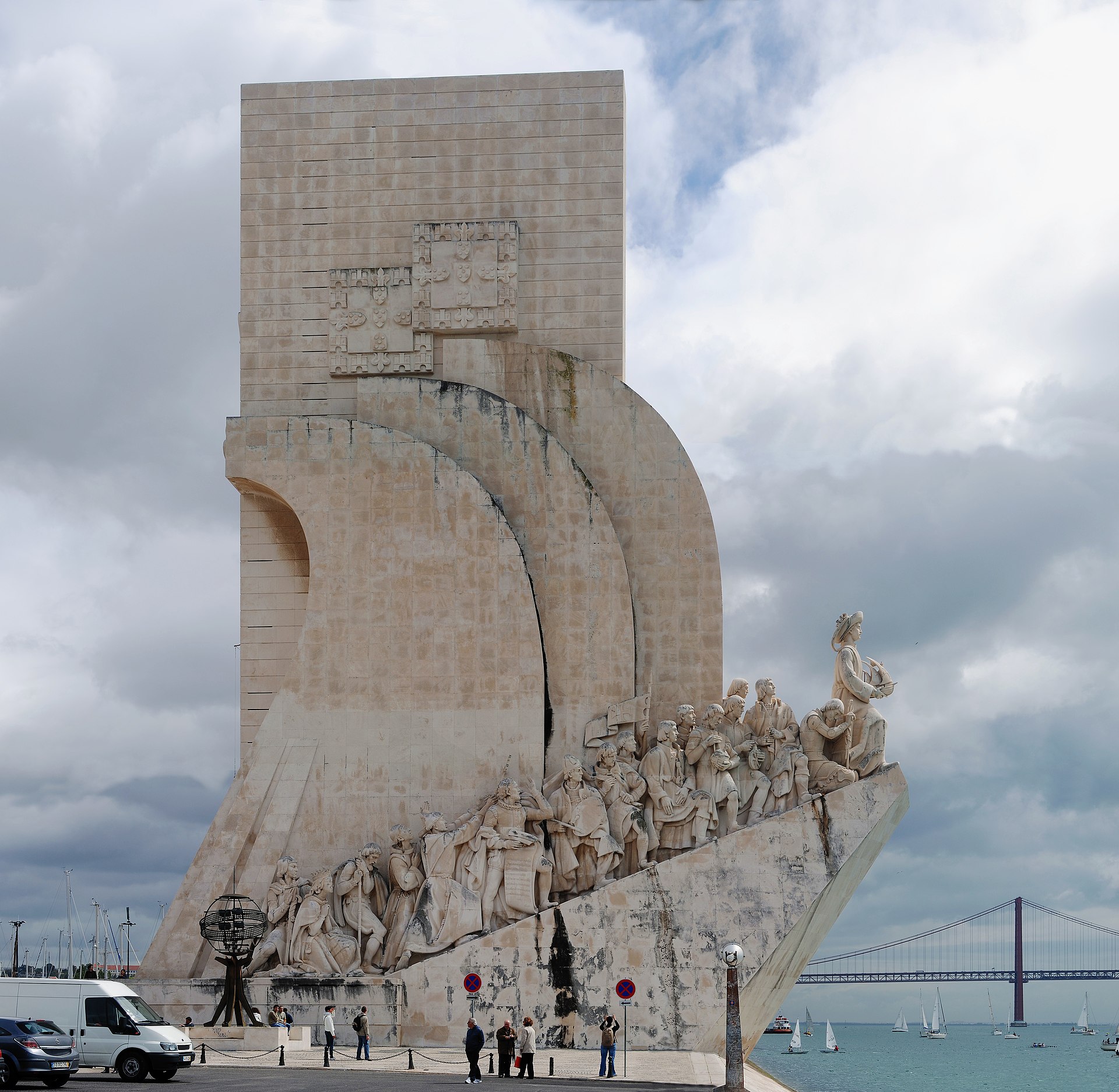
The Padrão dos Descobrimentos (Monument to the Discoveries) is a monumental structure located on the northern bank of the Tagus River estuary in the Belém district of Lisbon. It was originally conceived in 1939 for the Portuguese World Exhibition to celebrate the historical figures associated with the Portuguese Age of Discovery, specifically honoring the maritime expansion of the 15th and 16th centuries.
The current concrete structure was inaugurated in 1960 to commemorate the 500th anniversary of the death of Prince Henry the Navigator. Designed by architect Cottinelli Telmo and sculptor Leopoldo de Almeida, the monument is shaped like the prow of a caravel, featuring a stylized sword-shaped facade and a massive statue of Prince Henry leading a procession of 32 historical figures, including explorers, cartographers, and missionaries.
Key Facts
- Materials
- Reinforced concrete, Lioz limestone
- Civilization
- Portuguese
- Accessibility
- Elevator access to the top floor
- Date(s)
- 1958-1960
- Condition
- Well-preserved, includes an observation deck and exhibition space
- Original Function
- Commemorative monument
- Key Figures
- Henry the Navigator, Vasco da Gama, Ferdinand Magellan, Luís de Camões
Conception and World Exhibition
1939-1940The monument was first constructed as a temporary structure made of wood and plaster for the 1940 Portuguese World Exhibition. It served to highlight the nationalist narrative of the Estado Novo regime regarding Portugal's colonial history.
Permanent Reconstruction
1958-1960Due to the deterioration of the original temporary materials, the monument was rebuilt in concrete and stone. The permanent version was inaugurated in 1960 to mark the quincentenary of the death of Prince Henry the Navigator.
Modern Integration
1985-presentIn 1985, the interior was converted into a cultural center, adding an exhibition hall, an auditorium, and a panoramic viewpoint. The surrounding plaza features a large wind rose mosaic, a gift from the Republic of South Africa in 1960.
Cultural Significance
The monument serves as a powerful symbol of Portugal's maritime heritage and its role in global exploration. It represents the historical narrative of the 'Age of Discovery,' which fundamentally altered global trade routes and cultural exchange between Europe, Africa, Asia, and the Americas.
In contemporary discourse, the monument has become a focal point for debates regarding the legacy of Portuguese colonialism. While it remains a major tourist landmark, it is increasingly viewed through a critical lens that acknowledges the human cost of the expansionist policies it celebrates.
Interpretive Notes
Scholarly debates and areas of uncertainty
Academic debate centers on the monument's role as a tool of propaganda for the Estado Novo regime. Scholars analyze how the selection of the 32 figures depicted on the monument reflects a curated, nationalist version of history that often omits the perspectives of indigenous populations encountered during the voyages.
Visiting Information
Entry Rules
The monument is open daily. Tickets are required for access to the interior exhibition space and the panoramic observation deck. The exterior plaza and the wind rose mosaic are accessible to the public at no cost.
Best Times to Visit
Late afternoon provides the best lighting for photography of the riverfront. Weekday mornings are generally less crowded than weekends.
Photography
Personal photography is permitted. Commercial photography and filming require prior authorization from the municipal authorities.
Preservation Notes
The structure is subject to regular maintenance due to its proximity to the Tagus River and exposure to salt air. Visitors are requested to respect the integrity of the stone carvings and the surrounding plaza.
Nearby POIs
11 shownSources & Further Reading
- [1]The Portuguese Empire, 1415-1825 — A.J.R. Russell-Wood. Johns Hopkins University Press (1998)
- [2]Lisbon: A Cultural and Literary History — Paul Buck. Signal Books (2002)
Key Facts
- Materials
- Reinforced concrete, Lioz limestone
- Civilization
- Portuguese
- Accessibility
- Elevator access to the top floor
- Date(s)
- 1958-1960
- Condition
- Well-preserved, includes an observation deck and exhibition space
- Original Function
- Commemorative monument
- Key Figures
- Henry the Navigator, Vasco da Gama, Ferdinand Magellan, Luís de Camões