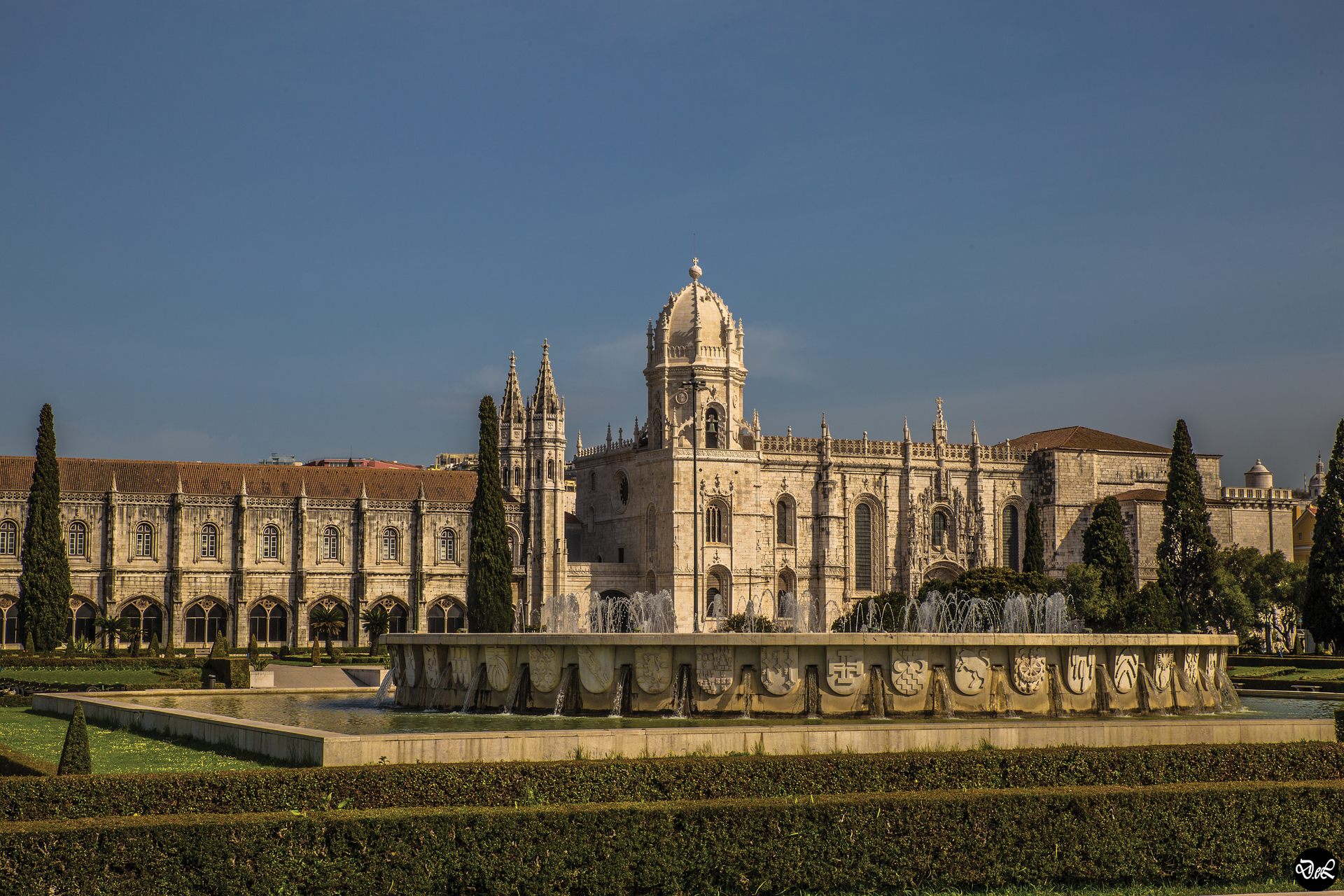
The Jerónimos Monastery, or Mosteiro dos Jerónimos, is a former monastery of the Order of Saint Jerome located near the Tagus River in the Belém district of Lisbon. Commissioned by King Manuel I in 1501 to commemorate the successful voyage of Vasco da Gama to India, it stands as the most prominent example of the Manueline architectural style, characterized by intricate maritime-themed ornamentation and late Gothic elements.
The complex served as a religious house for the Order of Saint Jerome for over four centuries before being secularized in 1833. Today, it functions as a national monument and a significant cultural site, housing the tombs of historical figures such as Vasco da Gama and the poet Luís de Camões, as well as the National Archaeology Museum and the Maritime Museum.
Key Facts
- Materials
- Lioz limestone, Marble
- Civilization
- Portuguese
- Accessibility
- Ground floor and church are wheelchair accessible
- Date(s)
- 1501-1601
- Condition
- Well-preserved, active cultural site and church
- Original Function
- Monastery of the Order of Saint Jerome
- Key Figures
- King Manuel I, Vasco da Gama, Luís de Camões, Diogo de Boitaca
Foundation and Construction
1501-1550King Manuel I founded the monastery on the site of a former hermitage where Vasco da Gama spent his final night before departing for India. Construction began in 1501 under the direction of architect Diogo de Boitaca, funded by the wealth generated from the spice trade.
Completion and Expansion
1550-1600Work continued throughout the 16th century with architects like João de Castilho and Diogo de Torralva contributing to the cloister and the church's interior. The project was largely completed by the end of the century, establishing the definitive Manueline aesthetic.
Secularization and Restoration
1833-1900Following the dissolution of religious orders in Portugal in 1833, the monastery was secularized. The buildings were repurposed for educational and charitable use, and extensive restoration work was undertaken in the late 19th century to preserve the structure's integrity.
Modern Status
1983-PresentThe monastery was designated a UNESCO World Heritage site in 1983. It remains a central site for Portuguese national identity, hosting state ceremonies and serving as a major destination for historical research and tourism.
Cultural Significance
The Jerónimos Monastery is a symbol of the Portuguese Age of Discovery, representing the wealth and global reach of the Portuguese Empire during the 16th century. Its architecture, which blends Christian motifs with nautical symbols like ropes, armillary spheres, and coral, reflects the maritime spirit that defined the era.
Beyond its architectural value, the site is a national pantheon. The presence of the tombs of Vasco da Gama and Luís de Camões links the monastery directly to the foundational narratives of Portuguese exploration and literature, making it a focal point for national commemoration.
Interpretive Notes
Scholarly debates and areas of uncertainty
There is ongoing academic discussion regarding the extent of the influence of Islamic architectural traditions on the Manueline style found at the monastery. While the style is distinctly Portuguese, scholars debate how much the intricate stone carving techniques were influenced by Mudéjar artisans working in the region.
Visiting Information
Entry Rules
Open Tuesday to Sunday. Tickets are required for entry to the cloister and the museum wings, while the church remains accessible for worship. Modest dress is requested when entering the church area.
Best Times to Visit
Early morning (10:00) or late afternoon (16:00) to avoid the peak tour bus crowds. Weekdays are generally quieter than weekends.
Photography
Personal photography is permitted without flash or tripods. Professional or commercial photography requires prior authorization from the Directorate-General for Cultural Heritage.
Preservation Notes
The Lioz limestone is sensitive to environmental pollution and humidity. Visitors are asked not to touch the carvings or lean against the walls. Restoration work is periodic and may occasionally restrict access to specific sections of the cloister.
Nearby POIs
11 shownSources & Further Reading
- [1]The Jerónimos Monastery: A Manueline Masterpiece — Paulo Pereira. Scala Arts & Heritage Publishers (2016)
- [2]Monastery of the Hieronymites and Tower of Belém in Lisbon — UNESCO World Heritage Centre. UNESCO (1983)View
Key Facts
- Materials
- Lioz limestone, Marble
- Civilization
- Portuguese
- Accessibility
- Ground floor and church are wheelchair accessible
- Date(s)
- 1501-1601
- Condition
- Well-preserved, active cultural site and church
- Original Function
- Monastery of the Order of Saint Jerome
- Key Figures
- King Manuel I, Vasco da Gama, Luís de Camões, Diogo de Boitaca