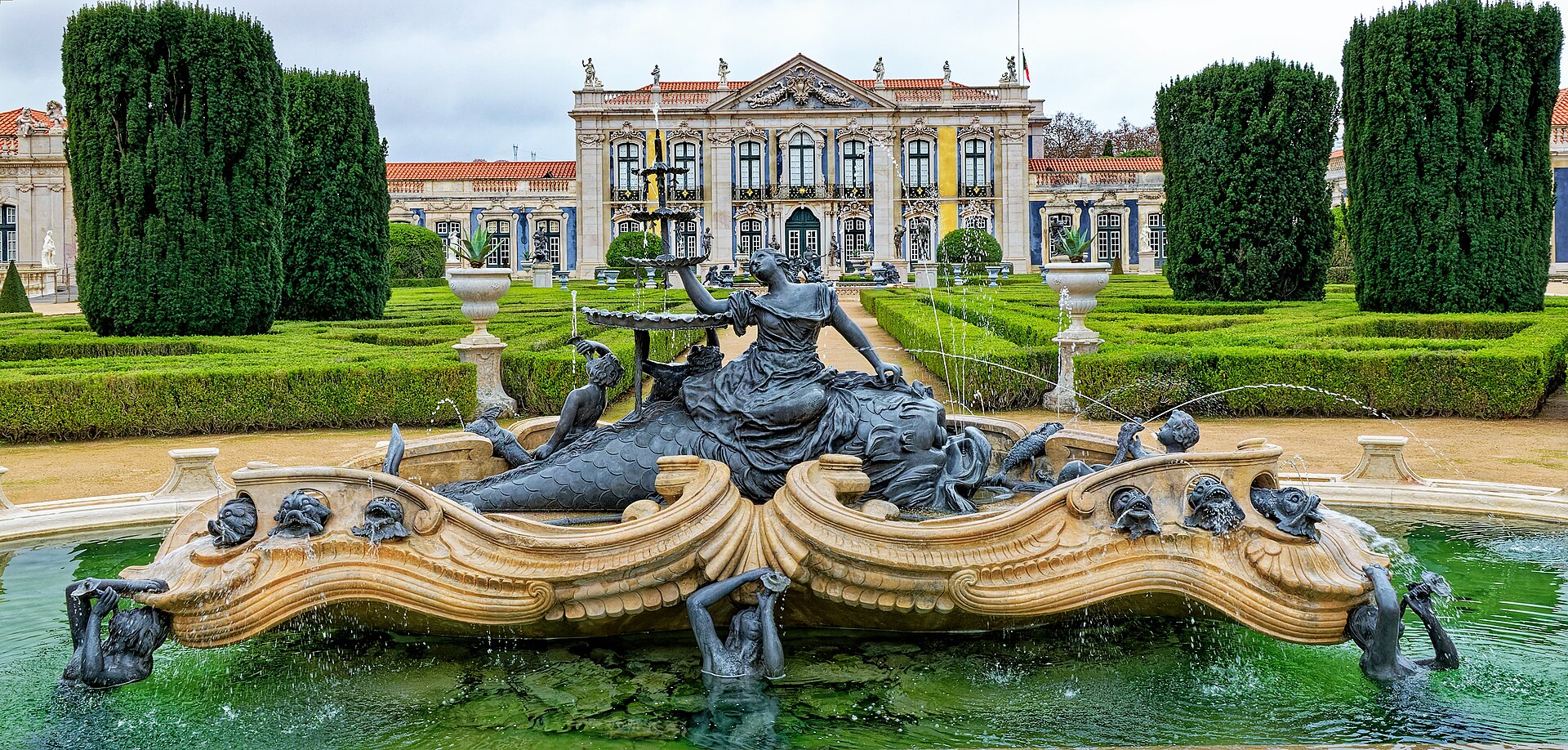
The Palácio de Queluz is an 18th-century palace located in Queluz, a civil parish of the municipality of Sintra, in the Lisbon District. Originally commissioned as a summer residence for Dom Pedro of Braganza, who later became King Pedro III, the palace evolved from a modest hunting lodge into a grand royal residence under the direction of architects Mateus Vicente de Oliveira and Jean-Baptiste Robillon.
Characterized by its ornate Rococo and Neoclassical architecture, the palace is often referred to as the 'Portuguese Versailles.' It served as the official residence of the Portuguese royal family during the late 18th and early 19th centuries, notably housing Queen Maria I during her period of mental decline and serving as the birthplace and deathbed of King Pedro IV.
Key Facts
- Materials
- Stone, Marble, Tile (Azulejos), Gilded wood
- Civilization
- Portuguese
- Accessibility
- Partially accessible; some areas have stairs
- Date(s)
- 1747-1794
- Condition
- Well-preserved, museum and state venue
- Original Function
- Summer residence
- Key Figures
- Dom Pedro III, Queen Maria I, King Pedro IV, Jean-Baptiste Robillon
Origins as a Hunting Lodge
1747The site began as a hunting lodge owned by the Marquis of Castelo Rodrigo. Dom Pedro of Braganza acquired the estate and commissioned Mateus Vicente de Oliveira to transform it into a summer palace suitable for the royal court.
Expansion and Rococo Splendor
1750-1780Under the influence of French architect Jean-Baptiste Robillon, the palace expanded significantly. The addition of the formal gardens, the canal, and the intricate interior decorations established the site as a premier example of Portuguese Rococo architecture.
Royal Residence and Political Hub
1794-1821The palace became the primary residence of the royal family. It was here that Queen Maria I lived during her final years. Following the Peninsular War and the flight of the court to Brazil, the palace saw a decline in its role as the center of power.
Modern Preservation
1908-PresentThe palace was acquired by the Portuguese state in 1908. It has since undergone extensive restoration to preserve its historical interiors and gardens, and it currently functions as a museum and a venue for hosting visiting heads of state.
Cultural Significance
The Palácio de Queluz represents the height of 18th-century Portuguese courtly life and the transition between the Baroque, Rococo, and Neoclassical styles. It is a vital symbol of the Braganza dynasty's influence and the artistic exchange between Portugal and the rest of Europe during the Enlightenment.
Beyond its architectural value, the palace is deeply embedded in Portuguese national memory as the site of significant royal events, including the birth and death of King Pedro IV, the first Emperor of Brazil. It remains a key site for understanding the domestic life of the Portuguese monarchy prior to the liberal revolutions of the 19th century.
Interpretive Notes
Scholarly debates and areas of uncertainty
There is ongoing academic discussion regarding the extent of Jean-Baptiste Robillon's influence versus that of Mateus Vicente de Oliveira in the design of the palace's most iconic features, particularly the gardens and the Throne Room. Additionally, the degree to which the palace's design was intended to mimic Versailles as a deliberate political statement remains a subject of debate among architectural historians.
Visiting Information
Entry Rules
Open daily except Tuesdays. Tickets can be purchased online or at the entrance. Visitors are required to follow marked paths and respect the integrity of the historical furniture and decor.
Best Times to Visit
Spring and early autumn are ideal for exploring the extensive gardens. Weekday mornings are recommended to avoid weekend crowds.
Photography
Personal photography is permitted without flash or tripods. Commercial photography requires prior authorization from the Parques de Sintra administration.
Preservation Notes
The palace contains delicate 18th-century tapestries, gilded wood, and tile work. Visitors must refrain from touching surfaces or using flash photography, as light and physical contact accelerate the degradation of these materials.
Nearby POIs
11 shownSources & Further Reading
- [1]Queluz: The Palace and Gardens — José Sarmento de Matos. Scala Publishers (2005)
- [2]The Royal Palaces of Portugal — Paulo Pereira. Edições Inapa (2010)
Key Facts
- Materials
- Stone, Marble, Tile (Azulejos), Gilded wood
- Civilization
- Portuguese
- Accessibility
- Partially accessible; some areas have stairs
- Date(s)
- 1747-1794
- Condition
- Well-preserved, museum and state venue
- Original Function
- Summer residence
- Key Figures
- Dom Pedro III, Queen Maria I, King Pedro IV, Jean-Baptiste Robillon