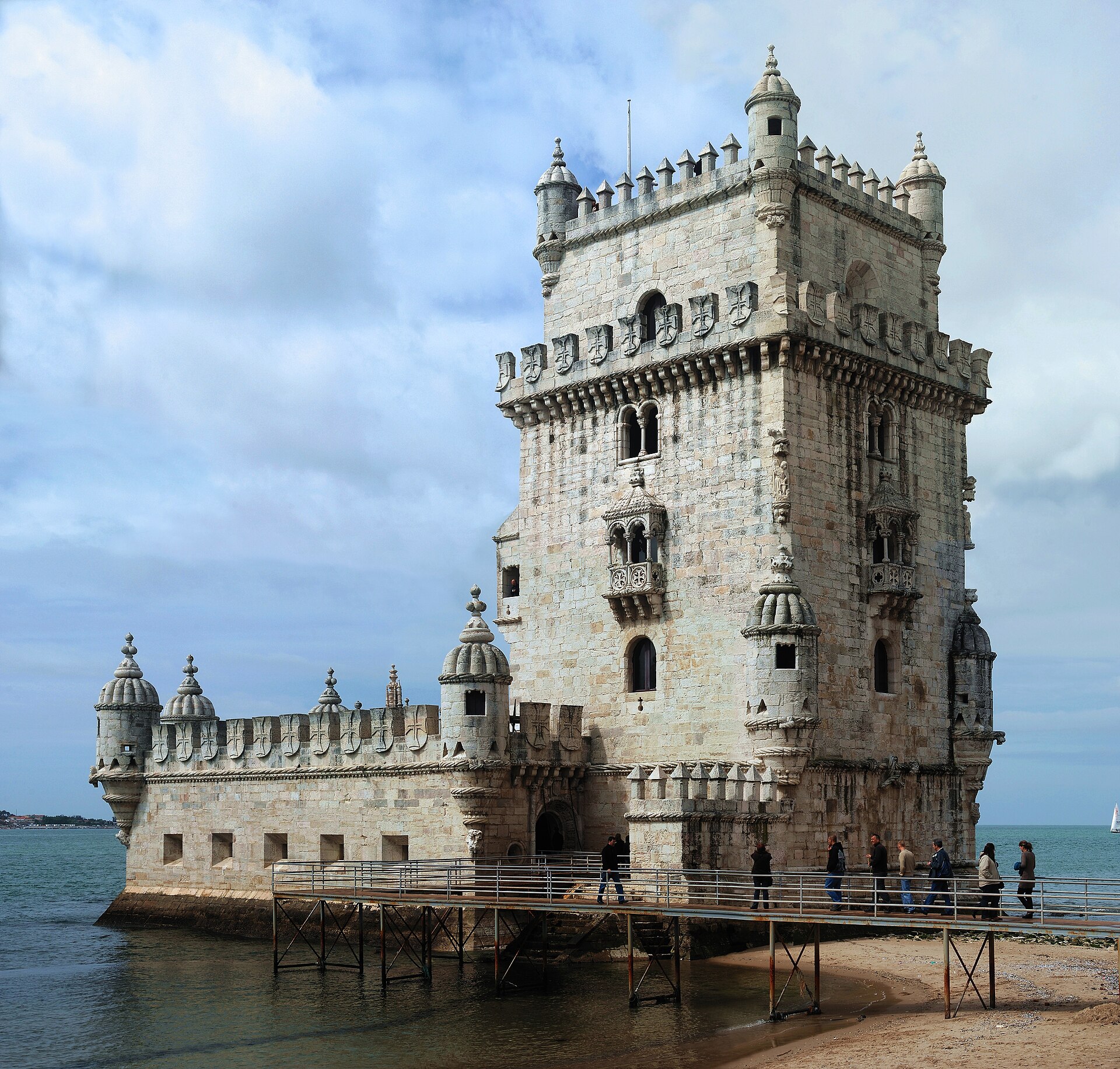
Belém Tower, or Torre de Belém, is a 16th-century fortification located on the northern bank of the Tagus River in Lisbon. Commissioned by King John II as part of a defensive system at the mouth of the Tagus, it was constructed between 1514 and 1520 during the reign of King Manuel I. The tower served as a ceremonial gateway to Lisbon and a point of embarkation for Portuguese explorers during the Age of Discovery.
Architecturally, the structure is a prime example of the Manueline style, characterized by intricate maritime motifs, stone carvings of armillary spheres, and ornate balconies. Although it functioned as a fortress, it also served as a customs house and a prison. Today, it stands as a symbol of Portugal's maritime history and is recognized as a UNESCO World Heritage site.
Key Facts
- Materials
- Lioz limestone
- Civilization
- Portuguese
- Accessibility
- Limited; narrow spiral staircase access to upper levels
- Date(s)
- 1514-1520
- Condition
- Well-preserved, open as a museum
- Original Function
- Defensive fortress and ceremonial gateway
- Key Figures
- King Manuel I, Francisco de Arruda, Diogo de Boitaca
Commission and Construction
1514-1520The tower was commissioned by King Manuel I to protect the harbor of Lisbon. Architect Francisco de Arruda was tasked with the design, incorporating military defensive features with the decorative Manueline style popular during the Portuguese Renaissance.
Strategic and Administrative Use
16th-18th centuryBeyond its military role, the tower functioned as a customs house for ships entering the Tagus. Its lower levels were later repurposed as a political prison, housing detainees during the Spanish occupation and subsequent conflicts.
Restoration and Recognition
19th century-presentThe tower underwent significant restoration in the 1840s under Queen Maria II. It was classified as a National Monument in 1910 and designated a UNESCO World Heritage site in 1983, cementing its status as a cultural landmark.
Cultural Significance
Belém Tower is an enduring icon of the Portuguese Age of Discovery. It represents the era when Portugal expanded its influence globally through maritime exploration. The tower's location on the riverbank served as the final sight of land for many explorers, including Vasco da Gama, making it a poignant symbol of departure and return in the national consciousness.
Interpretive Notes
Scholarly debates and areas of uncertainty
There is ongoing academic discussion regarding the extent to which the tower's defensive capabilities were compromised by its decorative Manueline aesthetic. Some historians argue the ornamentation was intended primarily as a display of royal power rather than a functional military necessity.
Visiting Information
Entry Rules
Open Tuesday to Sunday. Tickets are required for entry. Visitors are advised to book in advance during peak tourist seasons. Large bags are not permitted inside the tower.
Best Times to Visit
Early morning or late afternoon to avoid peak cruise ship crowds and midday heat. The site is particularly striking during sunset.
Photography
Personal photography is permitted. Tripods and professional equipment require prior authorization from the site management.
Preservation Notes
The structure is sensitive to tidal erosion and humidity. Visitors must follow marked paths and avoid touching the limestone carvings to prevent further degradation.
Nearby POIs
11 shownSources & Further Reading
- [1]Torre de Belém: A Manueline Masterpiece — Paulo Pereira. Scala Publishers (2008)
- [2]The Age of Discovery and Portuguese Architecture — Rafael Moreira. Lisbon University Press (2015)
Key Facts
- Materials
- Lioz limestone
- Civilization
- Portuguese
- Accessibility
- Limited; narrow spiral staircase access to upper levels
- Date(s)
- 1514-1520
- Condition
- Well-preserved, open as a museum
- Original Function
- Defensive fortress and ceremonial gateway
- Key Figures
- King Manuel I, Francisco de Arruda, Diogo de Boitaca