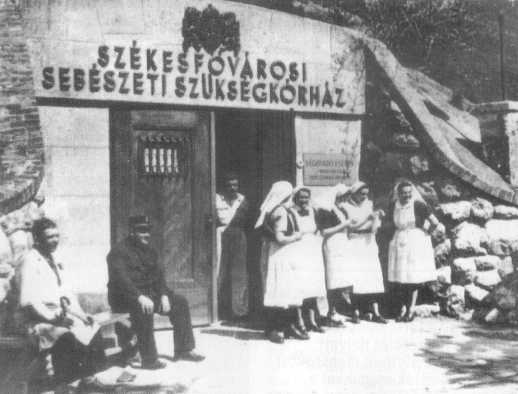
The Hospital in the Rock is a subterranean facility located within the natural cave and tunnel system beneath Buda Castle in Budapest. Originally developed in the 1930s to serve as an emergency hospital, it was significantly expanded during World War II to provide medical care for soldiers and civilians during the Siege of Budapest.
Following the war, the facility was repurposed as a top-secret emergency hospital and later a nuclear bunker during the Cold War. Today, it operates as a museum dedicated to preserving the history of the site, showcasing original medical equipment, period-accurate wax figures, and the civil defense infrastructure maintained during the mid-20th century.
Key Facts
- Materials
- Limestone, Concrete, Steel
- Civilization
- Hungarian
- Accessibility
- Limited due to subterranean nature; stairs and uneven surfaces present
- Date(s)
- 1930s
- Condition
- Restored and preserved as a museum
- Original Function
- Emergency hospital and air-raid shelter
- Key Figures
- Dr. István Kovács
Development and WWII
1930s-1945The facility was carved into the existing cave system beneath the castle district to serve as an emergency hospital. During the Siege of Budapest in 1944-1945, it became a critical medical hub, operating far beyond its intended capacity to treat wounded soldiers and civilians amidst heavy bombardment.
Cold War Conversion
1950s-1960sDuring the early Cold War, the site was classified as a top-secret facility. It was upgraded with air filtration and power systems to function as an emergency hospital and nuclear bunker in the event of a chemical or atomic attack.
Museum Transformation
2007-PresentAfter decades of restricted access and maintenance, the site was opened to the public as a museum. It now serves as a historical site documenting the medical and civil defense history of 20th-century Hungary.
Cultural Significance
The Hospital in the Rock serves as a poignant reminder of the civilian experience during the Siege of Budapest and the pervasive anxiety of the Cold War era. It is a significant site for understanding Hungarian resilience and the evolution of emergency medical infrastructure in urban environments.
Interpretive Notes
Scholarly debates and areas of uncertainty
Discussions often center on the ethics of 'dark tourism' and the balance between maintaining the site's authentic atmosphere and the educational requirements of a modern museum space.
Visiting Information
Entry Rules
Guided tours only. Advance booking is highly recommended due to limited group sizes. Visitors must be prepared for underground conditions.
Best Times to Visit
Weekdays during the off-season to avoid large tour groups. The site maintains a constant temperature year-round.
Photography
Photography is permitted for personal use; flash and tripods are generally prohibited to protect the artifacts.
Preservation Notes
The site is highly sensitive to humidity and temperature fluctuations. Visitors are required to stay with the guide and avoid touching any historical equipment or walls.
Nearby POIs
11 shownSources & Further Reading
- [1]Hospital in the Rock: The History of the Secret Emergency Hospital — Hospital in the Rock Museum Foundation. Official Museum Archives (2020)View
- [2]Budapest: A History of the City — Károly Vörös. Corvina Press (1998)
Key Facts
- Materials
- Limestone, Concrete, Steel
- Civilization
- Hungarian
- Accessibility
- Limited due to subterranean nature; stairs and uneven surfaces present
- Date(s)
- 1930s
- Condition
- Restored and preserved as a museum
- Original Function
- Emergency hospital and air-raid shelter
- Key Figures
- Dr. István Kovács