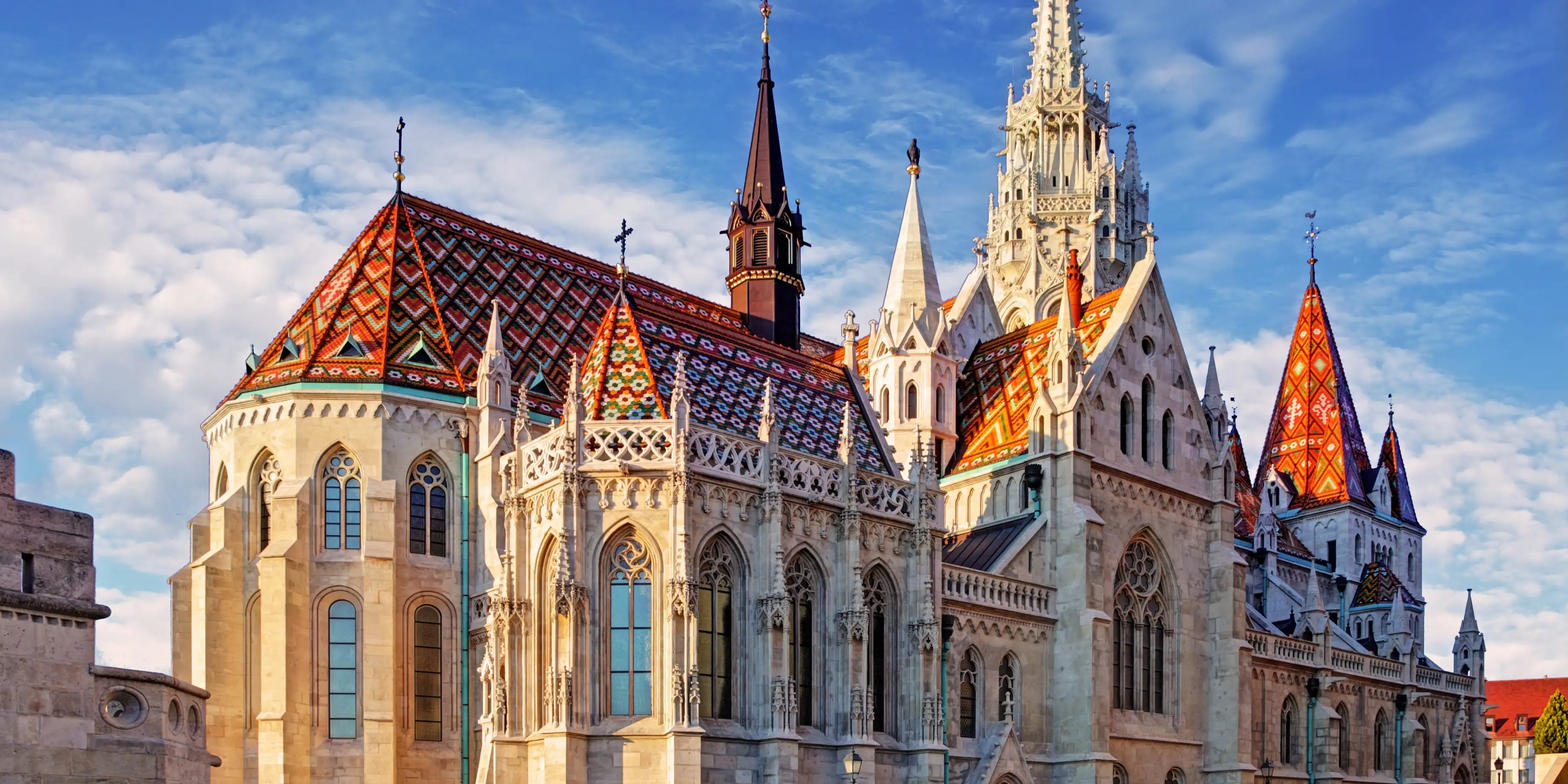
Matthias Church, officially the Church of Our Lady, is a Roman Catholic place of worship located in the heart of Budapest's Castle District. While its foundations date back to the 13th century, the current structure is largely the result of a comprehensive 19th-century restoration that introduced its iconic colorful Zsolnay roof tiles and intricate Gothic revival details.
Historically serving as the site for the coronations of Hungarian monarchs, including Charles IV, the church has undergone numerous transformations throughout its history. It functioned as a mosque during the Ottoman occupation of Buda in the 16th and 17th centuries before being reclaimed and restored to its Catholic roots, reflecting the complex religious and political shifts of the Hungarian state.
Key Facts
- Materials
- Sandstone, Zsolnay ceramic tiles, Stained glass
- Civilization
- Hungarian
- Accessibility
- Wheelchair accessible via side entrance
- Date(s)
- 13th century (original), 1873-1896 (restoration)
- Condition
- Well-preserved, active parish church
- Original Function
- Royal coronation church
- Key Figures
- King Matthias Corvinus, Frigyes Schulek, Queen Elisabeth of Hungary
Foundations and Early Gothic Period
13th centuryThe original church was commissioned by King Béla IV following the Mongol invasion of Hungary. It was constructed as a royal chapel and served as the primary place of worship for the German-speaking citizens of Buda.
Ottoman Occupation
1541-1686Following the fall of Buda to the Ottoman Empire, the church was converted into the city's main mosque. Most of the interior frescoes were whitewashed, and the furnishings were removed to comply with Islamic iconoclasm.
Baroque Transformation
1686-1873After the liberation of Buda, the church was returned to the Jesuits, who renovated the structure in the Baroque style. Much of the original Gothic character was obscured during this period of reconstruction.
Neo-Gothic Restoration
1873-1896Architect Frigyes Schulek led a major restoration project to return the church to its medieval appearance. This project added the distinctive diamond-patterned roof tiles and the ornate spire, finalizing the building's current silhouette.
Cultural Significance
Matthias Church serves as a primary symbol of Hungarian national identity and royal history. Its role as the coronation site for the last Habsburg kings links the building directly to the legitimacy of the Hungarian crown.
Beyond its political history, the church is a landmark of Hungarian ecclesiastical architecture. The integration of folk-art motifs into the Neo-Gothic design, particularly in the roof tiling, represents a unique synthesis of European architectural trends and local Hungarian artistic expression.
Interpretive Notes
Scholarly debates and areas of uncertainty
The extent of the 19th-century restoration remains a subject of debate among architectural historians. Some argue that Schulek's work was an idealized, romanticized interpretation of Gothic architecture rather than a strictly accurate historical reconstruction, effectively creating a 'new' building rather than preserving the original medieval fabric.
Visiting Information
Entry Rules
Open daily for visitors. Tickets are required for entry. Modest dress is requested, and visitors are asked to remain quiet as it is an active place of worship.
Best Times to Visit
Early morning or late afternoon to avoid peak tourist crowds. The church is particularly significant during national holidays when special masses are held.
Photography
Photography is permitted for personal use without flash. Tripods and professional equipment require prior authorization.
Preservation Notes
The Zsolnay roof tiles are fragile and require periodic maintenance. Visitors are asked to stay within designated areas and avoid touching the historical stonework.
Nearby POIs
11 shownSources & Further Reading
- [1]The Matthias Church in Budapest — László Gerő. Corvina Press (1980)
- [2]Budapest: A History of the City — András Gerő. Central European University Press (2016)
Key Facts
- Materials
- Sandstone, Zsolnay ceramic tiles, Stained glass
- Civilization
- Hungarian
- Accessibility
- Wheelchair accessible via side entrance
- Date(s)
- 13th century (original), 1873-1896 (restoration)
- Condition
- Well-preserved, active parish church
- Original Function
- Royal coronation church
- Key Figures
- King Matthias Corvinus, Frigyes Schulek, Queen Elisabeth of Hungary