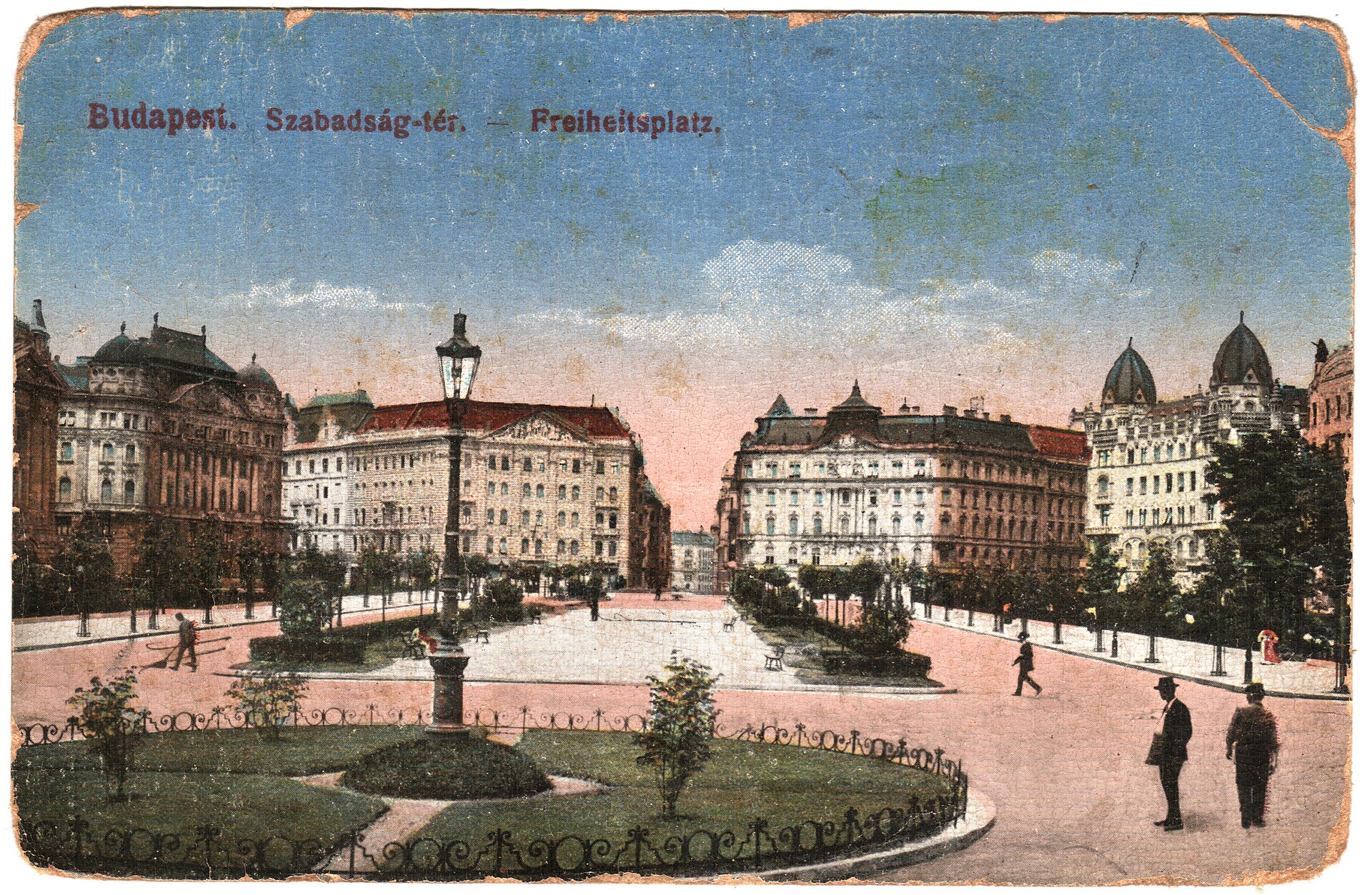
Liberty Square (Szabadság tér) is a public square located in the Lipótváros neighborhood of Budapest. It was established at the turn of the 20th century on the site of the former Neugebäude, a massive military barracks and prison used by the Austro-Hungarian Empire. The square is characterized by its blend of Art Nouveau and eclectic architecture, serving as a prominent civic space surrounded by significant buildings, including the Hungarian National Bank and the United States Embassy.
The square functions as a site of historical memory, hosting a diverse collection of monuments that reflect Hungary's complex 20th-century history. These include tributes to international figures like Ronald Reagan and Harry Hill Bandholtz, as well as the Soviet War Memorial, which remains the last remaining Soviet-era monument in a public square in Budapest.
Key Facts
- Materials
- Stone, Bronze, Granite
- Civilization
- Hungarian
- Accessibility
- Fully accessible at street level
- Date(s)
- 1897-1902
- Condition
- Well-maintained public space
- Original Function
- Public square and urban park
- Key Figures
- Ronald Reagan, Harry Hill Bandholtz, Imre Nagy
The Neugebäude Era
1786-1897Before the square existed, the site was occupied by the Neugebäude, a large military barracks and prison. It gained notoriety as the place where Lajos Batthyány, the first Prime Minister of Hungary, was executed following the 1848-1849 Revolution.
Urban Development
1897-1902Following the demolition of the barracks, the area was redeveloped as part of a city-wide modernization project. The square was designed to provide a grand, open space in the heart of the administrative district, flanked by prestigious financial and government buildings.
Soviet Occupation and Memorialization
1945-1989Following World War II, the Soviet War Memorial was erected in the square to commemorate the Red Army's role in the liberation of Budapest from Nazi occupation. It became a focal point for the political landscape during the socialist era.
Post-Socialist Transformation
1990-PresentAfter the fall of communism, the square became a site for re-evaluating national history. New monuments were added to honor figures associated with Western democratic values, while the Soviet memorial remains, sparking ongoing public and political discourse regarding historical legacy.
Cultural Significance
Liberty Square serves as a microcosm of Hungary's turbulent 20th-century history. Its juxtaposition of monuments representing different political ideologies—from the Soviet War Memorial to statues of American figures—reflects the country's shifting alliances and its struggle to reconcile its past. It is a frequent site for public gatherings and political demonstrations.
Interpretive Notes
Scholarly debates and areas of uncertainty
The presence of the Soviet War Memorial in a prominent public square remains a subject of intense debate. Some argue for its removal as a symbol of past oppression, while others maintain it should be preserved as a historical artifact of the liberation from Nazi forces and the subsequent Soviet occupation.
Visiting Information
Entry Rules
Public park, open 24 hours. No entry fees. Standard public conduct rules apply.
Best Times to Visit
Spring and autumn for pleasant walking conditions. Weekdays are generally quieter than weekends.
Photography
None for personal use. Commercial photography may require local municipal permits.
Preservation Notes
The monuments are protected heritage sites. Please refrain from climbing on statues or defacing memorial surfaces.
Nearby POIs
11 shown- St. Stephen's Basilica0.4 km
- Hungarian Parliament Building0.5 km
- House of Terror Museum1.2 km
- Hungarian National Gallery1.2 km
- Fisherman's Bastion1.2 km
- Buda Castle1.2 km
- Budapest History Museum1.2 km
- Matthias Church1.2 km
- National Szechenyi Library1.3 km
- Hospital in the Rock1.5 km
- Hungarian National Museum1.7 km
Sources & Further Reading
- [1]Budapest: A History of the City — András Török. Corvina Books (2007)
- [2]The Politics of Memory in Post-Communist Europe — Maria M. Kovács. Central European University Press (2015)
Key Facts
- Materials
- Stone, Bronze, Granite
- Civilization
- Hungarian
- Accessibility
- Fully accessible at street level
- Date(s)
- 1897-1902
- Condition
- Well-maintained public space
- Original Function
- Public square and urban park
- Key Figures
- Ronald Reagan, Harry Hill Bandholtz, Imre Nagy
Nearby POIs
11 shown- St. Stephen's Basilica0.4 km
- Hungarian Parliament Building0.5 km
- House of Terror Museum1.2 km
- Hungarian National Gallery1.2 km
- Fisherman's Bastion1.2 km
- Buda Castle1.2 km
- Budapest History Museum1.2 km
- Matthias Church1.2 km
- National Szechenyi Library1.3 km
- Hospital in the Rock1.5 km
- Hungarian National Museum1.7 km