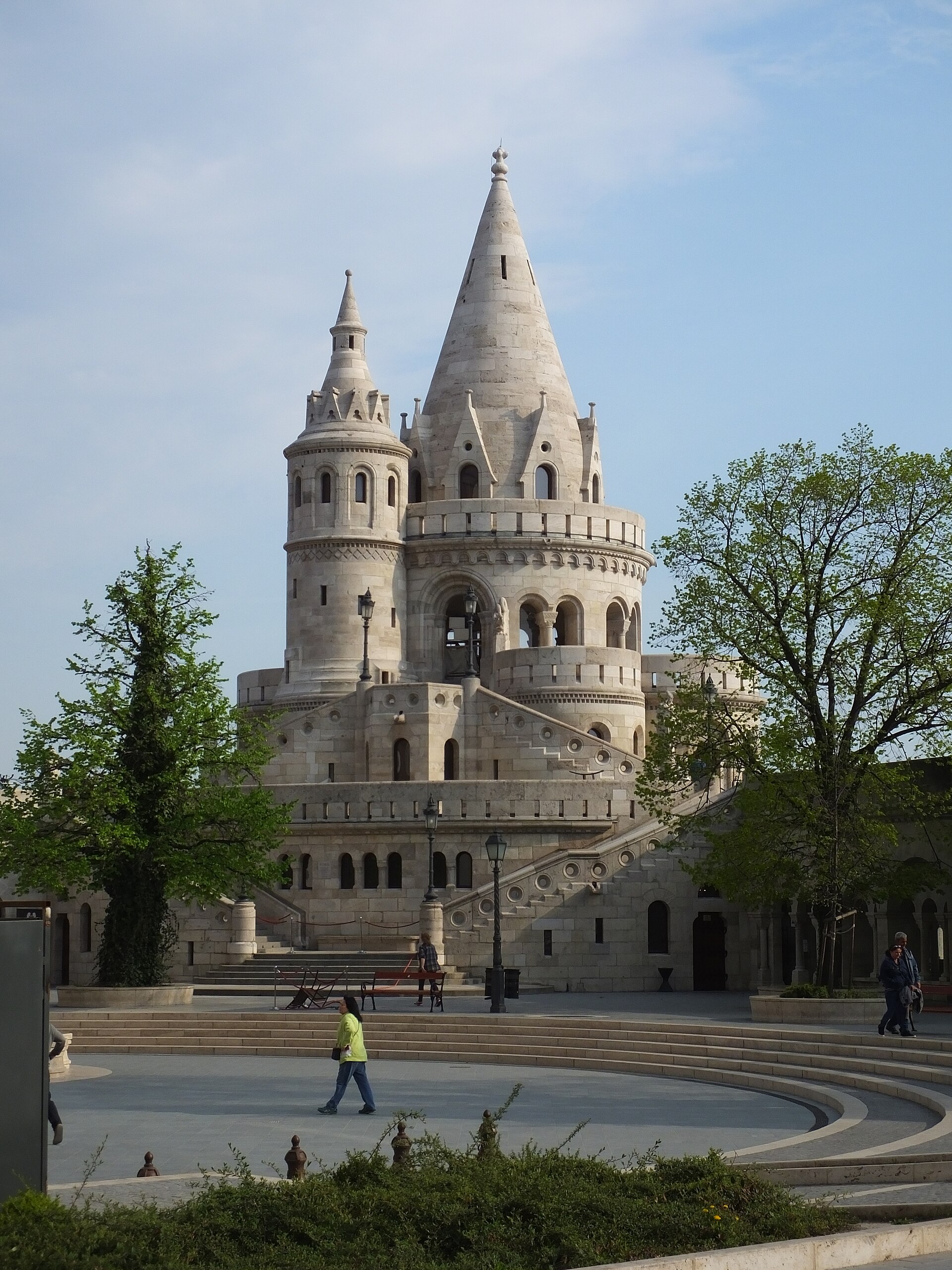
Fisherman's Bastion is a neo-Romanesque and neo-Gothic terrace situated on the Buda bank of the Danube, on the Castle Hill in Budapest. It was designed and built between 1895 and 1902 as part of the series of developments to celebrate the 1000th anniversary of the Hungarian state.
The structure features seven stone towers representing the seven Magyar tribes that settled in the Carpathian Basin in 895. While it was designed to serve as a decorative viewing terrace rather than a defensive fortification, its name commemorates the guild of fishermen who were responsible for defending this stretch of the city walls during the Middle Ages.
Key Facts
- Materials
- White limestone, Sandstone
- Civilization
- Hungarian
- Accessibility
- Partially accessible; some areas involve stairs
- Date(s)
- 1895-1902
- Condition
- Well-preserved, major tourist landmark
- Original Function
- Commemorative monument and viewing terrace
- Key Figures
- Frigyes Schulek
Medieval Origins
Middle AgesThe site was part of the defensive wall system of Buda Castle. The name originates from the local fishermen's guild, which was tasked with protecting this specific section of the ramparts during times of conflict.
Construction and Millennial Celebrations
1895-1902Architect Frigyes Schulek designed the structure to celebrate the 1000th anniversary of the Hungarian Conquest. It was built on the site of the old castle walls, incorporating elements of neo-Romanesque architecture to harmonize with the nearby Matthias Church.
Post-War Restoration
1947-1948The bastion suffered significant damage during the Siege of Budapest in World War II. Following the war, the structure was meticulously restored under the supervision of the architect's son, János Schulek.
Cultural Significance
Fisherman's Bastion serves as a primary symbol of Hungarian national identity and the millennial history of the Magyar people. Its architectural style, which blends Romanesque and Gothic influences, reflects the 19th-century romanticization of Hungary's medieval past.
Today, it is one of the most visited landmarks in Budapest, functioning as a panoramic observation point that offers unobstructed views of the Parliament Building and the Danube. It remains a focal point for cultural events and historical commemoration in the Castle District.
Interpretive Notes
Scholarly debates and areas of uncertainty
There is occasional academic discussion regarding the historical authenticity of the site's design. Some critics argue that the structure is a 'historicist fantasy' that obscures the actual medieval fortifications it replaced, rather than a faithful reconstruction of the original defensive walls.
Visiting Information
Entry Rules
The lower terraces are free to access, while the upper towers require a ticket during peak tourist hours. Open daily; hours vary by season.
Best Times to Visit
Early morning before 9:00 AM to avoid large tour groups and for optimal lighting for photography.
Photography
Personal photography is permitted. Commercial photography requires prior authorization from the Budapest Castle District management.
Preservation Notes
The white limestone is sensitive to environmental pollution and weathering. Visitors are requested to stay on designated paths and refrain from climbing on the decorative parapets.
Nearby POIs
11 shownSources & Further Reading
- [1]Budapest: A History of the City — Gábor Gyáni. Corvina Books (2002)
- [2]The Architecture of the Hungarian Millennium — József Sisa. Akadémiai Kiadó (2007)
Key Facts
- Materials
- White limestone, Sandstone
- Civilization
- Hungarian
- Accessibility
- Partially accessible; some areas involve stairs
- Date(s)
- 1895-1902
- Condition
- Well-preserved, major tourist landmark
- Original Function
- Commemorative monument and viewing terrace
- Key Figures
- Frigyes Schulek