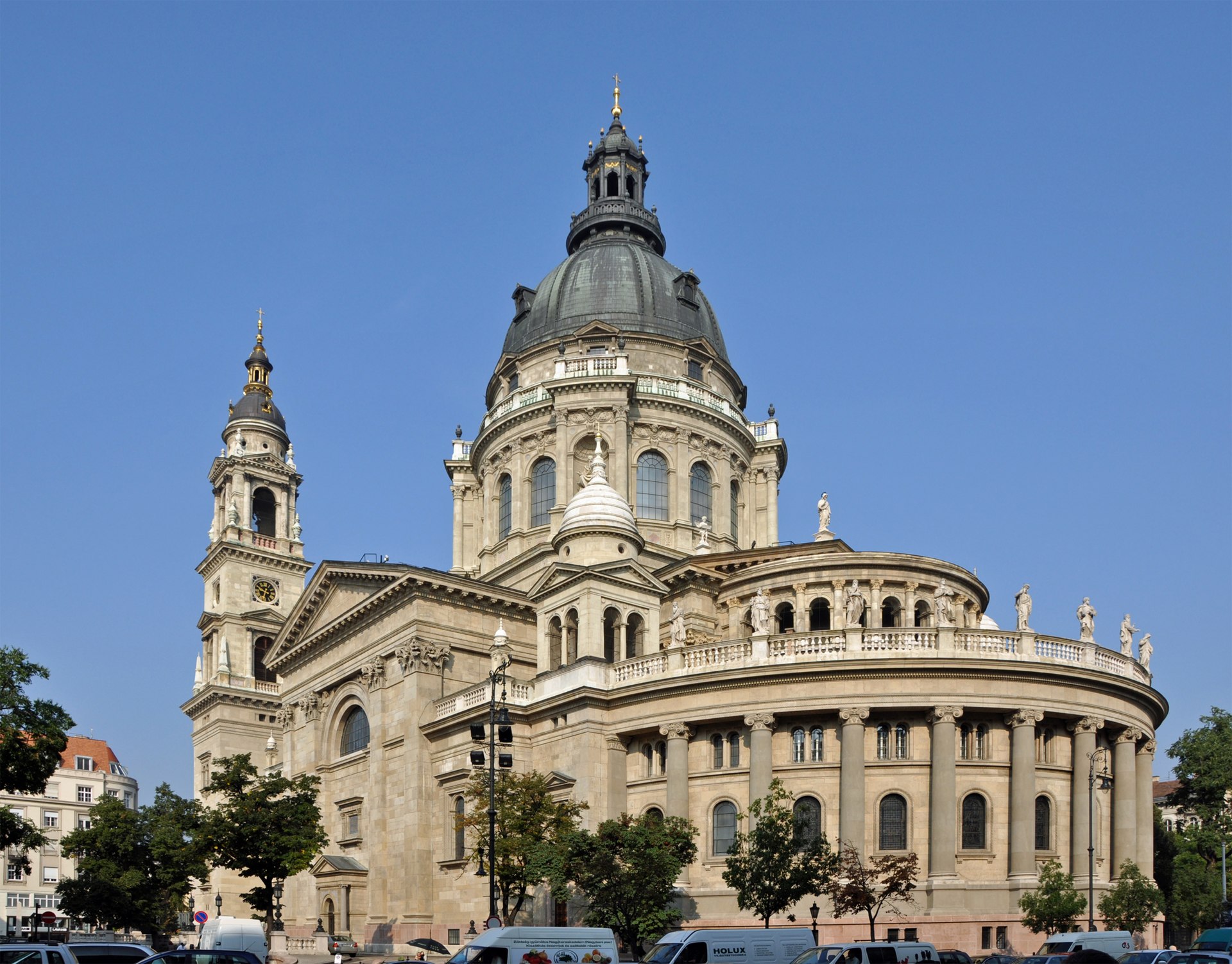
St. Stephen's Basilica is a Roman Catholic basilica in Budapest, Hungary, named in honor of Stephen, the first King of Hungary, whose right hand is housed in the reliquary. It is one of the most important religious buildings in the country and a significant tourist attraction due to its architectural grandeur and historical significance.
The structure is characterized by its Neoclassical and Neo-Renaissance style, featuring a massive dome that reaches a height of 96 meters, matching the height of the Hungarian Parliament Building. This architectural symmetry symbolizes the balance between church and state in Hungarian national identity.
Key Facts
- Materials
- Stone, Marble, Gold leaf, Bronze
- Civilization
- Hungarian
- Accessibility
- Wheelchair accessible via side entrances
- Date(s)
- 1851-1905
- Condition
- Well-preserved, active place of worship
- Original Function
- Cathedral and pilgrimage site
- Key Figures
- József Hild, Miklós Ybl, József Kauser
Planning and Early Construction
1851-1867The project began in 1851 under architect József Hild. Following his death in 1867, construction was halted due to the collapse of the dome in 1868, which necessitated a complete redesign of the structure's foundations and upper levels.
Completion and Consecration
1868-1905Miklós Ybl took over the project, introducing Neo-Renaissance elements to the design. After Ybl's death, József Kauser oversaw the final stages. The basilica was consecrated in 1905 in the presence of Emperor Franz Joseph I.
World War II and Restoration
1944-1945During the Siege of Budapest, the basilica suffered significant damage from bombing. The roof and parts of the facade were destroyed, but the structure was painstakingly restored in the post-war decades, with major renovations completed in 2003.
Cultural Significance
The basilica serves as a primary symbol of Hungarian Catholicism and national heritage. It houses the Holy Right, the mummified right hand of King Stephen I, which is paraded through the streets of Budapest annually on August 20th, the national holiday celebrating the founding of the Hungarian state.
Interpretive Notes
Scholarly debates and areas of uncertainty
There is ongoing discussion regarding the structural integrity of the foundations relative to the weight of the dome, given the site's proximity to the Danube and the soil composition, which has required periodic monitoring and reinforcement.
Visiting Information
Entry Rules
Open daily for visitors. Entry is free, though donations are encouraged. Modest dress is required (shoulders and knees covered). Security checks are in place at the entrance.
Best Times to Visit
Early morning or late afternoon to avoid peak tourist crowds. The observation deck offers the best views of the city during sunset.
Photography
Photography is permitted without flash. Tripods and professional video equipment require prior authorization from the parish office.
Preservation Notes
Visitors are requested to maintain silence as it is an active place of worship. Do not touch the reliquary or altar surfaces.
Nearby POIs
11 shownSources & Further Reading
- [1]Budapest: A History of the City — Károly Kocsis. Akadémiai Kiadó (2000)
- [2]The Architecture of St. Stephen's Basilica — József Sisa. Hungarian Studies Review (2015)
Key Facts
- Materials
- Stone, Marble, Gold leaf, Bronze
- Civilization
- Hungarian
- Accessibility
- Wheelchair accessible via side entrances
- Date(s)
- 1851-1905
- Condition
- Well-preserved, active place of worship
- Original Function
- Cathedral and pilgrimage site
- Key Figures
- József Hild, Miklós Ybl, József Kauser