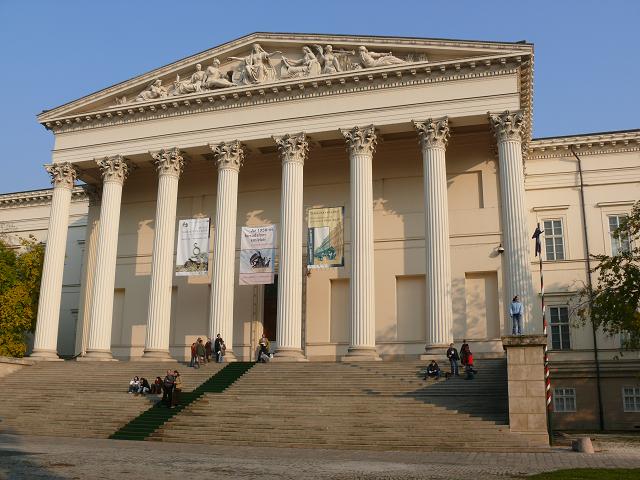
The Hungarian National Museum is the oldest public museum in Hungary, established in 1802 following the donation of Count Ferenc Széchényi's extensive collection of books, coins, and antiquities. The current building, a prominent example of Neoclassical architecture, was designed by Mihály Pollack and constructed between 1837 and 1847. It serves as the primary repository for the nation's historical, archaeological, and artistic heritage.
The museum's collections span from the prehistoric era to the end of the 20th century, documenting the history of the Carpathian Basin. It is particularly noted for its role in the 1848 Hungarian Revolution, as its front steps served as a symbolic site for the uprising against Habsburg rule. Today, it remains a central institution for national identity and historical research in Hungary.
Key Facts
- Materials
- Stone, Brick, Stucco
- Civilization
- Hungarian
- Accessibility
- Wheelchair accessible with elevator access to main floors
- Date(s)
- 1837-1847
- Condition
- Well-preserved, active museum
- Original Function
- National museum and library
- Key Figures
- Ferenc Széchényi, Mihály Pollack, Sándor Petőfi
Foundation and Early Collection
1802The museum was founded when Count Ferenc Széchényi donated his private collection to the nation. The Hungarian Diet subsequently passed legislation to support the institution, establishing it as a public entity dedicated to preserving Hungarian culture.
Construction of the Neoclassical Building
1837-1847To house the growing collection, architect Mihály Pollack was commissioned to design a dedicated building. The resulting structure, featuring a grand portico inspired by Roman temples, became a landmark of Budapest's urban development.
The 1848 Revolution
1848The museum became a focal point of the Hungarian Revolution of 1848. On March 15, the poet Sándor Petőfi is said to have recited his 'National Song' on the museum's steps, cementing the site's status as a symbol of Hungarian independence.
Modern Era and Expansion
20th Century - PresentThroughout the 20th century, the museum expanded its scope to include extensive archaeological and historical exhibitions. It has undergone several renovations to modernize its facilities while preserving its historical architectural integrity.
Cultural Significance
The Hungarian National Museum is the primary institution for the preservation of Hungarian national memory. Its architecture and history are deeply intertwined with the 19th-century struggle for independence, making it a site of significant patriotic importance. It serves as a venue for major national commemorations and educational outreach regarding the history of the Carpathian Basin.
Interpretive Notes
Scholarly debates and areas of uncertainty
There is ongoing scholarly discussion regarding the provenance of certain artifacts within the collection, particularly those acquired during the 19th and early 20th centuries. Additionally, curators frequently debate the best methods for presenting complex, multi-ethnic historical narratives within a nationalistic framework.
Visiting Information
Entry Rules
Open Tuesday to Sunday. Tickets can be purchased at the entrance or online. Visitors are required to leave large bags in the cloakroom. Photography is permitted for personal use without flash.
Best Times to Visit
Weekday mornings are generally quieter. The museum is particularly significant on March 15th, the anniversary of the 1848 Revolution, though it is often crowded on this date.
Photography
Personal photography is allowed in most permanent exhibitions without flash or tripods. Temporary exhibitions may have specific restrictions.
Preservation Notes
Do not touch artifacts or display cases. Maintain a quiet demeanor in the galleries. Some areas may be closed for maintenance or exhibition rotation.
Nearby POIs
11 shown- Gellert Hill Cave1.1 km
- St. Stephen's Basilica1.3 km
- Liberty Square1.7 km
- Budapest History Museum1.8 km
- House of Terror Museum1.8 km
- Buda Castle1.8 km
- National Szechenyi Library1.8 km
- Hungarian National Gallery1.8 km
- Hungarian Natural History Museum2 km
- Hungarian Parliament Building2.2 km
- Matthias Church2.5 km
Sources & Further Reading
- [1]The Hungarian National Museum: A History — László Csorba. Hungarian National Museum Press (2012)
- [2]Neoclassical Architecture in Budapest — József Sisa. Akadémiai Kiadó (2005)
Key Facts
- Materials
- Stone, Brick, Stucco
- Civilization
- Hungarian
- Accessibility
- Wheelchair accessible with elevator access to main floors
- Date(s)
- 1837-1847
- Condition
- Well-preserved, active museum
- Original Function
- National museum and library
- Key Figures
- Ferenc Széchényi, Mihály Pollack, Sándor Petőfi
Nearby POIs
11 shown- Gellert Hill Cave1.1 km
- St. Stephen's Basilica1.3 km
- Liberty Square1.7 km
- Budapest History Museum1.8 km
- House of Terror Museum1.8 km
- Buda Castle1.8 km
- National Szechenyi Library1.8 km
- Hungarian National Gallery1.8 km
- Hungarian Natural History Museum2 km
- Hungarian Parliament Building2.2 km
- Matthias Church2.5 km