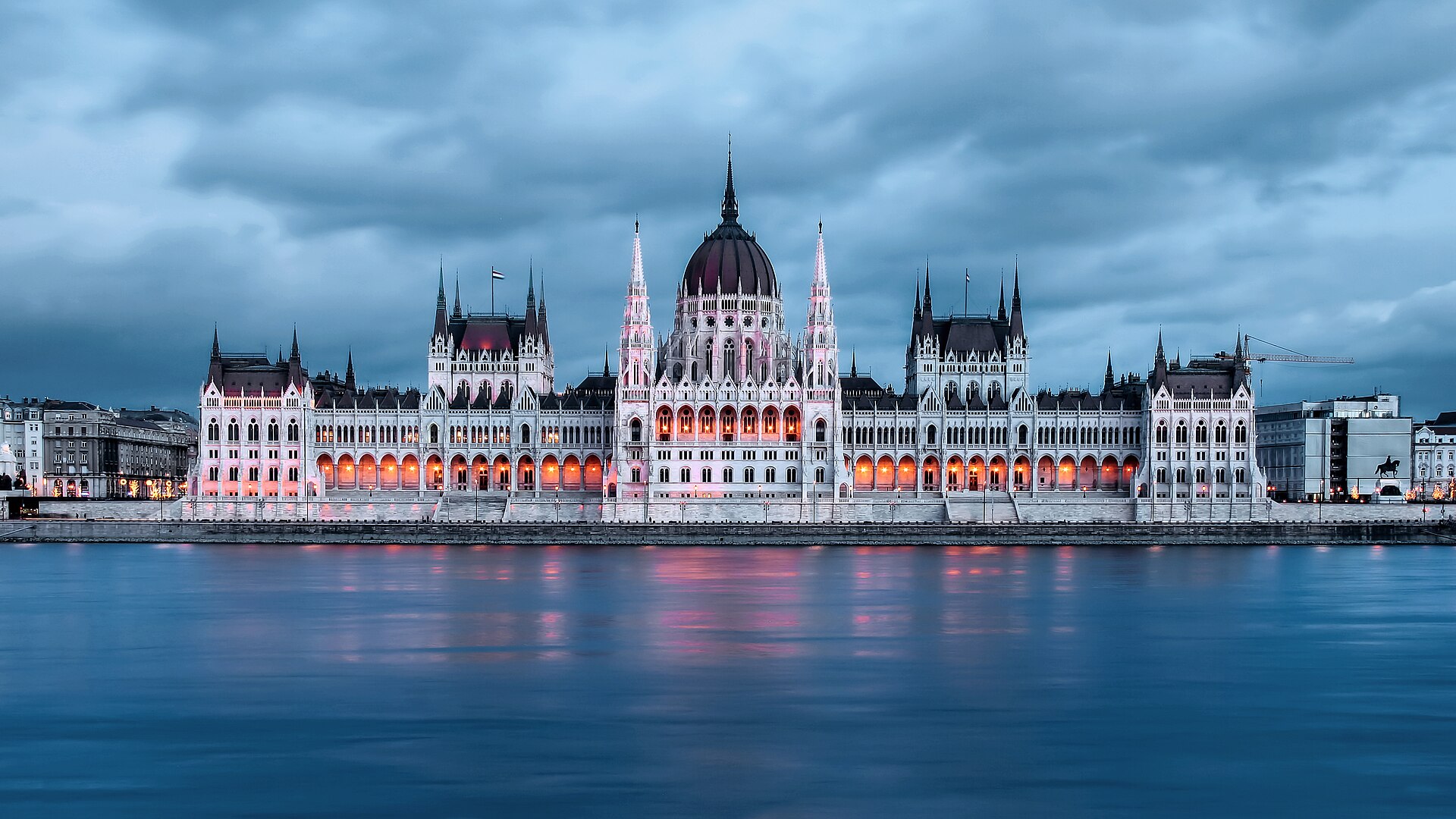
The Hungarian Parliament Building, located on the banks of the Danube in Budapest, serves as the seat of the National Assembly of Hungary. Designed by architect Imre Steindl and completed in 1904, the structure is a prominent example of Neo-Gothic architecture, featuring a symmetrical facade and a central dome that reaches a height of 96 meters.
The building is the largest in Hungary and remains one of the most significant landmarks in Budapest. Its interior is lavishly decorated with gold leaf, frescoes, and stained glass, housing the Hungarian Crown Jewels and serving as a symbol of national sovereignty and the country's constitutional history.
Key Facts
- Materials
- Limestone, Marble, Gold leaf
- Civilization
- Hungarian
- Accessibility
- Wheelchair accessible via designated entrance
- Date(s)
- 1885-1904
- Condition
- Active government building
- Original Function
- Seat of the National Assembly
- Key Figures
- Imre Steindl, Miklós Ybl
Design and Competition
1880sFollowing the unification of Buda, Pest, and Óbuda in 1873, the government held an international competition for a new parliament building. Imre Steindl's design was selected for its grand scale and synthesis of Gothic and Renaissance elements.
Construction
1885-1904Construction began in 1885, employing thousands of workers and utilizing exclusively Hungarian materials, with the exception of the marble columns. The building was partially inaugurated in 1896 for the millennium of the Hungarian state, though final completion occurred in 1904.
Twentieth Century and Beyond
1904-presentThe building survived the turbulence of the 20th century, including the World Wars and the socialist era, during which a red star was temporarily placed atop the dome. Following the transition to democracy in 1989, it resumed its role as the center of Hungarian parliamentary life and underwent extensive restoration to preserve its facade.
Cultural Significance
The building is a cornerstone of Hungarian national identity, representing the country's transition to a modern constitutional state. Its location on the Danube emphasizes the historical and economic importance of the river to Budapest.
It is a major tourist destination and a site of national ceremony, where the Hungarian Crown Jewels are displayed. The building's architectural grandeur is frequently cited as a reflection of the aspirations of the Austro-Hungarian era.
Interpretive Notes
Scholarly debates and areas of uncertainty
Debates exist regarding the extent of the building's structural integrity due to the porous nature of the limestone used in the facade, which requires constant maintenance and replacement. Additionally, some architectural historians discuss the political symbolism of its Neo-Gothic style, which was chosen to evoke historical continuity during a period of rapid modernization.
Visiting Information
Entry Rules
Access is restricted to guided tours which must be booked in advance. Security screening is mandatory for all visitors. Visitors must present a valid ID or passport.
Best Times to Visit
Early morning or late afternoon for the best light on the facade. Weekdays are generally less crowded than weekends.
Photography
Photography is permitted in most areas, except for the room housing the Hungarian Crown Jewels.
Preservation Notes
The building is under constant exterior restoration due to environmental pollution affecting the limestone. Visitors are required to stay with their tour groups at all times.
Nearby POIs
11 shownSources & Further Reading
- [1]The Hungarian Parliament Building — József Sisa. Budapest Architecture Guide (2010)
- [2]Imre Steindl and the Parliament — Pál Ritoók. Hungarian Academy of Sciences (2015)
Key Facts
- Materials
- Limestone, Marble, Gold leaf
- Civilization
- Hungarian
- Accessibility
- Wheelchair accessible via designated entrance
- Date(s)
- 1885-1904
- Condition
- Active government building
- Original Function
- Seat of the National Assembly
- Key Figures
- Imre Steindl, Miklós Ybl